
A successful career used to be easier to define. A good salary, a respected title, job security and steady progress were often seen as clear signs of success.
Those things still matter, but people are now looking at work more broadly.
They want to earn well, but they also want enough time for life outside work. They want opportunities to grow without constantly feeling stretched. Flexibility, wellbeing, useful technology and the chance to build skills that remain relevant are becoming part of the picture too.
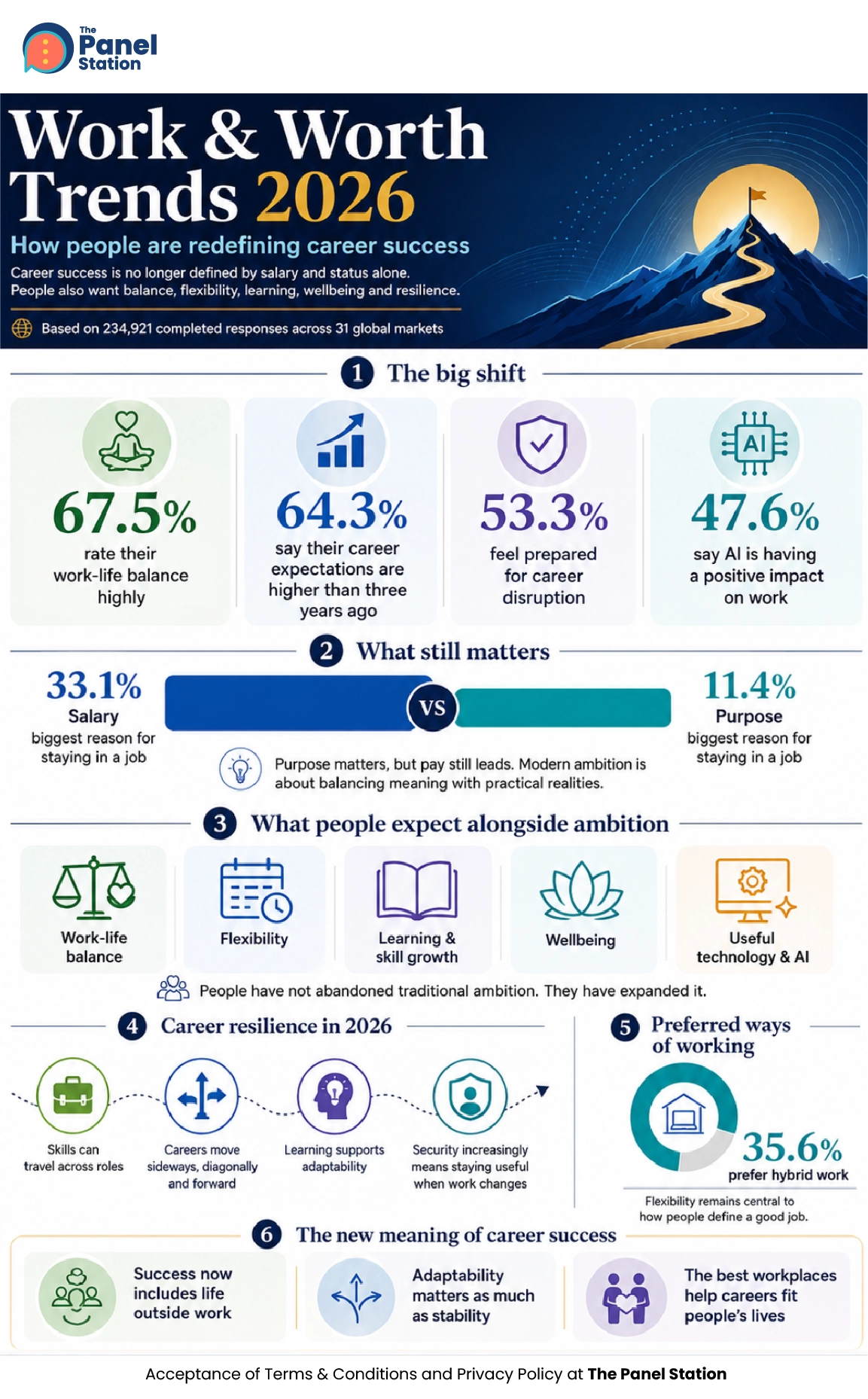
Nearly 2 in 3 rate their work–life balance highly, yet 45.8% still struggle with workload.
The question is no longer only “Am I moving ahead in my career?” It is also “Does my career work for the life I want to have?”
Panel Station’s Work & Worth Trends 2026, based on 234,921 completed responses across 31 global markets, reflects this shift.
These findings suggest that people have not lowered their ambitions. They have expanded them. A good career is increasingly expected to provide not only progress and financial security, but also flexibility, balance and the ability to adapt when work changes.
Why Is Work-Life Balance Becoming a Form of Career Wealth?
For years, long hours could be interpreted as commitment. Being constantly available could signal ambition. Personal time was sometimes treated as something employees sacrificed in exchange for professional progress.
That equation is becoming less convincing. Nearly 70% have felt burnt out or overwhelmed at least sometimes in the past three months.
A higher salary can improve someone’s standard of living, but an extremely demanding career can reduce the time available to enjoy that life. A promotion may bring greater income and responsibility, but its value feels different if it consistently comes at the cost of sleep, health, relationships or personal interests.
This does not mean ambition is disappearing. It is becoming more multidimensional. Work-life balance is therefore becoming more than a workplace benefit.
Why Do Employees Expect More From Work Than They Used To?
Expectations rise when people can see alternatives.
Employees can now compare salaries, cultures, benefits and career paths more easily. Remote and hybrid work have shown that conventional workplace structures are not the only option. Digital learning has also made professional development more accessible.
But higher expectations do not simply mean wanting a bigger paycheque.
64.3% say their career expectations are higher than three years ago, suggesting employees increasingly expect careers to deliver more than just a salary.
People increasingly ask: Will I learn? Can I progress? Will I have flexibility? Is the work meaningful? Will I feel secure? Can I maintain a life outside work?
This changes the traditional employment bargain. Employees still consider what they can contribute to an organisation, but they are also evaluating what the organisation contributes to their growth, wellbeing and future employability.
What Makes A Job Worth Staying For?
Take The Panel Station Survey And Share What Matters Most In Your Working Life.
Compare Your Priorities With Professionals Across Global Markets.
Does Salary Still Define a Good Job?
Despite growing discussion around wellbeing, purpose and flexibility, money has not suddenly become irrelevant.
What is interesting is what happens after salary. No other factor dominates.
33.1% say salary is the strongest reason for staying in a job.
Instead, employees seem to construct career value from several ingredients: income, opportunity, security, autonomy and meaning.
Salary and wellbeing are not necessarily competing priorities either. Financial security can reduce stress, support families and create greater choice. At the same time, there may be a point where another salary increase feels less valuable than more flexibility, better development or a healthier working environment.
The modern employee is therefore not simply choosing between money and meaning. Many want a reasonable combination of both.
What Skills Will Keep Your Career Moving?
Share the skills you are building for the future and see how your priorities compare with professionals across global markets.
Hybrid work is usually discussed as a location question: home or office?
The deeper issue may be autonomy.
Hybrid work, at 35.6% is one of the leading workplace models in the study.
Its appeal comes partly from allowing face-to-face interaction without requiring employees to surrender all control over where their working day happens.
But flexibility extends beyond geography. People may want greater influence over when they work, how they organise focused tasks and how professional responsibilities fit alongside commuting, childcare or other commitments.
The broader shift is that employees increasingly expect workplace arrangements to have a reason. Office presence should serve a purpose. Remote work should serve a purpose. Flexibility should support both the work and the people doing it.
The future workplace may therefore be less about finding one perfect model and more about designing work intentionally.
Is AI Making Work Less Human or More Human?
Few workplace topics create as much uncertainty as artificial intelligence.
If technology can write, analyse, automate, summarise and predict, it naturally raises questions about what happens to the people who previously performed those tasks.
47.6% say AI has had a positive impact on their work or career prospects.
Many workers are already encountering AI not only as a possible source of disruption but as a practical assistant. It can reduce repetitive tasks, organise information, speed up research, support brainstorming and help people learn unfamiliar topics.
The important question may therefore be less about whether AI will be part of work and more about what people contribute alongside it.
What Happens When Your Job Changes Faster Than Your Career Plan?
Career paths used to feel more straightforward. You chose a profession, built experience and, over time, moved into more senior roles.
64.3% say their career expectations are higher than three years ago, suggesting employees increasingly expect careers to deliver more than just a salary.
That sense of certainty is becoming harder to rely on. Roles are changing, familiar tasks are being automated, new areas of work are emerging, and skills that once gave someone an advantage are quickly becoming expected.
As a result, career security may start to mean something different.
It may be less about staying with the same employer for years and more about being able to move with change. If a role evolves, a company restructures or an industry shifts, the real advantage is having skills that can travel with you.
Is Purpose Replacing Traditional Ambition?
Purpose matters at work, but it has not replaced the need for good pay, stability or career progress.
44.3% value flexible work options from employers, while 42.1% value wellbeing support.
That does not make purpose less important. It simply shows that people are weighing meaning against everyday realities. A job can feel rewarding, but if it creates constant financial pressure, that sense of fulfilment may be difficult to sustain. Equally, a well-paid role can become frustrating if the work feels disconnected from what someone values.
For many people, ambition is therefore becoming less about choosing between money and meaning and more about finding the right mix of both.
Are Career Ladders Turning Into Career Portfolios?
Career growth does not always follow a straight line anymore.
47.2% value opportunities to learn and grow from their employer.
People may move into a different industry, learn new skills, freelance for a period, take a career break, return to education or shift between specialist and leadership roles. A move that looks sideways on paper can sometimes open up opportunities that would not have existed on a traditional career path.
This means a career can increasingly be seen as a collection of experiences rather than a series of promotions.
What matters is not only the titles someone has held, but the skills they build along the way. One person might combine industry knowledge with communication, AI literacy, data skills and leadership experience. Another might build a career across full-time employment, consulting and entrepreneurship.
What Should Employers Offer When Employees Want Different Things?
Employees are not all looking for the same thing from work.
53.4% value supportive leadership, making it the strongest workplace attribute in that part of the research.
For some, salary is the priority. Others care more about career growth, stability, flexibility or purpose. Many want a combination, and those priorities can shift as their lives and responsibilities change.
That makes a one-size-fits-all employee experience increasingly difficult to maintain.
Organisations may need to give people more choice in how they grow and work. This could mean different career paths, better learning opportunities, flexible arrangements where possible and benefits that reflect a wider range of needs.
What Would You Change About Your Working Life?
Take The Panel Station Survey And Tell Us What Would Make Your Career Work Better For You.
What Will Career Success Mean in the Future?
Work & Worth Trends 2026 shows that traditional career priorities have not disappeared.
Salary still matters. So do progression and security. But people are now asking for more alongside them.
Work-life balance, flexibility, learning, wellbeing and the ability to keep up with changing technology are becoming part of how people judge a good career. Increasingly, people also want skills and experience that will remain valuable if their role or circumstances change.
This is making professional success harder to define through salary or job title alone.
Work affects much more than working hours. It influences finances, relationships, health, identity and how much freedom people have outside the workplace. A successful career therefore needs to work within the wider reality of someone’s life.
That may be one of the biggest shifts shaping the future of work.
Rather than expecting people to continually organise their lives around their jobs, stronger workplaces may be those that make it easier for people to build careers around the lives they want to lead.
In 2026 and beyond, that balance could become just as important a measure of career success as how far someone climbs.
Frequently Asked Questions
1. What is redefining career success in 2026?
Career success increasingly combines financial security with balance, flexibility, professional growth, wellbeing and adaptability. Salary remains important, but it is now one part of a broader definition of a worthwhile career.
2. Why has work-life balance become so important?
Around 67.5% rate their work-life balance highly. People increasingly recognise that professional achievement can lose value if it consistently reduces time for health, relationships, rest and life outside work.
3. Are employees expecting more from employers?
Yes. Around 64.3% say their career expectations are higher than three years ago. Growth, flexibility, wellbeing and future employability increasingly sit alongside salary and stability.
4. Is salary still the biggest career motivator?
Yes. Salary is the leading individual reason for staying at 33.1%. However, career growth, stability, flexibility and purpose show that employees assess jobs across several dimensions.
5. Why is hybrid work attractive?
Hybrid work can combine in-person collaboration with greater autonomy. Around 35.6% prefer it, making hybrid the leading working arrangement among survey respondents.
6. How is AI changing careers?
Around 47.6% say AI has positively affected their work or career prospects. It can improve efficiency and learning while increasing the importance of human judgement and adaptable skills.
7. Are workers prepared for career disruption?
Around 53.3% say they feel prepared if their job changes or disappears, suggesting growing resilience but also leaving a substantial share that may feel less ready.
8. Why will continuous learning become more important?
Jobs and technologies are evolving quickly. Continuous learning helps employees develop new capabilities, move between responsibilities and remain valuable as roles and industries change.
9. What will employers need to do differently?
Employers will need to balance competitive pay with flexibility, development, wellbeing and effective management while recognising that employees value different things at different life and career stages.
10. What will define a successful career in the future?
A successful career will increasingly provide financial security while supporting growth, adaptability, wellbeing and life beyond work. The goal is becoming a career that enables a better life, not simply a bigger title.