

Online shopping has changed what consumers expect from a good experience. Competitive prices and large product ranges still matter, but shoppers increasingly expect the entire journey to feel easy.
They want to find what they need without spending too long searching, understand their options quickly and feel confident about the purchase. They also expect payment, delivery and post-purchase support to work without adding unnecessary effort.
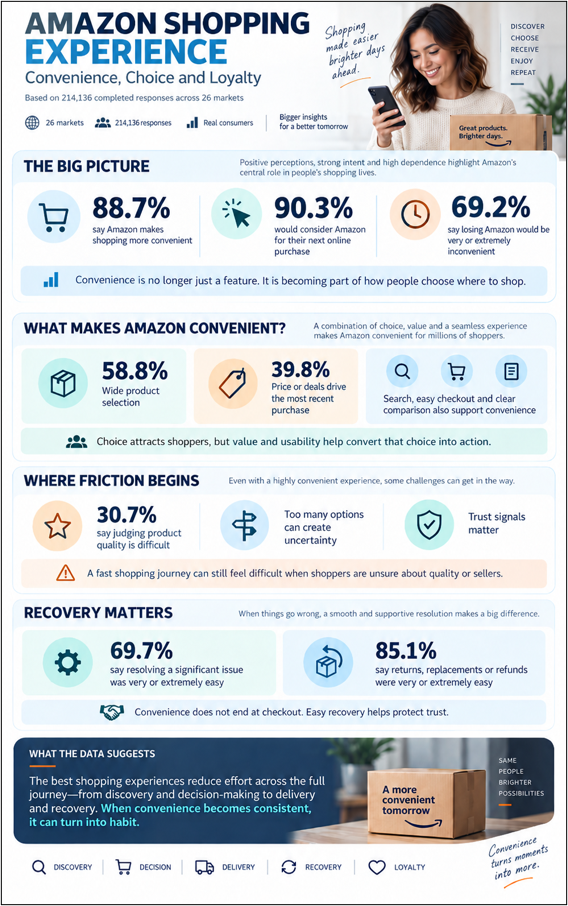
Our recent research into the Amazon shopping experience captures this shift. 88.7% of respondents say Amazon makes shopping more convenient for them, while 90.3% say they would probably or definitely consider it the next time they need to buy something online.
For a closer look at the data behind these behaviours, Amazon Shopping Experience Trends 2026: Convenience, Choice and Loyalty explores how consumers experience search, choice, checkout, delivery and post-purchase support.
The bigger question is what happens when convenience stops feeling like a benefit and becomes something consumers simply expect.
Has Convenience Become Bigger Than Speed?
Convenience is often associated with faster delivery or quicker checkout, but consumers experience it much more broadly.
A shopper can find a product in seconds and still spend several minutes deciding whether it is worth buying. Another may complete payment instantly but remain uncertain about when the order will arrive.
Modern convenience is therefore less about accelerating one part of the journey and more about reducing the work surrounding the entire purchase.
For businesses, this means looking beyond speed. The more useful question is where customers still hesitate, compare excessively, double-check information or worry about what happens next.
Is More Choice Always Better?
Choice remains one of the biggest advantages of ecommerce. Consumers can compare products, sellers and prices that would never fit inside a single physical store.
The Amazon research shows how valuable this can be. 58.8% of respondents say wide product selection makes shopping more convenient.
However, abundance can also create work. When dozens of similar products appear, shoppers need to compare specifications, prices, ratings and unfamiliar sellers before deciding which differences really matter.
This creates a new challenge for ecommerce businesses. The goal is no longer simply to offer more products, but to organise choice in a way that helps consumers decide without feeling overwhelmed.
Search, recommendations, comparison tools and clear product information all become more important because they turn assortment into something useful.
Readers who want to explore the tension between product choice and shopping friction can find the detailed findings in Amazon Shopping Experience Trends 2026.
Why Is Trust Becoming Part of Convenience?
A transaction can be fast without feeling easy.
Our research found that 30.7% of respondents say difficulty judging product quality makes Amazon less convenient. This matters because uncertainty can add effort even when the website itself works perfectly.
When consumers are unsure about quality, they start investigating. They read more reviews, compare sellers, visit other platforms and check return policies before they feel comfortable buying.
Clear information can reduce this burden. Credible reviews, transparent seller details, understandable policies and stronger quality signals help consumers spend less time verifying what they see.
Convenience is therefore not just about reaching checkout quickly. It is about reaching that point with enough confidence to stop searching.
WHAT MAKES SHOPPING FEEL EASY TO YOU?
Share the experiences that build confidence or create frustration. Join The Panel Station and tell us what matters.
Does Price Still Decide Where We Shop?
Consumers have not stopped caring about price simply because customer experience has become more important.
In the survey, 39.8% say price or a deal was the main reason they chose Amazon for their most recent purchase.
A competitive offer can therefore bring the shopper into the journey, but the experience that follows determines whether the decision feels worthwhile.
Consumers still need to find the right product, compare it confidently, complete the transaction and receive what they expected. If those steps become difficult, the original price advantage quickly loses some of its impact.
This is why value and convenience increasingly work together. Price may help win one transaction, while an easy experience can increase the likelihood of winning the next.
Why Does Reliability Feel So Valuable?
Speed gets a lot of attention because it is easy to promise and easy to measure. But for customers, knowing what to expect can matter just as much.
A delivery that arrives on Thursday as promised may feel more convenient than one that says “tomorrow” but leaves the customer wondering whether it will actually turn up. The same is true for refunds, support requests, appointments, and other digital services.
When people know what is happening and what comes next, they do not have to keep checking or following up. That saves more than time. It also saves attention.
Sometimes, the easiest experience is simply the one customers do not have to think about.
What Happens When Something Goes Wrong?
No shopping experience works perfectly every time. Deliveries get delayed, products disappoint and returns become necessary.
What happens after the problem can shape how the entire experience is remembered.
Among Amazon respondents who tried to resolve a significant issue, 69.7% described the resolution as very or extremely easy. Among those who had experienced a return, replacement or refund, that figure reached 85.1%.
These results highlight an important weakness in many customer journeys. Businesses often spend significant effort simplifying the purchase but tolerate far more complexity after the sale.
Customers do not make that distinction. A smooth checkout followed by a difficult refund still creates a frustrating overall experience.
Good recovery keeps complexity inside the organisation rather than transferring it to the consumer.
The full Amazon Shopping Experience Trends 2026 article explores these post-purchase experiences in more detail, including problem resolution, returns and customer service.
When Does Convenience Turn Into Habit?
The most powerful convenience may be the kind consumers eventually stop noticing.
Once shoppers understand an interface, trust the process and know what to expect, the next purchase requires less thought. Familiarity gradually removes small decisions from the journey.
This helps explain one of the most revealing findings in the research. 69.2% say it would be very or extremely inconvenient if Amazon were no longer available to them.
That goes beyond satisfaction because it suggests the platform has become part of the way many people organise their shopping.
Consumers may not consciously describe this as loyalty. They may simply return because using the familiar option feels easier than starting again somewhere else.
For businesses, this is important because habit can influence the next purchase before consumers have even begun comparing alternatives.
Are Businesses Adding When They Should Be Simplifying?
Digital businesses have spent years adding features, products, channels and personalisation. The next opportunity may come from understanding what customers no longer need.
Sometimes a clearer choice creates more value than ten additional options. A more reliable delivery promise may be better than a faster but uncertain one, while a simpler return process can build more confidence than another promotional feature.
Artificial intelligence will make search, recommendations and service increasingly sophisticated, but its success should not be measured by how much technology is visible.
The more useful measure is whether customers need to search, compare, question and troubleshoot less because of it.
MAKE YOUR EXPERIENCE COUNT
What keeps you returning to the same shopping platforms? Share your perspective with The Panel Station.
The Brands That Feel Easy Become Harder to Replace
The broader lesson from the Amazon research extends well beyond Amazon.
Consumers still care about price, choice and speed, but they increasingly judge businesses by the amount of effort required to access those benefits.
A useful search result saves time. Clear information builds confidence. Reliable delivery removes uncertainty, while easy recovery prevents a small problem from becoming a lasting frustration.
When these experiences repeat, familiarity grows. Over time, that familiarity can influence behaviour long after the details of an individual purchase have been forgotten.
For readers who want the complete data behind these insights, Amazon Shopping Experience Trends 2026: Convenience, Choice and Loyalty provides a detailed view across the full shopping journey.
Convenience should therefore not be treated simply as a feature. It can become one of the reasons customers return and, eventually, one of the reasons a business becomes difficult to replace.
Frequently Asked Questions
1.What does shopping convenience mean today?
Shopping convenience is about reducing the time, uncertainty and effort involved in finding, evaluating, buying, receiving and, when necessary, returning a product.
2.Can too much choice make shopping difficult?
Yes. Large assortments provide variety, but similar products and multiple sellers can increase comparison effort and make decisions harder.
3.Why does trust affect convenience?
Trust reduces the amount of checking consumers feel they need to do. Clear product information, credible reviews and transparent policies can therefore make shopping feel easier.
4.Does price still matter when consumers value convenience?
Yes. Price remains an important purchase driver, but convenience can determine whether consumers feel the overall experience is worth repeating.
5.Why are returns important to customer experience?
A simple return or refund process prevents an initial problem from becoming a much larger source of frustration and effort.
6.How can convenience create repeat behaviour?
Familiar experiences require less thought. When consumers know what to expect, returning to the same platform can feel easier than evaluating alternatives.
7.How can convenience create repeat behaviour?
Familiar experiences require less thought. When consumers know what to expect, returning to the same platform can feel easier than evaluating alternatives.
8.What should businesses do to improve convenience?
Businesses should identify where customers hesitate, repeat information, struggle to compare options or need support, and then remove unnecessary effort at those points.