
Technology no longer waits to be invited into our day. It is already there.
It wakes us up, delivers the first messages of the morning, helps us work, guides us through unfamiliar streets, manages payments, recommends what to watch, and increasingly influences how we search, learn, shop, and make decisions. From the moment we open our eyes, digital life is running quietly in the background.
Most of this feels useful. Often, we barely notice how much we depend on it. That may be the biggest change of all: technology has become so convenient, familiar, and constant that being connected now feels like the default.
But when digital life can follow us everywhere, a different question begins to matter. Not how much more technology can do for us, but how much of our attention we are willing to give it.
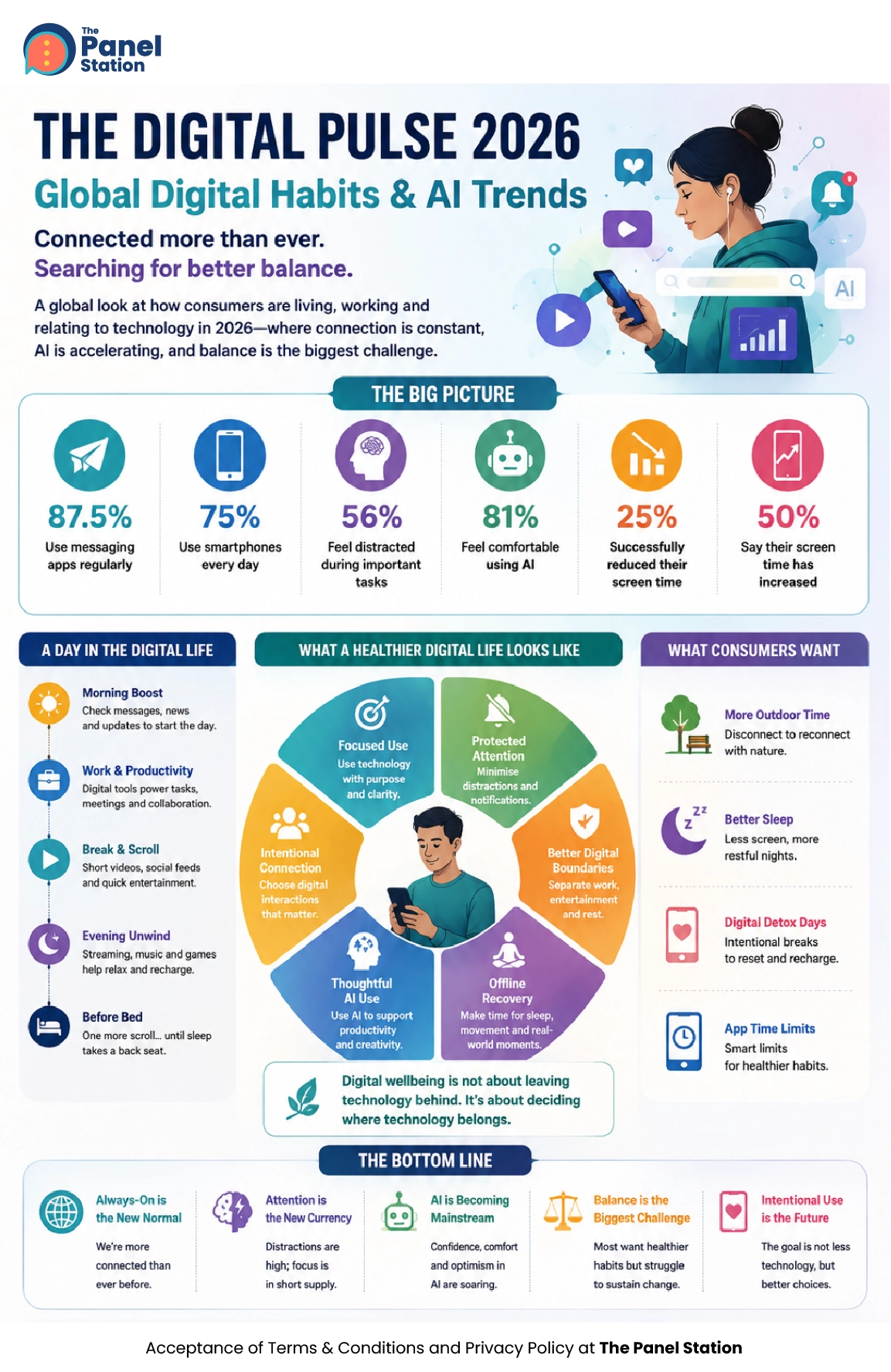
The survey suggests that around 60% are frequently distracted during important tasks.
That question sits behind many of the shifts explored in The Digital Pulse 2026: Global Digital Habits & AI Trends. The trends article looks at how digital behaviour is changing. The bigger conversation is what those changes mean for attention, wellbeing, productivity and the relationship people want to have with technology.
The next phase of digital life may not be about becoming less connected but about becoming more intentional about when, why and how we connect.
Why Has Being Connected Started to Feel Different?
For years, digital progress was largely measured by access.
Faster internet was better. More powerful phones were better. More apps, more features and more ways to stay connected represented progress. That logic made sense when the challenge was getting online.
Now the challenge is often getting away from it. A phone is no longer just a communication device. It can be a workplace, entertainment centre, shopping tool, bank, camera, map, newspaper and social space at the same time.
With around nine in ten using messaging apps every day, digital connection has become deeply embedded in everyday life.
The convenience is undeniable, but so is the difficulty of truly switching off. Work messages can interrupt dinner. The problem is not necessarily that technology is doing something wrong. It is that digital boundaries have become less visible.
Why Is Attention Becoming One of Our Most Valuable Resources?
Time is limited, but attention may be even more difficult to protect. A person can technically have an hour available and still struggle to use it well if their attention is repeatedly divided. That is one of the hidden costs of digital distraction.
Around one in three respondents want app limits, digital-detox days, better sleep and more outdoor time. While this may not yet represent the majority, it signals a growing desire for a healthier relationship with technology—one where being connected does not mean being constantly online.
Notifications, messages, open tabs and the urge to check something quickly can create constant switching between tasks. Each interruption may seem insignificant, but together they can make concentration feel harder than it should.
Why Does Screen Time Feel Harder to Control Than Expected?
Most people do not consciously decide to spend more time online than they intended. It usually happens gradually.
While 50% say their screen time has increased, only 25% have actively tried to reduce it.
A few minutes checking messages turn into a few more on social media. One short video leads to another. A work-related search opens the door to an unrelated article. Screen time rarely grows because of one big decision. It grows through dozens of small ones made almost automatically.
The goal is not to treat technology as the enemy. It is to bring intention back into the decision to use it—and to make stopping as deliberate as starting.
What Does Digital Balance Look Like for You?
Take the Panel Station Survey and share how technology fits into your everyday routine and where you would like greater control.
Screen time is easy to measure. Digital wellbeing is much harder to define. The number of hours alone does not tell the whole story because the survey indicates 89.5% say digital life has a somewhat or very positive effect on their mood.
Two people can spend the same number of hours online and come away with completely different experiences. One may use technology to speak with family, learn something new, complete meaningful work, or unwind with entertainment. Another may spend the same amount of time moving between notifications, comparison, work pressure, and endless scrolling.
A healthier digital life depends not only on how much technology someone uses, but also on what that time gives back. Does it make life easier? Support something meaningful? Strengthen a relationship? Help someone learn or create? Or does it leave them feeling distracted, tired, and unable to switch off?
Why Are Digital Boundaries Becoming Harder to Maintain?
Technology has made many of the boundaries that once shaped the day optional. People can answer work messages from bed, shop during meetings, watch entertainment while eating, and read the news while talking to someone else. That flexibility can be useful, but when every activity can happen everywhere, the day begins to lose its natural divisions.
Still, around one in three respondents want app limits, digital-detox days, better sleep and more outdoor time. While this may not yet represent the majority, it signals a growing desire for a healthier relationship with technology—one where being connected does not mean being constantly online.
Boundaries matter because they create transitions. That may mean people now have to recreate them deliberately. A short walk after work can signal that the working day is over. Keeping phones away from the dinner table can protect conversation. Turning off non-essential notifications can stop every app from competing equally for attention.
Why Is AI Becoming Part of Ordinary Digital Life?
Artificial intelligence can still sound futuristic, but much of its value is becoming surprisingly ordinary.
Around 80% of respondents are using AI to organise ideas, find information, summarise material, support learning, draft content, solve routine problems, and reduce the time spent on repetitive tasks.
In that sense, AI is becoming less of a separate technology and more another layer of everyday digital life. The bigger question is no longer simply whether people will use AI. It is how, when, and why they will use it.
Can Technology Improve Productivity Without Taking Over Our Attention?
Technology has always promised to help people do more in less time. Often, it succeeds.
Tasks that once required several steps can now happen almost instantly. Teams collaborate across locations, information is easier to access, and AI can reduce repetitive work. But faster tools do not automatically create calmer or more focused days.
Sometimes the time saved simply makes room for more tasks, more messages, more meetings, and higher expectations. Technology can therefore create a strange paradox: it saves time while leaving people feeling as though they have less of it.
The difference may lie between productivity tools and productive behaviour.
Why Are People Looking for More Offline Time?
Wanting more time offline does not necessarily mean people are rejecting technology. Often, it means they are rediscovering the value of experiences technology cannot fully reproduce.
Around 30% say they want more quality sleep which indicates that non digital activities are desires for well being.
A night of uninterrupted sleep. A walk without checking notifications. A conversation without someone glancing at a screen. Reading without switching apps. Spending time outdoors. Or simply doing nothing for a few minutes.
These moments can feel increasingly valuable because digital life leaves fewer natural gaps in the day.
What Will a Healthier Digital Future Look Like?
The future is unlikely to involve less technology.
AI will become more capable. Digital services will become more integrated. Devices will become increasingly personalised, responsive, and useful. The more interesting change may be in how people choose to live alongside them.
Digital maturity could mean knowing when convenience is useful and when it becomes distracting. It could mean allowing AI to simplify repetitive work while protecting human judgement, staying connected and accepting that not every empty moment needs to be filled.
How Is Your Digital Life Changing?
Take the Panel Station Survey and share how you manage connection, focus, AI and the search for a healthier digital balance.
Frequently Asked Questions
1. What is digital balance?
Digital balance means using technology in a way that supports everyday life without allowing screens, notifications or online activity to dominate attention, rest and relationships.
2. Why is digital wellbeing becoming more important?
Technology now sits inside work, communication, entertainment, shopping and many daily routines. Digital wellbeing helps people manage that constant connection while protecting focus, sleep and offline experiences.
3. How can people reduce digital distractions?
Reducing unnecessary notifications, keeping devices away during focused tasks and creating specific periods for messages or social media can make interruptions easier to control.
4. Is reducing screen time always necessary?
Not necessarily. The quality and purpose of screen use can matter as much as duration. Useful work, learning and meaningful communication can have a very different impact from automatic or distracted scrolling.
5. What are healthy digital boundaries?
Healthy digital boundaries are simple rules that define when technology should and should not have access to someone’s attention, such as device-free meals, work cut-off times or phone-free periods before sleep.
6. How can AI support a healthier digital life?
AI can reduce repetitive work, organise information and make some tasks easier. Healthy use also requires people to maintain judgement, verify important information and decide which tasks should remain human-led.
7. Why is offline time important?
Offline time provides opportunities for rest, movement, uninterrupted conversation, concentration and mental recovery. It can also create a clearer boundary between different parts of the day.
8. What is a digital detox?
A digital detox is a deliberate period of reduced or avoided technology use. It can help people notice their habits, although sustainable everyday boundaries may be easier to maintain than occasional extreme breaks.
9. How can technology companies support digital wellbeing?
Companies can design clearer controls, reduce unnecessary interruptions, improve transparency and create tools that help users accomplish tasks efficiently instead of encouraging constant engagement.
10. What will define the future of digital living?
The future of digital living is likely to combine greater technological capability with stronger demand for control, focus and wellbeing. The most useful technologies will help people stay connected without making them feel constantly distracted.