
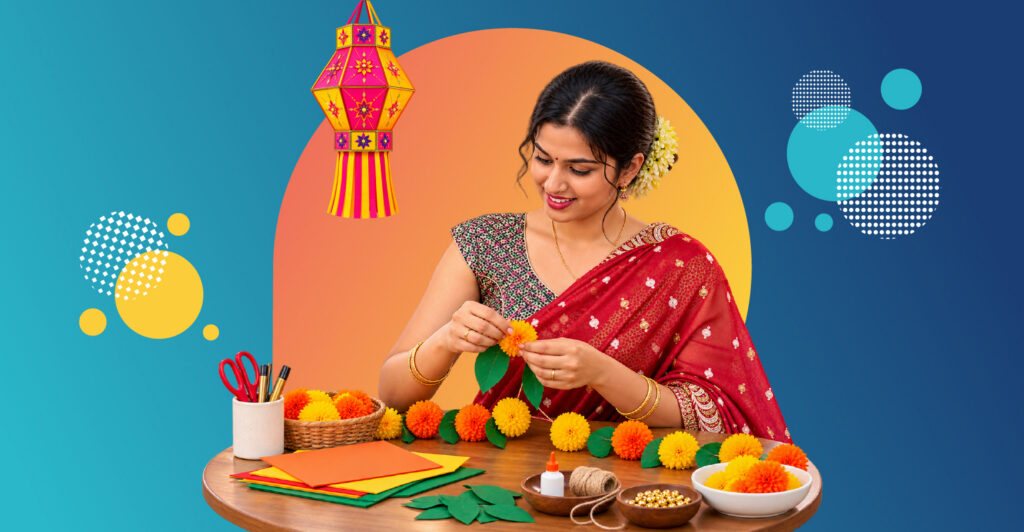
You don’t need special skills or expensive supplies to make your own Diwali decorations. Most of the Diwali craft ideas below use paper, cloth, clay and glass jars, take one to three hours, and can be made over a couple of evenings. This guide explains what counts as a Diwali craft, why handmade décor is worth the effort, how to make six pieces for your home and a clay diya, when to start, and how to choose materials that are safer and less wasteful.
What counts as a Diwali craft Decorations
Diwali decorations centre on light and welcome, and most traditional crafts serve one of those purposes.
- Diyas. Small lamps, traditionally made of clay and lit with oil and a cotton wick.
- Rangoli. Patterns made on the floor near the entrance, using coloured powder, rice, flower petals or chalk.
- Toran or bandhanwar. Hangings across the top of the main door, traditionally made with mango leaves and marigolds.
- Akash kandil. Hanging paper lanterns, often star-shaped, especially popular in Maharashtra.
- Paper and cloth décor. Garlands, wall hangings and table pieces that add colour around the home.
Why make your own Diwali decorations
Handmade décor has practical advantages beyond the satisfaction of making it:
- It suits your space. You choose the size, colours and style to fit your door, walls and lighting.
- It uses what you have. Old sarees, leftover paper, empty jars and spare beads all become materials.
- It lasts. Well-made lanterns, torans and wall hangings can be stored and reused for years, unlike many single-use decorations.
- It cuts plastic waste. Paper, cloth and clay replace plastic and thermocol décor.
- It’s time together. Crafting over a few evenings gives family members and friends something to do side by side before the festival.
Best Diwali craft ideas for your home
Each craft below lists the time, difficulty and materials, followed by the main steps. Times are approximate and don’t include drying. The paper firecracker garland and jar lanterns also suit older children working with an adult.
1. Paper lantern (akash kandil)
Time: 2 to 3 hours · Difficulty: Moderate
Materials: Thick coloured card, translucent paper such as butter paper or tissue, glue, scissors, a ruler, a pencil, string, and an LED tealight or a hanging LED bulb.
- Draw and cut six identical rectangles of card, each about 10 × 20 cm, with a 1 cm tab along one long side.
- Cut a window shape, such as a diamond, arch or star, into the centre of each panel.
- Glue translucent paper behind each window.
- Glue the panels together side by side, tab to edge, then close the last joint to form a six-sided tube.
- Add a card base, punch two holes at the top for the string, and attach paper tassels to the bottom corners.
- Place the LED light inside and hang it from a window or balcony.
Use only LED lights inside paper lanterns. A candle or diya flame can set the paper alight.
2. Felt or fabric toran
Time: 1 to 2 hours · Difficulty: Easy
Materials: A strip of fabric or ribbon about 5 cm wide and as long as your door frame, green felt or card for leaves, orange and yellow felt or paper for marigolds, small bells or beads, needle and thread or fabric glue.
- Cut 15 to 20 leaf shapes from green felt, about the size of a mango leaf.
- Make simple marigolds by cutting circles of orange and yellow felt, stacking three, and stitching through the centre.
- Attach the leaves along the strip, pointing downwards, alternating with flowers.
- Add a bell or bead at the tip of every second leaf.
- Sew loops at each end and hang across the top of the door.
A felt toran keeps its shape and colour for years. A fresh version with real mango leaves and marigolds lasts only a few days.
3. Mirror and bead wall hanging
Time: About 1.5 hours · Difficulty: Easy
Materials: An embroidery hoop or metal ring, coloured thread or wool, small craft mirrors, beads, small bells and strong glue.
- Wrap the hoop tightly with thread in one or two colours, gluing the ends.
- Cut five to seven lengths of thread in decreasing lengths, longest for the centre.
- Thread beads and glue mirrors along each strand, finishing each with a bell.
- Tie the strands evenly along the bottom half of the hoop.
- Add a loop at the top and hang it where it can catch light from a lamp or window.
4. Paper firecracker garland
Time: About 1 hour · Difficulty: Easy
Materials: Card or paper tubes (kitchen roll tubes cut in half work well), coloured paper, crepe paper in red, orange and yellow, glue, scissors and string.
- Cover each tube with brightly coloured paper and add stripes or dots.
- Cut thin strips of crepe paper and glue them to the top of each tube as “sparks”.
- Make a few spinning-wheel “chakri” shapes from paper spirals for variety.
- Punch a hole near the top of each piece and thread them onto string.
- Hang the garland across a wall, shelf or window.
This gives the colour of firecrackers without noise, smoke or risk, which suits homes with pets, elderly relatives or small children.
5. Upcycled jar lanterns
Time: About 1 hour, plus drying · Difficulty: Easy
Materials: Clean glass jars, coloured tissue paper, white craft glue mixed with a little water, a brush, thin wire or twine, and tealights in metal cups or LED tealights.
- Tear tissue paper into small pieces.
- Brush the glue mixture onto the outside of a jar and press the tissue on in overlapping layers.
- Brush another coat of glue over the top and leave to dry.
- Wrap wire or twine around the neck to make a handle.
- Place a tealight inside and arrange the jars along a windowsill or stair.
The glass shields the flame, but keep jars away from curtains and anything that can catch fire.
6. Reusable rangoli board
Time: 2 to 3 hours, plus drying · Difficulty: Moderate
Materials: A round board of MDF or thick cardboard, a pencil, acrylic paints or coloured rice, glue, small mirrors or beads, and a clear sealant.
- Draw a simple symmetrical design on the board: a central flower with petals radiating outwards works well.
- Fill each section with paint, or glue down coloured rice section by section.
- Add mirrors or beads at key points to catch the light.
- When dry, seal with a clear coat to protect the colours.
- Place the board by your entrance and surround it with diyas or fresh petals.
A board can be stored and used again each year, and it doesn’t smudge when people walk past.
7.How to make a clay diya for Diwali
Time: About 30 minutes to shape, plus drying and painting · Difficulty: Easy
Materials: Air-dry clay or terracotta clay, a small bowl of water, a toothpick, acrylic paints, fine brushes and a clear sealant.
- Shape the base. Roll a piece of clay about the size of a lemon into a smooth ball.
- Form the cup. Press your thumb into the centre and pinch the walls outwards evenly, keeping the base thick enough to stand steadily.
- Make the spout. Pinch one side of the rim into a small point where the wick will rest.
- Smooth and decorate. Smooth any cracks with a wet fingertip, then press dots, lines or petals into the surface with a toothpick.
- Dry it slowly. Leave the diya somewhere cool and shaded, turning it occasionally. Air-dry clay usually needs a day or two to dry fully, depending on the brand and the weather.
- Paint and seal. Paint once fully dry, then add a clear sealant.
Lighting it safely: Air-dry clay isn’t fired, so it can crack under heat and absorb oil. Place a tealight in a metal cup inside the diya, or use an LED tealight. Only diyas made of fired terracotta should be used with oil and a cotton wick directly.
HOW DO YOU DECORATE FOR DIWALI?
Handmade, store-bought or a bit of both: share your Diwali decorating habits with Panel Station.
When to start Diwali Craft Decorations
Diwali falls on 8 November 2026, so working back from the festival gives you about two and a half weeks.
|
When |
What to do |
|
Now to 24 October |
Choose your crafts and gather materials |
|
25 to 31 October |
Make the longest pieces: lanterns, toran, wall hanging, rangoli board |
|
By 1 November |
Shape your clay diyas, so they have time to dry |
|
2 to 4 November |
Paint and seal diyas; make jar lanterns and the paper garland |
|
5 to 6 November |
Hang décor and test LED lights before Dhanteras on 6 November |
|
8 November |
Add fresh flowers and light your diyas |
Diwali Craft Decorations Impact
What you make your decorations from affects how long they last, how safe they are and what happens to them afterwards.
- Choose materials that last or break down. Paper, cloth, clay, jute and natural fibres can be reused or composted; glitter, thermocol and plastic usually can’t.
- Reuse rather than replace. Store lanterns, torans and rangoli boards flat in a box, and they’ll be ready next year.
- Use flowers twice. Marigolds from your toran can go into the compost bin once they wilt.
- Keep flames away from paper and fabric. Use LED lights inside lanterns, place diyas on a heat-proof surface away from curtains, and never leave a lit diya unattended.
- Keep a safety kit nearby. A bucket of sand or water near any area with open flames is a sensible precaution.
Your next step
Pick two crafts that fit your time: perhaps a toran for the door and a set of clay diyas. Gather the materials this week. Take a photo of each finished piece on your phone, so you can repeat or improve the designs next year.
CURIOUS HOW PANEL STATION WORKS?
Panel Station is where people discover trends, share opinions on everyday choices like what they buy and why, and earn rewards.
Frequently Asked Questions
1. Which Diwali craft is quickest to make?
The paper firecracker garland and the jar lanterns each take about an hour, not counting drying time. If you have only one evening, start with one of those, then add a toran or diyas if you have more time later in the week.
2. Can I make diyas without a kiln?
Yes. Air-dry clay sets hard without firing and is easy to shape and paint. Because it isn’t fired, use it with an LED tealight or a tealight in a metal cup, rather than pouring oil straight into the clay.
3. How should I store handmade decorations for next year?
Store them flat in a sturdy box in a dry place. Wrap lanterns and wall hangings in old newspaper or cloth, keep clay diyas apart so they don’t chip, and add a sachet of silica gel or a few cloves to help keep damp and insects away.
4. What can I use instead of glitter?
Small craft mirrors, coloured rice, dried flower petals, metallic paper offcuts and beads all add sparkle. Unlike most glitter, they can be reused or composted, and they don’t scatter across the floor.
5. How can I colour rangoli without chemical powders?
Use dyed rice, lentils, turmeric for yellow, flower petals, or chalk. For dyed rice, mix uncooked rice with a little food colouring and a few drops of water, then spread it out to dry before use.
6. Can I put a real candle inside a paper lantern?
No. Paper catches fire easily, even when the flame doesn’t touch it directly. Use an LED tealight or a battery-powered bulb in paper lanterns, and keep real flames in glass, metal or clay holders.