
Electric vehicles are becoming increasingly familiar, but deciding whether one fits into everyday life can still involve a lot of practical questions.
Consumers want to know how easy charging will be, how much range they actually need, whether the battery will remain dependable over time, and whether the higher upfront cost will be worthwhile in the long run.
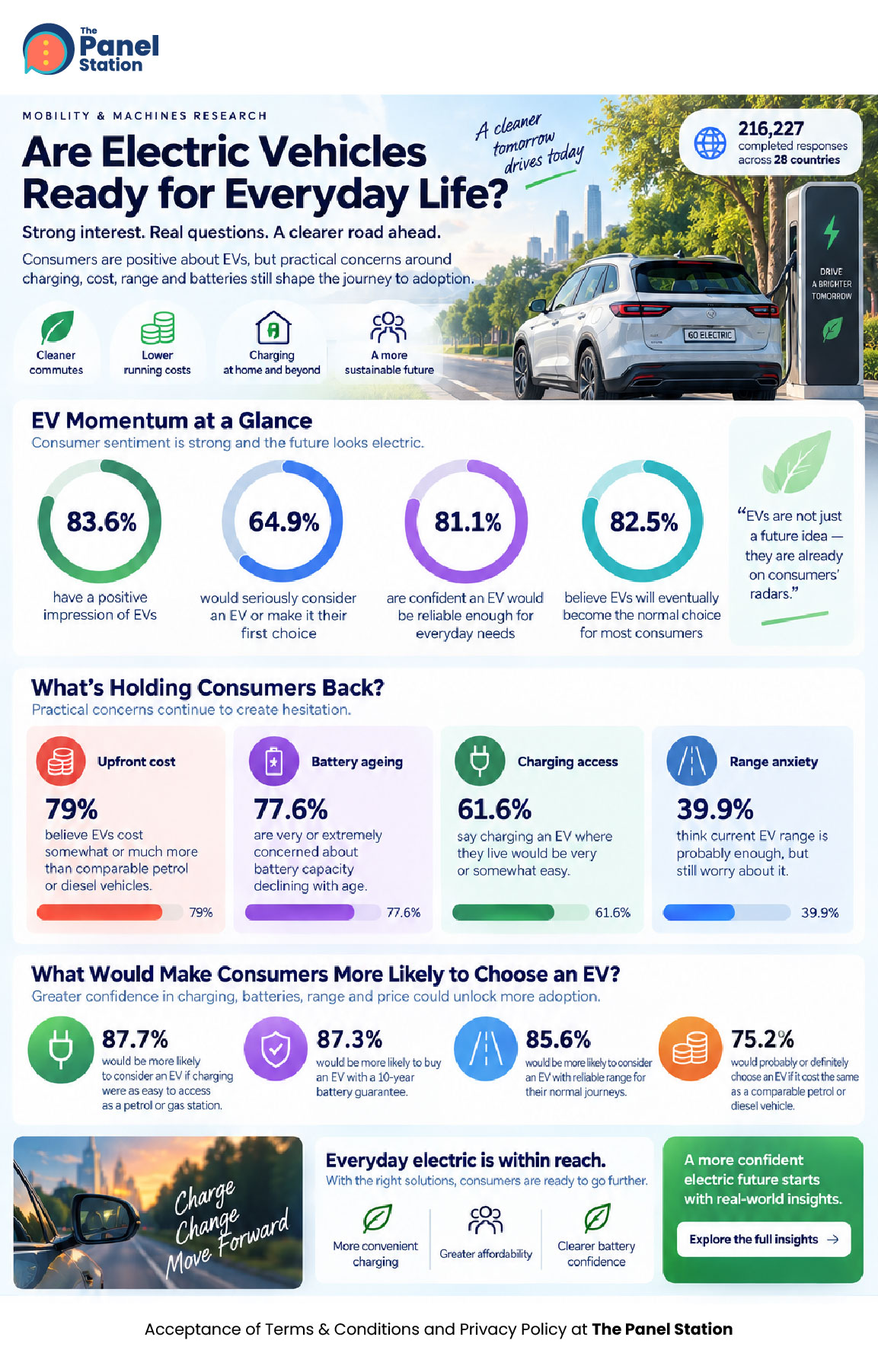
These questions are becoming more relevant as interest in EVs grows. In our recent research, 83.6% of respondents have a positive impression of EVs, while 64.9% would seriously consider one or make it their first choice if they were buying a vehicle today.
The broader Electric Vehicle Trends 2026: What Will Move Consumers From Interest to Adoption? explores what is driving this interest and the barriers that still remain. For someone considering an EV, however, the more immediate question is how those factors translate into everyday ownership.
What Actually Changes When You Move to an EV?
One of the biggest differences with EV ownership may have less to do with driving and more to do with how charging fits into everyday life.
Petrol and diesel vehicles are usually refuelled when the tank runs low. An EV, by contrast, can often be charged while it is already parked, especially at home or at work. For drivers with easy access to charging, this can make refuelling feel less like a separate task and more like part of the daily routine.
However, that experience depends heavily on where someone lives. 61.6% of respondents say charging an EV where they live would be very or somewhat easy, which still leaves a sizeable group more dependent on workplace or public charging.
This helps explain why the same EV can feel convenient for one driver and inconvenient for another. The technology may be identical, but the surrounding circumstances can make the ownership experience very different.
Why Does Charging Matter So Much?
For consumers, having chargers on a map is not enough. What matters is knowing that charging will be available when they actually need it.
A public charger that is hard to find, already occupied, or out of service can make a routine journey feel far more complicated. That uncertainty becomes especially noticeable because drivers of conventional vehicles are used to refuelling without giving the process much thought.
The difference that reliable access could make is clear. 87.7% say they would be more likely to consider an EV if charging were as easy to access as a petrol or gas station.
That does not mean EV charging has to copy the refuelling experience exactly. For many drivers, home charging could eventually make ownership even more convenient. What matters is creating the same confidence that energy will be available when it is needed.
For charging providers and policymakers, this means infrastructure should be judged not only by the number of chargers installed, but by how reliable and easy the overall charging experience feels.
WHAT WOULD MAKE ELECTRIC DRIVING EASIER FOR YOU?
Share how charging, cost and everyday journeys influence your view of EVs with The Panel Station.
Does Range Anxiety Really Mean People Need Bigger Batteries?
Range is often discussed as though more is always better, but the consumer concern is more complicated.
23% of respondents already believe current EV range is sufficient for them, while another 39.9% say it is probably enough but still worry about it.
That gap between capability and confidence is important. A vehicle may comfortably cover someone’s normal commute while still creating uncertainty around an unexpected detour, a longer weekend trip or a destination where charging is unclear.
Range therefore cannot be separated from charging. Reliable charging can make a moderate range feel comfortable, while poor charging access can make even a larger range feel restrictive.
For someone considering an EV, the better question may not be, “What is the longest range available?” It may be, “How far do I normally travel, and how easily can I charge when I go farther?”
That makes range a personal requirement rather than a universal number.
Price remains one of the strongest barriers to EV adoption. 79% of respondents believe EVs cost somewhat or much more upfront than comparable petrol or diesel vehicles.
That initial difference matters because consumers experience the purchase price immediately, while any potential savings appear gradually.
Yet 78.2% believe an EV would probably or definitely save them money over several years. This suggests consumers are already recognising that purchase price and ownership cost are not necessarily the same thing.
A useful comparison therefore goes beyond the showroom price. It includes how much someone drives, how they expect to charge, how long they plan to keep the vehicle and what they are likely to spend during that period.
The importance of affordability becomes even clearer when the price gap disappears. 75.2% say they would probably or definitely choose an EV if it cost the same as a comparable petrol or diesel vehicle.
The hesitation may therefore be less about rejecting electric mobility and more about whether the financial case feels convincing enough today.
Why Does the Battery Create So Much Uncertainty?
For many drivers, the battery is still one of the biggest unknowns in EV ownership. People are familiar with the idea that engines and mechanical parts wear over time. What is harder to judge is how an EV battery will perform after five, seven, or ten years of regular use.
That uncertainty matters because battery health affects range, performance, and how confident owners feel about the vehicle’s long-term value. In the survey, 77.6% of respondents say they are very or extremely concerned about battery capacity declining with age.
Most consumers do not need a technical lesson in battery chemistry. They need to know what level of performance they can reasonably expect over time and what support is available if the battery deteriorates more than expected.
That may explain why 87.3% say a 10-year battery guarantee would make them somewhat or much more likely to buy an EV.
For manufacturers, building confidence may therefore require more than improving battery technology. It also means making long-term performance easier for consumers to understand and trust.
Can an EV Handle Ordinary Everyday Life?
One of the more revealing findings is that 81.1% of respondents are confident an EV would be reliable enough for their everyday needs.
That suggests the main uncertainty may increasingly sit around ownership rather than the vehicle’s basic ability to do the job.
Consumers largely expect EVs to handle commuting, shopping, school runs and other routine journeys. What they are still trying to understand is how much the experience around the vehicle will require them to change.
Will charging fit naturally into the week? Will longer journeys involve too much planning? Will the battery remain dependable? Will the financial benefits justify the initial cost?
When those questions have straightforward answers, an EV stops feeling like a technology experiment and starts feeling like an ordinary vehicle choice.
How Can Someone Decide Whether an EV Fits Their Life?
Whether an EV makes sense depends less on the technology itself and more on how the vehicle will fit into everyday life.
Daily driving distance is a good place to start. Someone who mostly makes short local trips will have different needs from a driver who regularly covers long distances. Charging matters just as much, especially where the vehicle is parked overnight and whether convenient charging is available nearby.
Cost also needs to be viewed in context. A higher purchase price may be easier to justify for someone who drives frequently and can benefit from lower running costs, while the calculation may be different for an occasional driver.
Battery warranty, access to service, and how long the vehicle is likely to be kept should also be part of the decision.
Rather than asking whether EVs are better or worse overall, it may be more useful to ask whether a particular EV works for the way someone actually drives and lives.
What Will Make EVs Feel Truly Mainstream?
New technology becomes ordinary when people no longer need to think very hard about using it. EVs may be moving towards that point.
82.5% of respondents believe electric vehicles will eventually become the normal choice for most consumers, suggesting that the idea of an electric future is already widely accepted.
The remaining challenge is practical. Consumers need affordable vehicles, dependable charging, understandable battery guarantees and enough confidence to know that an EV can manage both routine days and occasional longer journeys.
For automakers, charging providers and policymakers, this means moving beyond simply promoting electric mobility. The bigger opportunity is reducing the uncertainty surrounding ownership.
For consumers, the decision can become simpler too. The question does not need to be whether EVs represent the future. It can simply be whether an EV works for the way they live today.
WHAT WOULD GIVE YOU THE CONFIDENCE TO GO ELECTRIC?
Tell The Panel Station what would make an EV easier for you to understand, trust and choose.
Frequently Asked Questions
1. What is the biggest everyday difference with an EV?
The main difference is how the vehicle gets its energy. EVs use electricity stored in a rechargeable battery rather than relying primarily on petrol or diesel.
2. Does everyone need a home charger?
No. Workplace and public charging are alternatives, although convenient home charging can make ownership easier.
3. How much EV range does someone really need?
It depends on normal driving patterns, longer journeys and charging access rather than simply choosing the highest available range.
4. Are EVs more expensive?
Many consumers perceive them as more expensive upfront, although longer-term ownership costs can differ because electricity replaces conventional fuel.
5. Why are people concerned about EV batteries?
The battery affects range, long-term performance and vehicle value, so consumers want confidence that it will remain dependable as the vehicle ages.
6. What should someone consider before buying an EV?
Consider normal driving distance, charging access, purchase and running costs, battery warranty, service availability and how often longer journeys are required.