Every generation grows up hearing that it sees the world differently from the one before it. The language changes, technology changes, expectations move, and new ideas about work, relationships and success begin to take shape. Those differences are real, but they can also become an easy explanation for behaviour that is far more complicated.
The Panel Station’s Generations in Transition Trends 2026 research, based on 265,949 completed responses across 35 countries, suggests that generational identity remains strong.
The generation gap may therefore be less about completely different worldviews and more about different ways of responding to the same needs. Security, independence, belonging and freedom can matter across age groups even when people disagree strongly about what those ideas should look like in practice.
Are Generations Really as Different as We Think?
Around 55% point to differences in values or lifestyle as the clearest signs of a generational divide, which helps explain why the gap can feel so visible in everyday life.
People may communicate differently, approach work differently or make very different choices about relationships, money and technology, even when their deeper priorities are not worlds apart.
The contrast becomes sharper when shared values are translated into behaviour. Stability might mean staying with one employer for years, or it might mean building several income streams and keeping skills current. Freedom could mean independence from family expectations, flexibility at work or simply having greater control over personal time.
This is why visible behaviour can exaggerate the divide. Generations may be pursuing similar needs through very different routes, and tension often begins when one group assumes its way of expressing a value is the only valid one.
Why Do So Many Generations Feel Misunderstood?
Generations often feel misunderstood because stereotypes turn complex groups of people into a few easy labels.
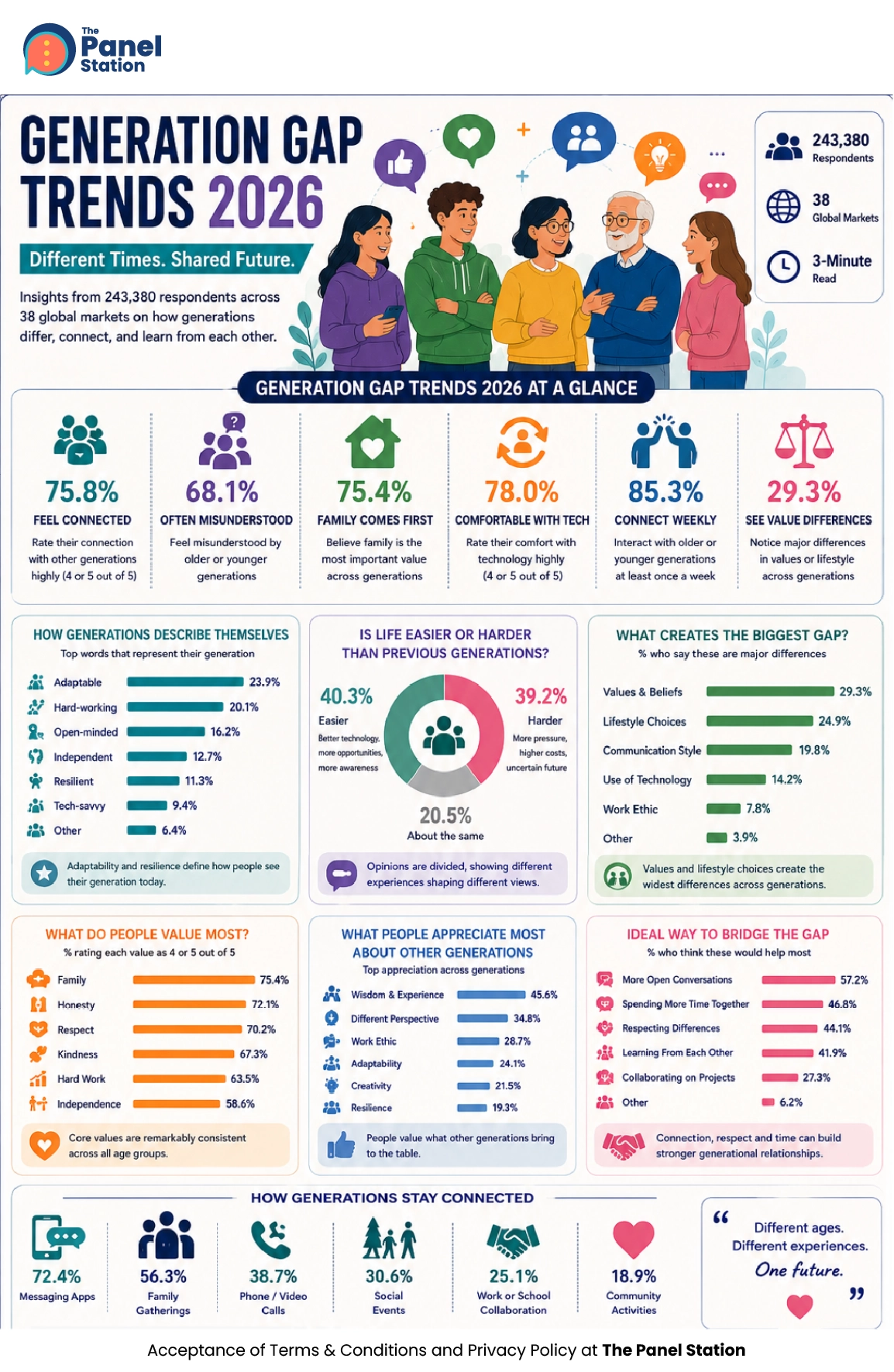
Nearly 7 in 10 say they feel misunderstood by other generations, showing how quickly difference can become judgement.
Ambition can be read as impatience, practicality as resistance to change, flexibility as a lack of commitment, and discipline as rigidity. Once those assumptions settle in, behaviour is judged through the stereotype rather than the person behind it.
The tension is not that people reject generational identity. Many still feel connected to their generation; they simply do not want that identity to become a shortcut for explaining everything they think, value or choose.
Why Do Generational Labels Feel So Convincing?
Generational labels are powerful because people genuinely recognise themselves in them.
Around 76% feel strongly connected to their generation, yet 68% also say their generation is misunderstood at least sometimes. That tension helps explain why generational labels can feel both useful and limiting.
Shared experiences do matter. Someone who grew up before smartphones entered a different social and working world from someone who has never known life without them. But broad patterns quickly become stereotypes when they are treated as fixed explanations for individual behaviour.
For example, 78% across the survey feel highly comfortable with rapid technological change, challenging the assumption that digital confidence belongs mainly to younger generations.
Generational labels are therefore most useful as context, not conclusions. They can help explain the world someone grew up in, but they cannot fully explain what that person values, how they work or how willing they are to change.
Are Generations More Similar in Their Values Than Their Habits?
The survey suggests that the generation gap may be narrower than it appears.
Only around 1 in 3 respondents see differences in values as the main divide between generations, meaning most do not view values as the biggest source of separation.
That makes the common ground more interesting. Family, stability, financial independence, privacy and freedom continue to matter strongly across generations, suggesting that people may want many of the same things even if they pursue them differently.
The real divide may therefore be less about what generations value and more about how they believe those values should be lived out.
Why Has Adaptability Become So Important?
Adaptability is often seen as a strength because it reflects the ability to learn, adjust and keep moving when circumstances change.
Around 1 in 4 respondents describe themselves as highly adaptable, suggesting that flexibility is becoming an important part of how people see themselves.
But adaptability may also be a response to uncertainty. Jobs evolve, living costs shift, technology advances and social expectations change quickly, making it harder to rely on one fixed way of working or living.
In that sense, adaptability is not only a generational strength. It is also a sign of the times—people are learning to change because standing still can increasingly feel like the greater risk.
What Defines Your Generation?
Take The Survey And Share The Values, Pressures And Experiences Shaping Your Generation. Compare Your Perspective With People Across 35 Countries.
Who Really Has Life Easier?
Few generational debates become as heated as the question of who had life easier.
The near-even split reflects the difficulty of comparing different kinds of advantage. Modern generations benefit from greater access to information, digital tools and new forms of opportunity. At the same time, they face pressures around housing, employment uncertainty, constant connectivity and social comparison that did not exist in the same way before.
Earlier generations faced challenges that younger people cannot fully recreate, just as younger generations are navigating conditions older people did not encounter at the same stage of life. Comparing hardship rarely closes the gap; understanding different forms of pressure may be more useful.
Does Meaningful Contact Reduce Generational Stereotypes?
Nearly 85% of respondents say they connect with younger or older generations at least once a week, showing that intergenerational contact is already part of everyday life for most people.
That matters because stereotypes are harder to maintain when people interact regularly. A younger colleague stops being seen simply as “Gen Z,” while an older relative or manager becomes more than a generational label. Real conversations add context that assumptions often miss.
Meaningful contact may not remove every disagreement, but it can make those differences easier to understand. The more generations know one another as individuals, the less room there is for age-based assumptions to define the relationship.
Is Technology Really the Main Generational Divide?
Technology is often blamed first when generations appear to be drifting apart.
But around 60% believe more open conversations could help reduce generational barriers, suggesting that communication may matter more than the devices people use.
The device itself may therefore be less important than the behaviour surrounding it. One person may see social media as a natural space for connection and self-expression, while another sees constant sharing as intrusive. One employee may view messaging outside work hours as flexible, while another sees it as a breakdown of boundaries.
Technology may simply make deeper differences more visible. Questions around privacy, communication, availability and personal boundaries existed long before smartphones; digital life has simply given generations new spaces in which those differences can play out.
What Can Generations Learn From One Another?
The survey suggests that generations are not only noticing differences; they are also recognising what others bring to the table.
Wisdom and experience rank as the most valued strengths at 46%, followed by the ability to offer a different perspective at 35%.
That matters because generational diversity is not only about managing tension. It can also widen the way people think, solve problems and make decisions. Experience can provide context, while a different perspective can challenge assumptions that have become too familiar.
The opportunity, then, is to move beyond comparing generations and start using their differences more constructively.
Can Generational Differences Become an Advantage?
Different generations have encountered different technologies, economies, workplaces and social norms. Those differences can create friction, but they can also expand the range of perspectives available when decisions are made.
The survey suggests that people already see value in these differences. Nearly 3 in 10 appreciate the work ethic they see in other generations.
These strengths can complement one another: experience can bring discipline and context, while adaptability can help teams respond more quickly when circumstances change.
The advantage is not in making generations think alike. It comes from combining different strengths in the same room and creating environments where ideas are judged on their value rather than the age of the person expressing them.
Will Generational Identities Become Less Important?
Generational labels are unlikely to disappear because they remain convenient ways to describe shared periods of social change. People also continue to feel a genuine connection to the generation they identify with.
At the same time, life paths are becoming less predictable. Education can happen throughout adulthood, careers can change several times, and major milestones such as marriage, home ownership or retirement occur at increasingly varied ages.
Generation may therefore remain part of identity without becoming a complete explanation of it. Future conversations may need to recognise shared generational experiences while leaving more room for people to contradict the stereotype.
What Will Actually Close the Generation Gap?
The generation gap is unlikely to disappear completely, and that should not necessarily be the goal. Different generations have lived through different economic, social and technological conditions, so some disagreement around work, money, relationships and success is inevitable.
Nearly 6 in 10 say a simple conversation can narrow the generation gap, while almost half believe time together and respect for differences can do the same.
The strongest bridges may be surprisingly human: talk more, spend time together and judge less. These actions create space for people to understand not just what another generation thinks, but why they think that way.
The aim is not to make generations agree on everything. It is to build enough understanding that difference becomes easier to navigate and, in some cases, even useful.
What Can Your Generation Teach The Others?
Share The Strengths, Lessons And Perspectives Your Generation Can Offer.
What Will Matter Across Generations?
Generations will continue to differ because they are shaped by different experiences, technologies and expectations. But beneath those differences, many still want the same things: security, independence, connection and opportunity.
The real progress will come from understanding those different perspectives and combining their strengths, rather than deciding which generation has the better way of seeing the world.
Frequently Asked Questions
1. What is causing the generation gap in 2026?
The generation gap is shaped by different values, lifestyles, technologies and experiences. The survey suggests that differences in values and lifestyle are perceived as larger divides than technology alone.
2. Are generations really very different?
Generations can behave differently while still valuing many of the same things. The biggest differences often concern how priorities such as security, independence and freedom are expressed.
3. Why do generations feel misunderstood?
Generational stereotypes reduce large and diverse groups to a small number of traits. This can make people feel that their individual experiences and priorities are being overlooked.
4. Is technology the biggest cause of generational tension?
No. Technology makes some differences more visible, but respondents place values and lifestyle ahead of technology as sources of the generation gap.
5. Why do generations approach work differently?
Different generations entered the workplace under different economic and professional conditions. Their views on stability, flexibility, loyalty and progression often reflect those experiences.
6. Which generation has had life easier?
There is no clear agreement. The survey is almost evenly divided between people who believe life is easier today and those who believe it is harder.
7. What can younger and older generations learn from each other?
Younger and older people can exchange technical knowledge, creativity, experience, discipline, resilience and practical judgement. The strongest learning works in both directions.
8. Does spending time with other generations reduce stereotypes?
Meaningful contact can make stereotypes harder to maintain because people begin responding to individuals rather than assumptions about an entire age group.
9. How can workplaces reduce generational tension?
Workplaces can avoid age-based assumptions, encourage two-way learning and create space for different communication styles, career expectations and perspectives.
10. Will the generation gap disappear?
Probably not. Different generations will continue to be shaped by different experiences. The more realistic goal is to understand those differences well enough to turn them into learning rather than division.