

For every 7 in 10 respondents, ambition is no longer defined only by status or achievement.
It is increasingly about opening up a better life—through travel, technology, better health and experiences that create more freedom, growth and possibility.
Panel Station Report on Dreams and Possibilities from 243,348 respondents across 38 countries reveals modern ambition is more than a desire for success. People still want progress, but they are also asking what that progress should make possible. A better career matters less if it leaves no time for relationships, while more money often matters because it reduces anxiety or creates freedom.
The deeper question is not simply what people want, but what kind of future would make life feel more secure, meaningful and genuinely their own.
Have Our Ambitions Become More Practical?
Future goals are often associated with exceptional achievement, but the survey points to something more grounded.
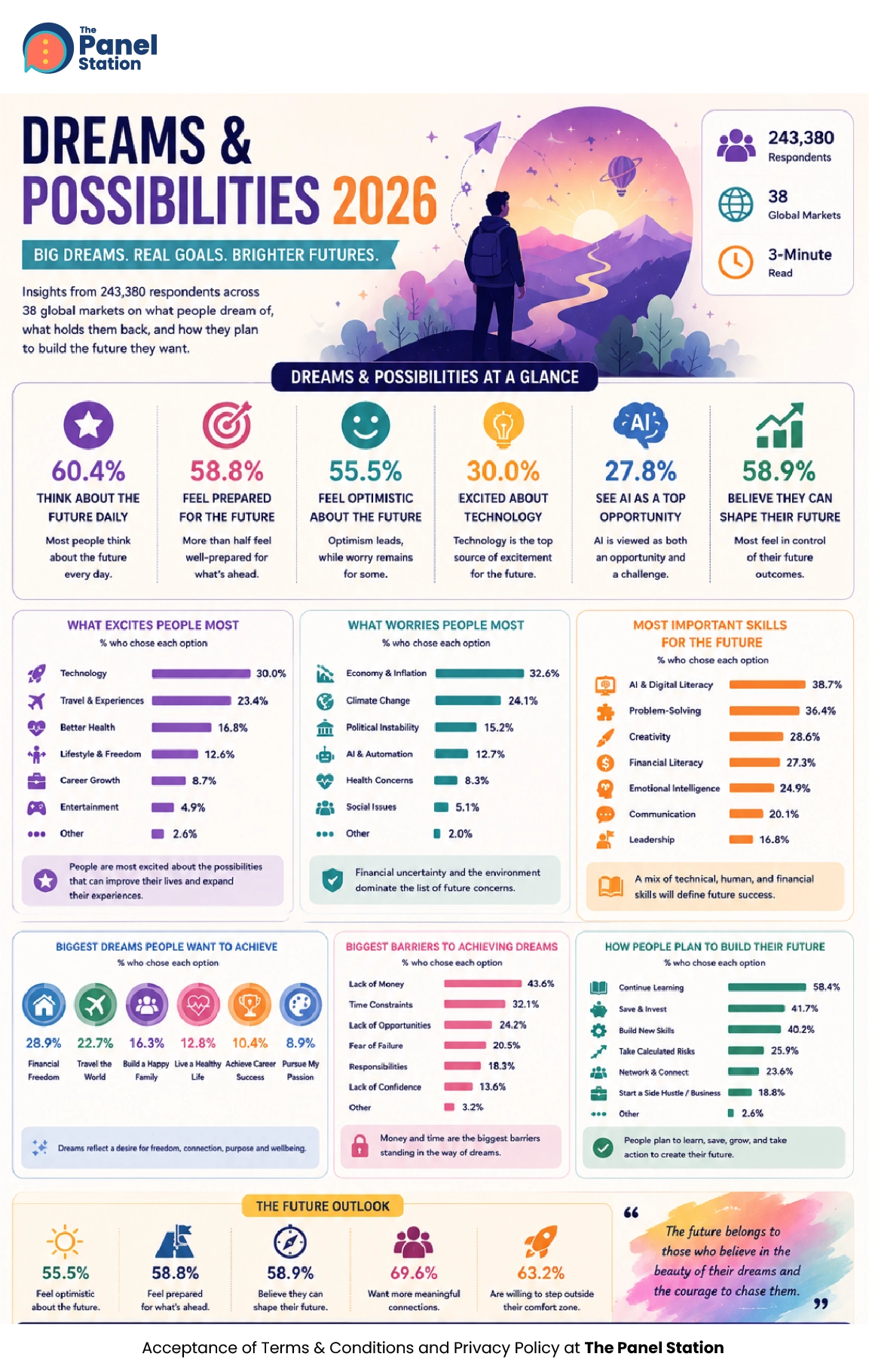
Nearly 4 in 10 respondents name financial freedom as their biggest long-term dream, while around 1 in 5 prioritise a peaceful life and a similar share choose career success.
These ambitions are not necessarily smaller. They suggest that success is increasingly being judged by what it makes possible: greater security, less financial pressure, meaningful work and more control over how life is lived. Salary and status may still matter, but often because they create choices rather than because they are the final goal.
The shift makes ambition feel more practical and personal. The future people want may be less about looking successful and more about having enough freedom, stability and peace of mind to feel successful.
Is Financial Freedom Really About Money?
Financial freedom sounds like a financial goal, but its appeal reaches far beyond money. It can mean being able to deal with an emergency without panic, leave a job that has become unhealthy, support family members, study again or simply make everyday decisions without calculating every consequence.
Around 35% of respondents worry about economic stability and inflation.
This is why money sits very close to ideas such as peace, independence and control. The value of money often lies in what it removes: anxiety, dependence and limited choice. Someone may not dream of wealth for its own sake; they may dream of reaching a point where money no longer dominates every important decision.
Seen this way, financial ambition becomes less about accumulation and more about creating enough stability for the future to contain real choices.
What Makes the Future of Ambition Feel Uncertain?
Ambition may be growing, but so are the pressures around it.
More than 70% of the respondents worry about inflation, economic uncertainty, political instability and climate change.
People can have clear goals and still feel unsure about whether the future will give them enough stability, opportunity or financial security to reach them. Economic uncertainty, changing job markets, rising costs and rapid technological change can all make long-term plans feel less predictable.
This uncertainty does not necessarily reduce ambition. In many cases, it changes how people pursue it. Instead of following one fixed path, people may become more cautious, build new skills, create backup options or rethink what success should look like if circumstances change.
The future of ambition may therefore depend less on having a perfect plan and more on being able to adapt without losing direction. People still want progress, but increasingly they also want enough resilience and flexibility to keep moving when the path ahead changes.
Traditional success has often been measured through visible milestones: income, status, home ownership, career progression and recognition. These things still matter, but they do not always explain why people pursue them.
Around 60% are willing to step out of their comfort zone which implies that modern ambition can look broader than a list of achievements.
People may be trying to improve several parts of life at once because no single success feels sufficient if everything around it remains unstable.
The deeper goal may be quality of life. A career can represent progress, but it may also represent confidence and independence. A home can represent ownership, but it may also represent security. Savings can be financial, but they can also create emotional breathing room. Health goals can improve wellbeing while also protecting the ability to enjoy everything else someone has worked for.
What Are You Working Towards?
Share The Goals That Matter Most To Your Future.
What Happens When Ambition Meets Reality?
Dreaming is easy when the future remains abstract. But the real test begins when those ambitions meet everyday responsibilities.
With 6 in 10 respondents feeling ready to face future challenges, there is a clear sense of confidence about what lies ahead.
Time is limited, money can restrict choices, opportunities are uneven, and confidence can fade when progress feels slow. Future readiness, then, is not only about optimism—it is about having the flexibility and resilience to keep moving when circumstances change.
This is where the language of ambition can become unhelpful. Telling people simply to work harder or believe in themselves ignores practical barriers that motivation alone cannot remove. A more useful view recognises both agency and circumstance. Future optimism becomes more realistic when the path towards them takes real conditions seriously.
Is Fear of Failure Always the Real Problem?
Fear of failure receives a great deal of attention because it is easy to personalise. If someone hesitates, the assumption is often that they lack confidence or courage.
Yet around 1 in 4 respondents say fear of failure holds them back, showing that uncertainty is a real part of pursuing bigger goals.
That hesitation can also be rational. Changing careers may mean giving up a stable income, starting a business can put savings at risk, and returning to education may demand time that is already scarce. What looks like fear may sometimes be a careful assessment of what is at stake.
Good decisions do not always look bold. Courage can mean taking a risk, but it can also mean preparing carefully, building a safety net or choosing a slower route that makes failure easier to absorb.
How Much Risk Should an Ambition Require?
Risk is often romanticised as proof that someone truly believes in a goal. The bigger the leap, the more serious the ambition is assumed to be. But this creates a narrow idea of progress.
A quarter of the respondents take calculated risks which implies that not every aspiration needs a dramatic decision.
Some goals are reached through smaller moves that steadily increase options: developing a new skill before changing jobs, building savings before starting a business, testing an idea before committing fully or strengthening health before taking on more responsibility.
This kind of progress may be less visible, but it can be more sustainable. Risk should serve the goal rather than become the goal itself.
Do We Still Believe the Future Is Ours to Shape?
A sense of control matters because dreams are difficult to pursue when the future feels completely determined by outside forces. Even small choices can become meaningful when they create evidence that life is still movable.
Around 60% focus on learning as a continuous process suggesting that many are building their future by staying open to new skills, knowledge and ways of thinking.
That does not mean people can control everything. Economic conditions, health, family responsibilities, opportunity and chance all influence outcomes. Personal agency operates inside those realities.
The more useful form of optimism is therefore not “everything will work out.” It is “some of what I do today can improve what becomes possible tomorrow.” That belief is modest, but it can be powerful because it turns the future from an idea into something people can influence.
Are We Changing What a Successful Life Means?
Success used to be easier to describe because it relied on visible markers. A strong career, financial progress, property and recognition created a familiar picture of someone doing well.
Today, that picture is becoming broader, with financial freedom leading people’s aspirations, followed by travelling the world and building a happy life.
People still value achievement, but they also think about health, relationships, freedom, peace, personal growth and the ability to enjoy what they have built. A life can look successful and still feel deeply unsatisfying if those parts are missing.
Traditional ambition has not disappeared; success is simply being judged through more dimensions. The question is not only what someone has achieved, but what that achievement has made possible
Can Success Be Personal Without Becoming Vague?
If success means something different to everyone, it can sound difficult to define. Yet personal definitions do not have to be vague. They can be more demanding because they require people to decide what actually matters rather than relying on familiar social markers.
For one person, success may mean financial independence. For another, it may mean meaningful work with enough time for family. Someone else may prioritise health, creative fulfilment or a quieter life with fewer pressures. None of these goals is automatically less ambitious because it is less visible.
The challenge is recognising whether a goal is genuinely personal or simply inherited from expectations. Dreams become more useful when they provide direction rather than comparison.
What Does It Mean to Dream Realistically Without Dreaming Smaller?
Realism is sometimes treated as the enemy of ambition. In reality, it can make ambition more durable. A realistic dream acknowledges the resources, time and support that will be required and builds a path that can survive ordinary setbacks.
This does not mean choosing smaller goals because the larger ones feel difficult. It means separating the size of the dream from the speed of the journey. A goal can remain ambitious even when progress happens gradually.
Possibility often grows through accumulation. Skills create options, savings create flexibility, and stronger health and relationships create support. Small improvements can expand what becomes possible next.
Could Having More Options Be a Better Measure of Progress?
Progress is often measured through arrival. Someone gets the job, buys the house, launches the business or reaches the financial target. But another form of progress happens before the destination is reached.
A person may become more employable, financially resilient or confident in making decisions. They may develop stronger relationships, better health or enough knowledge to recognise opportunities they would previously have missed. None of these changes is the final dream, yet each increases future choice.
A better future is not only one in which a goal is achieved. It is one in which people have more meaningful options than they did before.
What Would Make Your Future Feel More Possible?
Share What Would Help You Move Closer To The Life You Want.
What Will Define Ambition in the Future?
Ambition is unlikely to disappear, but its meaning may continue to widen. Career progress and financial security will remain important, yet people may increasingly judge success by whether those achievements support the rest of life.
The strongest future goals may be those that create flexibility rather than lock people into one definition of success. Careers, financial stability, health and relationships can all expand future choices.
Dreams give people direction, but possibility determines whether that direction can become movement. The future may belong less to those chasing the biggest goals and more to those building enough security and freedom to keep choosing what comes next.
Frequently Asked Questions
1. What are people dreaming about in 2026?
People increasingly dream of financial freedom, meaningful work, health, relationships and personal growth.
2. Why is financial freedom such an important goal?
Financial freedom can create independence, reduce stress and give people more choices. It is often less about wealth itself and more about having enough security to make decisions with greater confidence.
3. Why does family influence personal ambition?
Many goals are connected to the desire to provide, create stability or improve opportunities for people someone cares about. Ambition is often both personal and relational.
4. What commonly stands between people and their dreams?
Practical limits such as money, time, opportunity, responsibilities and uncertainty can all affect progress. Emotional barriers such as fear also matter, but they are only part of the picture.
5. Is fear of failure always a bad thing?
No. Fear can sometimes reflect a realistic understanding of risk. The goal is not to eliminate caution, but to distinguish between useful preparation and fear that prevents any movement at all.
6. Do big dreams require big risks?
Not necessarily. Many ambitious goals can be approached through smaller decisions that gradually build skills, resources and flexibility while reducing unnecessary risk.
7. How can people feel more in control of their future?
Focusing on decisions that can be influenced today can help. Building skills, savings, health, relationships and knowledge can gradually expand future choices.
8. Is the meaning of success changing?
Yes. Traditional markers still matter, but success is increasingly connected to wellbeing, freedom, relationships, fulfilment and whether achievement improves everyday life.
9. Can realistic goals still be ambitious?
Absolutely. Realism is about understanding what a goal requires, not making the goal smaller. Progress can be gradual while the ambition remains significant.
10. What makes a future feel full of possibility?
Possibility grows when people have meaningful choices. Financial security, useful skills, health, supportive relationships and access to opportunity can all make different futures easier to imagine and pursue.