
Why Is Lifelong Learning Becoming Essential in 2026?
For generations, learning followed a fairly predictable path. You went to school, perhaps continued to university or professional training, found a job and used what you had learned to build a career.
That sequence is becoming harder to follow. Technology changes quickly. Job roles evolve. New tools appear almost overnight. Skills that once remained useful for decades can now need updating within years.
The result is a different relationship with knowledge.
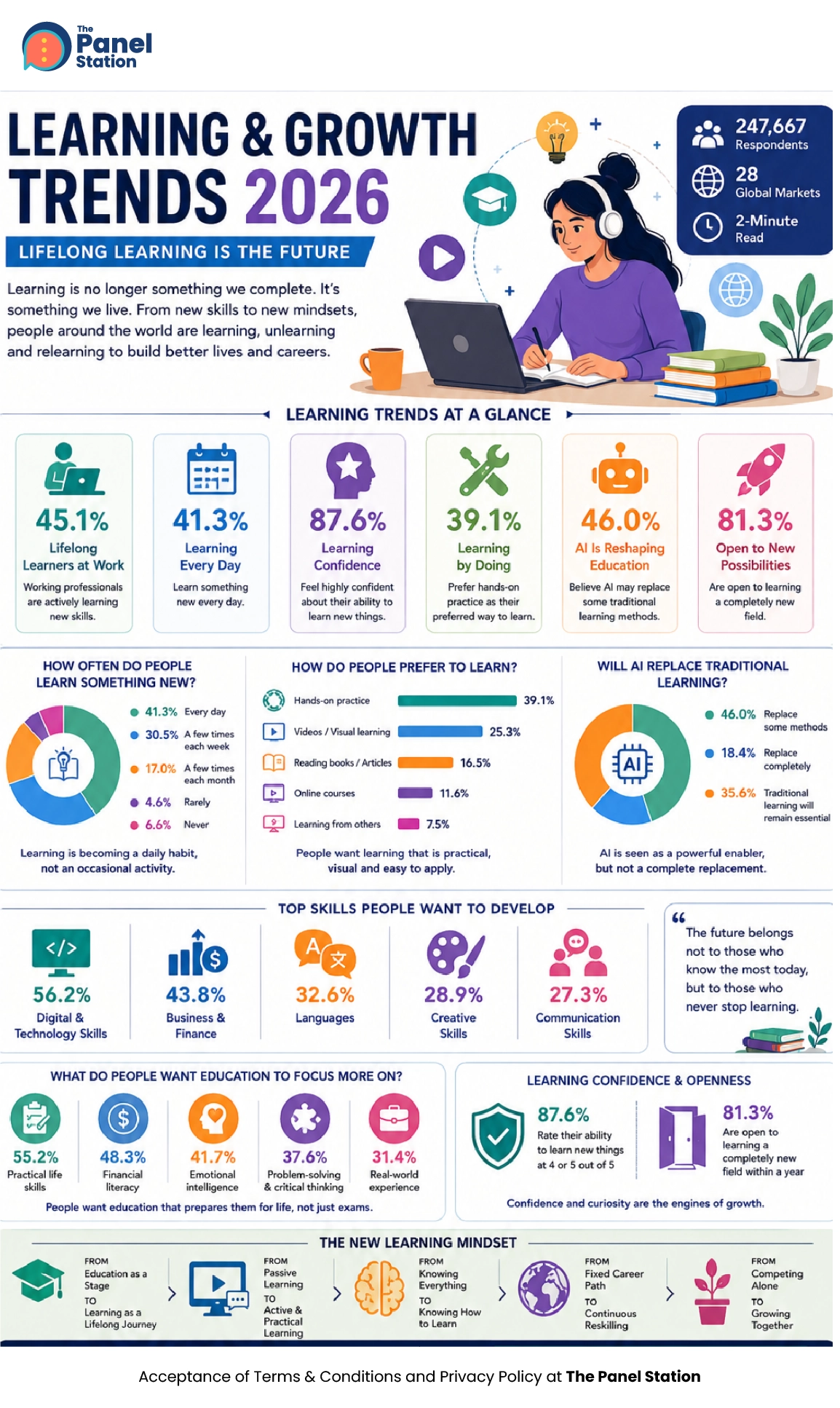
For more than 50% of the respondents, learning is becoming a part of life rather than something they complete before life begins.
The Panel Station’s Learning & Growth Trends 2026 study, based on 247,667 completed responses across 28 global markets, captures this shift.
These numbers point to something bigger than an interest in courses or qualifications. They suggest that adaptability itself is becoming part of how people prepare for their future.
So, what happens when learning stops being a stage of life and becomes a way of life?
Why Does Learning No Longer End When Education Ends?
Because careers no longer stand still. A qualification may help someone enter a profession, but it cannot necessarily prepare them for every change that profession will experience over the next 20 or 30 years. New technologies, business models and workplace expectations continually create reasons to update what we know.
That reality is already visible in people’s behaviour.
The research found that more than 40% professionals strongly identify with the need to keep learning new skills, reflecting a growing awareness that career development now requires continuous adaptation.
Why Is Everyday Learning Becoming More Powerful Than Occasional Training?
One of the most revealing findings is not simply that people are learning. It is how frequently they are doing it. Learning no longer has to involve enrolling in a three-month programme or sitting through a full day of training. It can happen through articles, videos, podcasts, conversations and real-world experimentation.
That matters because small learning moments are easier to fit around ordinary life. Someone can spend 15 minutes understanding a spreadsheet function they need for work. They can watch a demonstration before repairing something at home. They can listen to an expert explain an unfamiliar idea while commuting.
Individually, these moments can feel insignificant. Repeated over months and years, they create considerable knowledge.
What are you learning right now?
Take The Panel Station survey and compare your learning journey with people around the world.
Why Do People Increasingly Want to Learn by Doing?
Knowing something and knowing how to use it are not always the same thing.
Around 40% want to learn by doing. That distinction helps explain why practical learning is gaining ground. The appeal of practical learning is easy to understand. Doing something provides immediate feedback. You discover what works, what does not and where your understanding is incomplete.
This does not make books, classrooms or lectures irrelevant. Instead, it suggests that people increasingly expect learning to connect theory with application.
That expectation has implications for employers and educators.
Workplace learning may become more effective when employees can practise skills rather than simply attend training sessions. Education may become more engaging when students solve realistic problems instead of only memorising information.
How Is AI Changing What It Means to Learn?
AI is making learning faster, more interactive and more personalised with 46% believing AI is a powerful enabler of learning. People can ask questions, request simpler explanations, generate examples and explore ideas at their own pace.
But this does not mean traditional learning is disappearing. AI can provide speed and access, while teachers, mentors and colleagues bring context, judgement and human guidance.
The bigger shift may therefore be in what learners themselves need to become good at.
When answers are easy to generate, asking better questions, checking information and applying knowledge become more important. AI may make knowledge easier to access, but the real value lies in knowing what to do with it. The advantage will increasingly lie with people who can question information, connect ideas and decide how knowledge should be used.
Can Lifelong Learning Protect People From Career Obsolescence?
Lifelong learning cannot guarantee that a role will never change or disappear, but it can make people better prepared when it does. Continuously updating skills helps professionals respond to new technologies, shifting expectations and emerging opportunities.
The real advantage is adaptability. People who keep learning are more likely to recognise where their existing experience still has value, where new capabilities are needed and how they can move into different roles when industries evolve.
In this sense, lifelong learning is becoming less about collecting qualifications and more about staying useful, flexible and ready for what comes next.
Which Skills Matter When Nobody Knows Exactly What Comes Next?
Preparing for a predictable future is relatively straightforward. Preparing for an uncertain one is harder. The survey provides an interesting picture of how people are approaching that challenge.
Digital and technology skills emerge as the strongest learning priority at 56.2%, followed by business and finance, languages, creative skills and communication.
The combination matters. People are not choosing only technical capabilities. They are interested in a mixture of digital, commercial, creative and interpersonal knowledge. That may reflect a growing understanding that future readiness cannot be reduced to mastering one technology.
The most future-proof skill may therefore be difficult to put on a certificate. It could simply be the ability to recognise what you do not know, learn it and apply it when circumstances change.
What Happens When Learning Becomes Necessary, Not Optional?
When industries, technologies and roles change quickly, learning becomes part of staying relevant rather than something people do only for promotion or personal interest.
Around 90% have confidence to learn new skills with changing times which sound very optimistic.
But this can also create pressure. It places greater responsibility on individuals to recognise gaps in their skills before those gaps become barriers.
In this environment, the ability to learn continuously may become one of the most valuable skills of all. The challenge is no longer simply gaining more knowledge. It is knowing what to learn, when to learn it and how to apply it before the world moves on again.
Are We Learning for Careers That Do Not Fully Exist Yet?
Education has traditionally prepared people for familiar career paths. But technology, automation and changing business needs are reshaping jobs faster, meaning many learners may eventually work in roles that are still emerging.
This makes adaptability as important as technical knowledge. Skills such as communication, problem-solving, creativity and digital confidence can transfer across roles and industries.
The shift also changes how people think about career preparation. Instead of completing education and then entering a stable professional path, people may need to move repeatedly between learning, applying, updating and sometimes abandoning skills.
Can Education Keep Pace With a World That Reinvents Itself Constantly?
Education systems are built around structure, but the world of work is becoming far less predictable.
But more than 55% of respondents want the education system to use practical skills as a part of learning.
New technologies, business models and ways of working can emerge faster than traditional courses are updated, creating a gap between what people are taught and what they may actually need. This puts pressure on education to become more responsive without losing depth or quality.
The goal is not simply to teach the latest tool, but to help learners build the confidence to adapt when that tool is eventually replaced.
Why Could Confidence Be the Hidden Engine Behind Lifelong Learning?
Someone who believes they can learn is more likely to experiment with unfamiliar technology, attempt a difficult skill or consider moving into a different field. Mistakes become part of the learning process rather than evidence that they should stop. Confidence does not mean assuming everything will be easy. It means believing that unfamiliarity is temporary.
That distinction matters in a world where people may repeatedly become beginners. A professional with decades of experience can suddenly encounter a technology they have never used. An expert in one field may enter another where they know very little. Being comfortable with that temporary lack of expertise could become an important advantage.
If you could master one completely new skill this year, what would it be?
Join The Panel Station survey and see what people across global markets want to learn next.
Why Does Continuous Learning Require More Than Motivation?
Wanting to learn is only the starting point. Continuous learning also requires time, access, structure and opportunities to practise what has been learned.
People may be motivated to build new skills, but busy schedules, unclear priorities or limited resources can make consistency difficult. Without a clear reason to learn and a way to apply new knowledge, even strong motivation can fade.
This is why sustainable learning depends on habits and support as much as ambition. When learning is built into everyday routines, work and real problems, it becomes easier to continue.
The future of learning may therefore depend less on how motivated people feel and more on whether their environment makes learning possible.
What Does the Future of Learning Look Like?
The future of learning may be less about where education happens and more about how naturally it fits into everyday life.
The findings in the related Learning & Growth Trends 2026 report point towards learning that is continuous, practical, digitally enabled and increasingly self-directed.
People are learning while working. They are using short digital formats alongside traditional resources. They want opportunities to practise rather than merely absorb information. They are experimenting with AI while continuing to value human learning. And, importantly, they appear willing to enter fields that are completely new to them.
Education once implied reaching a particular destination. Lifelong learning assumes there will always be another destination.
The advantage of the future may therefore belong less to the person who can say, “I already know,” and more to the person comfortable saying, “I can learn.”
Frequently Asked Questions
1. What are the biggest learning and growth trends in 2026?
Learning is becoming more continuous, practical, and closely connected to work and everyday life. People are increasingly focused on developing new skills, adapting to change, and learning throughout their careers.
2. How often are people learning something new?
Around 41.3% learn something new every day, while 30.5% learn a few times each week, showing that learning is becoming a regular part of everyday life.
3. How confident are people about learning new things?
Confidence is high, with 87.6% rating their ability to learn new things at 4 or 5 out of 5.
4. How do people prefer to learn?
Hands-on practice leads at 39.1%, followed by videos and visual learning at 25.3%. Reading, online courses, and learning from others also remain important.
5. Which skills do people want to develop most?
Digital and technology skills lead at 56.2%, followed by business and finance at 43.8%, languages at 32.6%, creative skills at 28.9%, and communication skills at 27.3%.
6. What do people want education to focus on more?
Learners want greater emphasis on practical life skills, financial literacy, emotional intelligence, problem-solving, critical thinking, and real-world experience. Practical life skills lead at 55.2%.
7. Will AI replace traditional learning?
Most respondents do not expect AI to replace education completely. 46% believe AI may replace some traditional learning methods, while 35.6% believe traditional learning will remain essential.
8. Are people open to learning completely new fields?
Yes. 81.3% show strong openness to learning a completely new field, suggesting that reskilling and career change are becoming more accepted.
9. Why is practical learning becoming more important?
People increasingly want learning they can apply in real life. The preference for hands-on practice and demand for practical life skills suggest that learners want education to prepare them for everyday challenges as well as careers.
10. What will shape the future of learning?
The future of learning is likely to be shaped by continuous reskilling, practical learning, digital tools, AI, and the ability to adapt. Learning is moving from a fixed stage of life towards a lifelong process.