

There has never been an easier time to reach someone. A message takes seconds. Group chats keep families, friends, and colleagues updated throughout the day. Social media lets people follow lives unfolding thousands of kilometres away. Video calls make distance feel smaller, while notifications ensure that conversations rarely disappear completely.
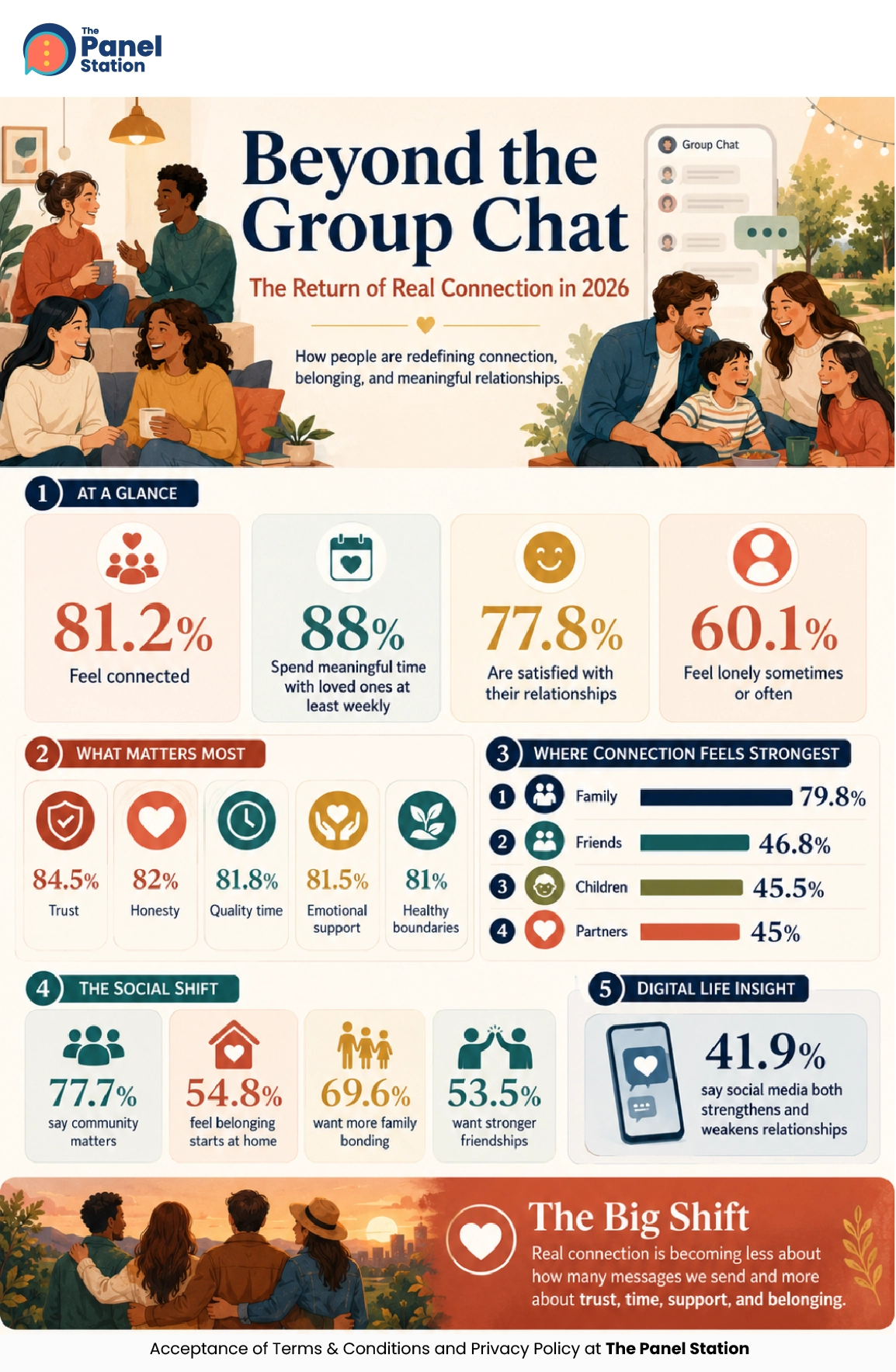
Yet being reachable is not the same as feeling close. More than eight in ten are looking for honest, reliable connections, showing that meaningful relationships still depend on trust and consistency—not just constant contact.
It is possible to exchange messages all day without having a meaningful conversation. People can know what their friends ate, watched, bought, or travelled to without knowing what they are worried about. A relationship can remain digitally active while becoming emotionally quieter.
That contradiction sits at the heart of Beyond the Group Chat: The Return of Real Connection. Drawing on insights from 127,542 respondents across 25 markets, the research explores meaningful time, relationship satisfaction, loneliness, emotional wellbeing, and the changing ways people experience connection.
The original trends report captures the numbers behind this shift. But those findings raise a bigger question: if people have more ways to stay connected than ever before, why can genuine closeness still feel difficult to find?
The answer may lie in recognising that modern relationships need something technology cannot automatically provide: presence.
Why Isn't Staying Connected the Same as Feeling Connected?
Digital communication has solved one of the oldest problems in relationships: distance.
9 out of 10 want meaningful time with people they care for, which means meaningful connections require more than access, they require attention.
People may have regular contact and functioning relationships while still wanting deeper conversations and more shared experiences.The report captures precisely this distinction.
This does not make digital relationships meaningless. Quite the opposite: technology has become an important way of maintaining relationships.
Knowing what someone is doing is different from understanding how they are feeling. Sending a reaction is different from having a conversation. Remaining visible in someone’s digital life does not necessarily create the emotional safety that allows people to speak honestly.
Why Is Presence Becoming More Valuable Than Constant Contact?
Attention has become one of the scarcest resources in modern relationships.
70% believe spending time together improves connection.
A conversation may happen while someone checks notifications. Dinner can be interrupted by messages. Friends can spend an evening together while simultaneously participating in several online conversations. People are physically present but mentally moving between multiple places. That makes undivided attention increasingly noticeable.
The report highlights the continuing importance of meaningful time and face-to-face interaction, where shared experiences and everyday conversations help deepen relationships in ways digital contact alone may not always achieve.
Why Can People Feel Lonely Even When They Have Active Social Lives?
Loneliness is often imagined as physical isolation. Someone may have hundreds of contacts, participate in several group chats, work alongside colleagues, and regularly interact online while still feeling emotionally alone. Around 60% feel lonely, sometimes revealing modern loneliness can look very different.
The Panel Station Survey Report on Social Connections makes this tension particularly visible. Loneliness continues to exist within highly connected lives, suggesting that the number of interactions people have does not necessarily determine whether those interactions feel fulfilling.
This is because loneliness is not always about the absence of people. Sometimes it is the absence of being understood. People need relationships in which they can be honest without constantly performing, explaining, or presenting a polished version of themselves. They need conversations that move beyond updates and into feelings, fears, hopes, and experiences.
Meaningful conversations rarely begin with dramatic questions. More often, they happen when someone feels that the other person is genuinely interested in the answer.
That difference can be surprisingly small.
“How are you?” can function as a greeting that expects “fine.” Or it can become an invitation to talk honestly. The words are identical. What changes is the attention behind them.
Meaningful interaction requires curiosity. It means asking follow-up questions, noticing when someone’s mood changes, remembering what mattered to them last time, and creating enough emotional space for a conversation to go somewhere unexpected.
What Creates Real Connection for You?
Share your perspective and compare what meaningful connection means to others.
Why is Quality Time Becoming More Important Than More Time?
Modern schedules make unlimited time together unrealistic. People work, travel, care for families, manage households, and maintain responsibilities that compete for their attention. Relationships therefore have to exist within lives that are already crowded.
82% believe shared quality time is increasingly important.
A short conversation where both people are genuinely present can sometimes create more connection than several hours spent together while distracted. A regular coffee, walk, shared meal, or phone call can become emotionally significant because it creates consistency.
Are We Expecting More From Our Relationships Than Before?
Relationships today are expected to provide more than companionship. People increasingly look to partners, friends, and family for emotional support, understanding, reassurance, trust, and a sense of belonging.
63% of respondents want honesty in their relationships.
These expectations can make relationships more meaningful, but they can also create pressure. When one person is expected to meet too many emotional needs, disappointment can build quickly.
Strong relationships therefore depend not only on closeness, but also on communication, realistic expectations, and mutual support. The goal is not for one relationship to provide everything, but for people to feel valued, understood, and able to rely on one another when it matters.
Why Do Strong Relationships Need Maintenance?
Relationships rarely disappear overnight. More often, closeness fades quietly. Conversations become shorter. Plans are postponed. Messages replace meetings. People assume that a long history will keep a relationship strong even when they are no longer creating new experiences together.
That is why relationships require maintenance even when nothing appears to be wrong. Maintenance does not need to feel like work. It can mean protecting time for people before calendars become too crowded. It can mean addressing misunderstandings before resentment grows, or continuing to ask questions even when someone feels familiar.
Do you think tomorrow will be safer?
See how your outlook compares with global opinion.
Can Digital Relationships Still Create Genuine Closeness?
The conversation about meaningful connection should not become a simple argument against technology.
Less than one-third respondents strongly believe digital communication has created forms of connection that previous generations could barely imagine.
Families separated by continents can see one another every day. Friendships can survive international moves. Communities can form around interests, identities, and experiences regardless of geography. The question is not whether digital relationships are real.
The more useful question is how technology is being used within them.
Why Does Emotional Safety Matter for Meaningful Connection?
People can spend enormous amounts of time together without becoming emotionally close if they do not feel safe enough to be honest.
More than 50% say emotional safety allows people to admit uncertainty, express disagreement, share worries, and reveal parts of themselves that may not appear in everyday conversation.
It is built gradually through listening without immediate judgement, respecting boundaries, keeping confidences, and responding consistently when someone becomes vulnerable. This kind of safety matters because meaningful relationships require people to move beyond polished versions of themselves.
Why Is Social Neglect Becoming a Growing Concern Today?
Social isolation is not always obvious. A person can be surrounded by colleagues, family members, online contacts, and constant notifications yet still feel that no one is truly checking in, listening, or noticing when something is wrong.
Around 80% want to be a part of a community more than a lifestyle preference.
Modern routines can make this easier to miss. Longer working hours, fragmented families, frequent relocation, digital communication, and increasingly individual lifestyles can reduce the time people spend in meaningful face-to-face interaction.
The concern is not simply about spending time alone. It is about what happens when people begin to feel overlooked or disconnected for long periods. This means communities, families, workplaces, and friendships all play a role in creating the sense that someone is seen, included, and supported.
Will Face-to-Face Connection Become More Valuable as Digital Life Expands?
Digital communication is unlikely to become less important. If anything, technology will continue making communication faster, easier, and more immersive.
45% want to invest time in community make physical presence more valuable.
When digital contact becomes abundant, experiences that cannot be replicated perfectly through a screen can gain emotional significance: sharing food, walking together, celebrating milestones, sitting beside someone during a difficult moment, or simply spending time in the same place without needing a reason.
What Will Meaningful Connection Look Like in the Future?
The future of connection is unlikely to be defined by how many people someone can reach.
The more meaningful measure may be how many relationships allow someone to feel understood, supported, comfortable, and fully present. That requires a different approach to socialising.
Instead of measuring relationships through frequency alone, people may increasingly value emotional quality. Instead of filling every silence with digital contact, they may protect time for uninterrupted interaction. Instead of assuming relationships will maintain themselves, they may become more intentional about nurturing them.
Where Could You Create More Closeness?
Share what would make your relationships feel more meaningful.
Frequently Asked Questions
1. What Are Meaningful Connections?
Meaningful connections are relationships in which people feel understood, valued, supported, and emotionally close. They are built through presence, trust, honest communication, shared experiences, and consistent attention.
2. Why Can People Feel Lonely Even When They Are Constantly Connected?
Frequent communication does not always provide emotional fulfilment. People can interact regularly through messages and social media while still lacking deeper conversations, quality time, or a sense of being genuinely understood.
3. Why Is Face-to-Face Connection Still Important?
Face-to-face interaction allows people to share attention, body language, experiences, and physical presence. These elements can create forms of closeness that digital communication may not always reproduce.
4. What Makes Time Together Meaningful?
Meaningful time usually involves attention and emotional presence rather than simply spending many hours together. Conversations, shared meals, walks, hobbies, and other everyday experiences can strengthen relationships when people are genuinely engaged.
5. How Can People Build Stronger Relationships?
Stronger relationships can develop through consistent quality time, honest communication, active listening, shared experiences, emotional support, and making an effort to remain involved in one another’s lives.
6. Can Digital Relationships Be Meaningful?
Yes. Digital communication can maintain and deepen relationships, particularly across distance. What matters is whether technology supports genuine conversation and emotional connection rather than simply increasing the frequency of contact.
7. What Is Emotional Connection in a Relationship?
Emotional connection is the feeling that another person understands, accepts, and cares about your experiences and emotions. It develops through trust, empathy, vulnerability, and consistent support.
8. Why Does Emotional Safety Matter in Relationships?
Emotional safety allows people to express thoughts, feelings, worries, and disagreements without fearing immediate judgement or rejection. It creates the conditions needed for deeper and more honest relationships.
9. How Can Social Media Affect Meaningful Connections?
Social media can help people maintain relationships and discover communities, but frequent digital contact does not automatically create closeness. Meaningful connection depends on the quality and emotional depth of interactions.
10. What Is the Future of Social Connection?
The report suggests that the future of connection will place greater emphasis on intentional time, clearer communication, emotional presence, and balancing digital convenience with genuine care.