
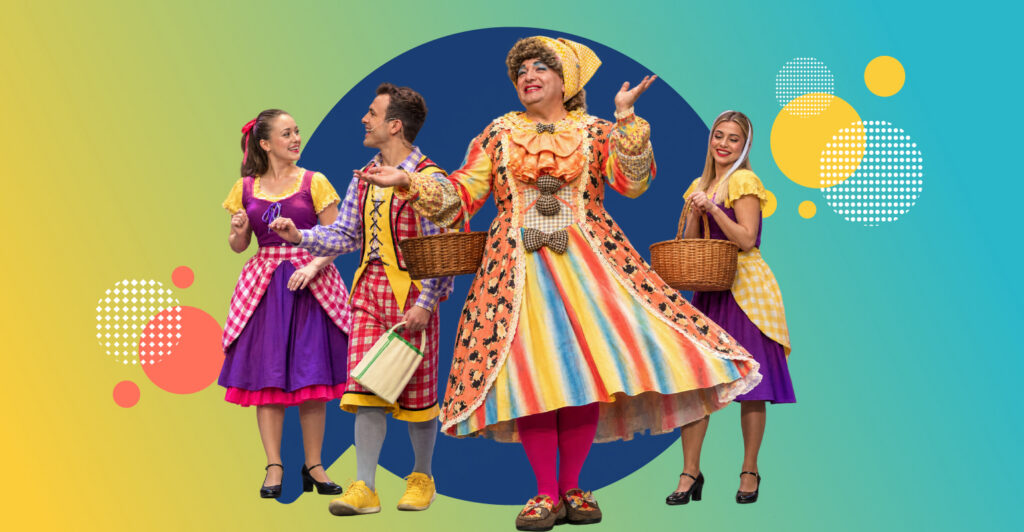
A pantomime, or panto, is a British family theatre show staged mainly over Christmas and New Year. Expect:
- a fairy-tale story;
- a dame in outrageous costumes;
- a villain the audience boos;
- songs and slapstick;
- a great deal of shouting back at the stage.
This guide explains what to expect and where the tradition comes from. It also covers how to choose and book a show without overspending or ending up at the wrong one for your group.
What a British panto is
Every production is different, but most share a familiar set of ingredients.
- A well-known story, loosely told. Classic panto stories include Cinderella, Aladdin, Jack and the Beanstalk, Snow White, Dick Whittington, Sleeping Beauty, Beauty and the Beast, Peter Pan, Puss in Boots and Mother Goose.
- The dame. A comic older woman, traditionally played by a man, with a new costume for almost every scene.
- The principal boy. The young hero, traditionally played by a woman, though many productions now cast a man.
- The villain and the good fairy. The villain is booed on every entrance. By tradition the villain enters from stage left and the good fairy from stage right.
- A comic sidekick. Often the character who befriends the children in the audience and asks them to shout a warning.
- Audience participation. “Oh no it isn’t!” “Oh yes it is!”, “He’s behind you!”, and a song-sheet sing-along near the end.
- Songs and slapstick. Pop songs with new lyrics, messy kitchen scenes and chases.
- Jokes on two levels. Silly gags for children, innuendo meant to go over their heads, and local or topical references for the adults.
Some shows add a panto animal, such as a cow or horse played by two performers in one costume.
Panto and mime are different things
In UK theatre, a panto is a spoken and sung comedy. Mime is performance without words, using gesture and movement alone. The confusion comes from the word itself: in drama classes, and in American English, “pantomime” often means acting out a story silently, as in charades. If you’re booking a Christmas show in the UK, you’ll get the noisy version.
Where pantomime came from
Panto’s roots go back much further than Victorian Christmases.
- The name. It comes from the Greek pantomimos, roughly “one who imitates all”. In ancient Rome, the term described a solo performer who danced every role in a story while a chorus sang.
- Italian street theatre. The modern form owes more to commedia dell’arte, the Italian improvised theatre of the 16th century. Its stock characters, including Harlequin, travelled across Europe.
- Early 18th-century London. Theatres began staging shows that mixed classical stories with comic, largely wordless harlequinades. John Weaver and John Rich are often credited with shaping the form in this period, which is usually treated as the start of English panto.
- The 19th century. The clown Joseph Grimaldi became one of the form’s first big stars. Victorian theatres, especially Drury Lane, then turned panto into lavish Christmas spectacles built on fairy tales. Music-hall performers such as Dan Leno played the dame. Many conventions audiences recognise today settled in this period.
- Today. Large productions with TV and stage names share the season with small community shows, but the fairy-tale stories and the audience’s part in them have stayed at the centre.
When panto season runs and how long a show lasts
Most productions run from late November or early December into early January. The busiest performances fall between mid-December and New Year. A few venues also stage pantos in spring or summer.
A typical show lasts around two to two and a half hours, including an interval. Some venues offer shorter versions designed for under-fives.
When you're choosing a Pantomime performance:
- Evening shows can finish late for young children, so a matinee may suit them better.
- Weekday matinees before schools break up are often popular with school groups. Expect a lively, very young audience.
- Shows after Christmas Day are usually the most in demand, because families are off work and school at the same time.
Choosing the right Pantomime show
The same story can feel very different depending on the venue. Decide what matters most to your group (spectacle, price, the age of your youngest child) before you compare titles.
| Type of production | What you get | Typical cost | Good for |
| Large productions in major city theatres | Big sets, special effects, well-known names | Highest | Special occasions; older children and adults |
| Regional and local theatres | Long-running local traditions, often a returning dame or comic | Mid-range | Families making it a yearly trip |
| Smaller venues and touring shows | Simpler staging, shorter runs | Lower to mid-range | Younger children; tighter budgets |
| Community and amateur pantos | Local casts in village halls and community theatres | Lowest | Budget trips, very young children, supporting local groups |
Panto in London
London has the widest choice, from West End spectaculars to long-running local traditions. The London Palladium has staged a large-scale panto each year since 2016, and Hackney Empire is known for a panto with a strong local following. Theatres across outer London run their own shows too, often at lower prices and with easier travel for families who don’t live centrally. When comparing a West End show with a nearer one, add travel costs and how late you’ll get home.
Finding this year's Pantomime show
Many theatres announce next year’s title during or soon after the current run. For the 2026–27 season:
- Check the websites of two or three theatres within easy reach and sign up for their newsletters for booking dates.
- Compare title, cast, dates and price across them.
- Reviews usually appear after press night in December, but the most popular dates may have sold out by then.
Check the age guidance and content for Pantomime
Most pantos are made for families, but they aren’t all the same. Before booking, check:
- Age guidance. Some venues recommend a minimum age, and policies for babies and under-twos vary.
- Adult-only shows. Pantos made for adult audiences contain explicit humour and carry an age restriction. Titles can look family-friendly, so check the age rating before you book .
- Effects. Loud bangs, pyrotechnics, smoke, strobe lighting and flying effects are common and are usually listed on the show page.
- The front rows. Audiences there may get splashed with water or invited on stage.
Pantomime Booking without overpaying
- Book early for the busiest dates. Weekends and the days after Christmas sell first. Weekday performances and dates early in the run are often cheaper, because prices usually vary by date and time.
- Look for deals. Ask about family tickets, group rates and any preview performances.
- Compare the total price. Include booking, transaction and postage fees, not just the ticket price.
- Buy from the theatre or its authorised agent. Be cautious with resale sites, where tickets can cost well above face value. A seller’s membership of the Society of Ticket Agents and Retailers (STAR) is one sign of a reputable agent.
- Check the seat before paying. Look for restricted views and side angles, and ask whether booster seats are available for children.
- Read the refund and exchange policy. Winter illness is common, and policies vary between venues.
IS PANTO PART OF YOUR CHRISTMAS?
Tell Panel Station how panto fits into your festive plans, and what decides whether you go.
Accessible and relaxed Pantomime performances
Many theatres schedule specific accessible performances during the panto run.
- Relaxed performances. Lower sound and lighting, house lights partly up, a relaxed attitude to noise and movement, and often a quiet space outside the auditorium. They suit autistic people, people with learning disabilities or sensory needs, and many very young children.
- BSL-interpreted performances with a British Sign Language interpreter.
- Captioned performances with the words displayed on screens.
- Audio-described performances, often with a touch tour of the set and costumes beforehand.
These dates are limited and can sell out early. Many venues also run access schemes, which can include reduced-price or free companion tickets. Registering before booking usually makes the process quicker.
On the Pantomime day: what to wear and what to bring
- Wear something comfortable. There’s no dress code. Bring layers, because theatres can be warm once you’re inside.
- Dress up if you like. Festive jumpers and costumes are welcome at many shows. Avoid tall hats or headwear that block the view behind you.
- Arrive early. Leave time for bag checks, toilets and collecting booster seats.
- Agree a budget for extras. Decide in advance what you’ll spend on programmes, interval ice creams and light-up toys. These add up quickly for a family.
- Bring ear defenders for children who are sensitive to noise.
- Check the venue’s policy on bringing your own food and drink.
Before you book: a quick checklist
- ☐ Show suits the ages in your group (adult-only versions ruled out)
- ☐ Performance time works for your youngest
- ☐ Buying from the theatre or an authorised agent
- ☐ Total price compared, including fees
- ☐ Seat view checked
- ☐ Access needs booked
- ☐ Refund and exchange policy read
- ☐ Budget for extras agreed
Planning your panto trip
Start with who’s going and what they’ll enjoy, then shortlist two or three theatres within easy reach and compare their dates and total prices. Book the busiest dates early, and check the age guidance before you pay. Panto is meant to be loud and silly, so choosing the right show for your group matters more than choosing the biggest one.
MORE TO SAY ABOUT THE FESTIVE SEASON?
Join Panel Station to receive invitations to surveys on everyday topics, from how people celebrate to how they spend.
Frequently Asked Questions
Q1: Is panto suitable for toddlers?
It can be, but choose carefully. A full show of two hours or more with loud effects is a lot for a two- or three-year-old. Some venues run shorter versions or relaxed performances that suit very young children better. Check the venue’s age guidance and its policy on babies before you book.
Q2: Do adults go to panto without children?
Yes. Evening performances often have plenty of adult groups, because the jokes are written to work on two levels. Some venues also stage adult-only pantos with an age restriction. These are a different show, so check which version you’re booking.
Q3: Where does the word "panto" come from?
“Panto” is short for a much older theatre term from the Greek pantomimos, meaning roughly “one who imitates all”. In ancient Rome, the term described a performer who acted out every role in a story. The meaning shifted over the centuries until, in Britain, it became the name for the Christmas family show.
Q4: What happens if my child is picked to go on stage?
Usually a short, friendly moment, often near the end with a sing-along or a quick chat with the comic. Performers are used to nervous children, and you can politely decline if your child doesn’t want to go. Seats near the front and on the aisles are the most likely to be picked.
Q5: Can I take photos or film during the show?
Generally not during the performance itself, because it distracts performers and other audience members and may breach copyright. Some theatres allow photos during the curtain call or the final song. Check the venue’s policy or ask front-of-house staff.
Q6: How early should I book for the week between Christmas and New Year?
As early as you can, ideally when tickets first go on sale. These dates are usually the most popular, and the best-value seats tend to go first. If you’re booking late, weekday performances in early December or early January usually offer more choice.
Q7: Is there panto outside Christmas?
Occasionally. A few theatres and touring companies stage spring or summer pantos, but most productions run from late November or early December into January.