What if the biggest fashion trend of 2026 is not a colour, silhouette, fabric, or designer—but the freedom to dress like yourself?
For years, fashion has been built around cycles. Something becomes desirable, reaches the mainstream, appears everywhere, and eventually gives way to the next look. Consumers still notice these shifts, but their relationship with fashion is becoming less obedient.
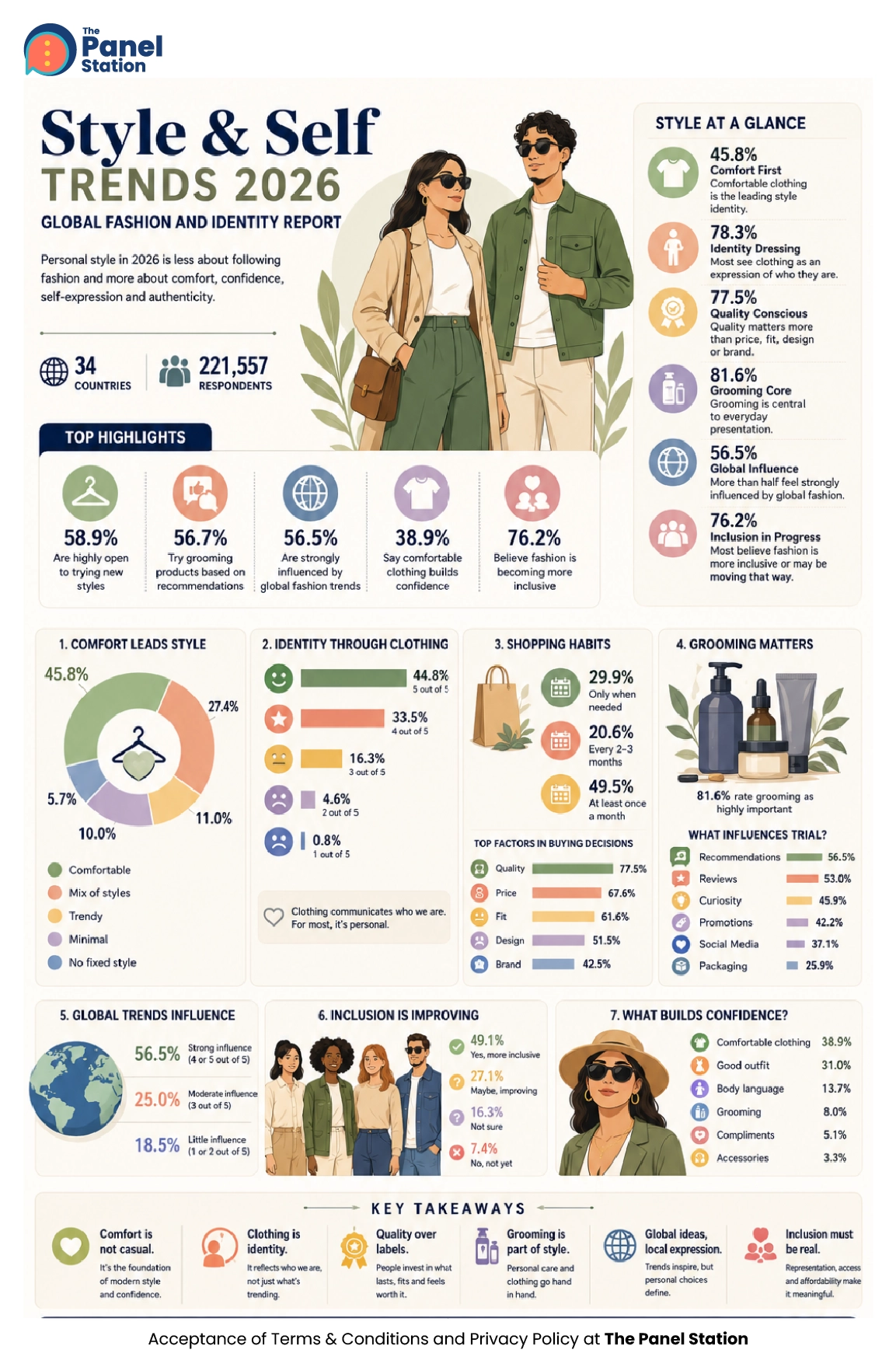
The related Style & Self Trends 2026 report from The Panel Station, based on 221,557 completed responses across 34 countries, captures this change clearly.
Comfort fashion preceeds style which points towards something bigger than a preference for comfortable clothes. They suggest consumers are gaining greater authority over what style means to them.
People are still inspired by fashion. They are simply becoming more selective about what earns a place in their wardrobes, grooming routines, and everyday identities.
Why Is Comfort Becoming a Form of Confidence?
Comfort used to be treated as the opposite of fashion. Something could be stylish or practical, glamorous or comfortable, appropriate for an occasion or easy enough to wear all day. That division is becoming harder to maintain.
Today, comfort is the leading style description at 45.8%.
Consumers describe their personal style as comfortable, making it the leading style identity. This does not mean consumers have stopped caring about appearance. It means their definition of looking good is becoming connected with feeling good.
A garment that looks impressive but restricts movement, requires constant adjustment, or feels disconnected from everyday life may no longer deliver the confidence it promises. In contrast, something that fits well, feels natural, and works across different settings can make the wearer feel more secure.
Is Identity Replacing Trend-Following as the Purpose of Fashion?
Fashion has always communicated something. It can signal profession, community, taste, culture, status, mood, personality, or belonging. What is changing is who gets to decide what those signals should mean.
78.3% see clothing as an important part of expressing identity
A person may wear traditional clothing one day, athleisure the next, formal clothing for work, and something experimental for an evening out. None of those choices necessarily cancels the others.
Identity today is often layered, and wardrobes are becoming layered too. Consumers do not always want to fit neatly into a single aesthetic such as minimalist, streetwear, classic, luxury, trendy, or casual.
What Does Your Style Say About You?
Take The Survey And Share The Choices That Make You Feel Most Confident.
Compare Your Style Profile With Consumers Across 34 Countries.
Why Is the Fashion Purchase Becoming More Considered?
The way consumers shop provides another clue about how style is changing. Frequency alone, however, does not reveal what people expect from those purchases.
Brand names still matter, but they are competing with more immediate questions: Will this last? Is it worth the price? Does it fit properly? Will I actually wear it?
Consumers have access to more options than ever, making brand recognition alone less powerful. Online marketplaces, direct-to-consumer businesses, resale platforms, international retailers, and social commerce have expanded the competitive field.mWhen alternatives are easy to discover, usefulness becomes a powerful filter.
Fashion needs change to remain interesting, and consumers have not lost their appetite for something new. Experimentation today appears selective rather than automatic.
Consumers can be curious about fashion while maintaining strong boundaries around what they will actually wear. A runway look, celebrity outfit, or social trend may capture attention without immediately becoming a purchase.
The question becomes: can this idea fit into my life? Wearability is increasingly the bridge between inspiration and adoption.
Can Red-Carpet Fashion Still Influence Consumers in the Age of Social Media?
The red carpet once offered one of the clearest routes from celebrity fashion to consumer aspiration. A memorable dress, suit or styling choice could dominate magazines and entertainment coverage for days. Social media has changed that influence rather than eliminated it. Red-carpet looks now appear alongside creator content, street style, brand campaigns and millions of everyday outfits competing for attention in the same feed.
What has changed most is the way consumers respond. People do not necessarily want to recreate an entire celebrity look. They may take inspiration from a colour, silhouette, hairstyle, accessory or styling detail and adapt it to their own wardrobe. A highly theatrical outfit can therefore influence everyday fashion through smaller, more practical interpretations.
How Did Grooming Become Part of the Same Style Conversation?
Grooming has become part of everyday expression with 9 in 10 saying it plays an important part. Personal style no longer ends at the wardrobe door.
Consumers often experience these categories as part of one routine rather than separate industries. The same person deciding what to wear may also be deciding how to style their hair, which skincare products to use, whether to wear fragrance, or how polished they want to appear for a particular setting.
Confidence can come from the combination. The strongest grooming brands may be those that combine excitement with evidence.
Are Global Fashion Trends Making Everyone Look the Same?
Fashion travels faster than almost any previous generation could have imagined. More than 55% are strongly influenced by global fashion trends.
Consumers still filter global trends through climate, culture, affordability, modesty preferences, work environments, body type, comfort, and local ideas of what feels appropriate.
The same trend can therefore take dozens of forms. Consumers are increasingly participating in a continuous exchange. Local styles can become global inspiration, while international trends are reinterpreted locally and sent back into the wider fashion conversation.
The future may therefore be less about global fashion replacing local identities and more about both constantly influencing one another.
How Are Runway Trends Finding Their Way Into Everyday Wardrobes?
Runway fashion may begin with dramatic silhouettes, bold styling and statement pieces, but its influence often reaches consumers in much smaller ways. Most people are unlikely to recreate a head-to-toe catwalk look. Instead, they pick up individual elements such as a colour, fabric, shape, print or accessory and work them into clothes they already own.
Social media has made this translation faster. Fashion-week looks can move from the runway to short videos, creator styling posts and retailer collections within days, giving consumers more ways to see how an idea might work outside a fashion show. What begins as an exaggerated concept can quickly become a more wearable version suited to work, weekends or everyday routines.
Why Is the Idea of a ‘Perfect Look’ Losing Its Influence?
For a long time, fashion encouraged people to work towards an ideal: the right outfit, the right body shape, the right brands, or whatever happened to be trending at the time. That idea is becoming harder to sustain.
77.5% say quality strongly influences what they buy.
Consumers are exposed to a much wider range of styles, cultures, body types and aesthetics, making it increasingly difficult for one definition of the “perfect look” to dominate. Instead, people are becoming more comfortable deciding what looks and feels right for them.
An outfit does not have to be flawless, expensive or trend-led to feel successful. Comfort, fit, personality and suitability for everyday life can matter just as much as appearance.
Social media may still create pressure to present a polished image, but it has also made countless individual styles more visible. The result is a more flexible idea of fashion, where looking good is becoming less about meeting a universal standard and more about feeling comfortable and recognisable in your own clothes.
When Does Fashion Inclusion Become Something Consumers Can Actually Feel?
Representation in advertising is visible, but consumers also encounter fashion through fitting rooms, size charts, online filters, product availability, price, models, store layouts, and whether clothing actually works for their bodies and lifestyles.
More than 75% say fashion has become more inclusive.
Inclusive campaigns mean less if consumers still cannot find their size. Representation matters less if products are technically available but unaffordable. The next stage of inclusive fashion may therefore be less about making statements and more about removing friction.
That includes broader sizing, better fit information, adaptable products, representative imagery, cultural awareness, accessible design, and price points that allow more consumers to participate. The brands that succeed will make inclusion feel normal rather than exceptional.
When Does Fashion Inspiration Become Trend Pressure?
Social media has made fashion inspiration almost constant. A scroll through a feed can introduce someone to new colours, silhouettes, styling ideas and brands within minutes. That accessibility can make fashion feel more creative and inclusive, giving people more ways to experiment and discover looks they might never have encountered otherwise.
But inspiration can begin to feel like pressure when trends move faster than people can realistically follow them. Repeated exposure to viral outfits, new aesthetics and carefully curated wardrobes can create the impression that staying stylish requires constant change. Clothes that felt perfectly relevant a few months ago may suddenly appear dated simply because something new is dominating the feed.
What Will Define Personal Style Beyond 2026?
The future of style may be defined less by what consumers are told to want and more by what they refuse to compromise on.
Fit remains essential. Consumers want the freedom to experiment, but they increasingly expect trends to adapt to them rather than the other way around.
Grooming will continue to become part of a broader personal presentation system. Global inspiration will travel quickly, but local identity will continue reshaping it. Inclusion will be judged by real access rather than visibility alone.
Most importantly, consumers appear increasingly comfortable with the idea that personal style does not need to remain consistent. The wardrobe of the future may therefore contain fewer rules and more reasons.
Why did you buy this? Because it fits well. Because it lasts. Because it feels like you. Because it makes you confident. Because it works for your life. Those answers may ultimately matter more than whether something appeared on a trend forecast.
Frequently Asked Questions
1.What is the biggest personal style trend in 2026?
Comfort is one of the clearest shifts, with 45.8% describing their style as comfortable. However, the broader trend is personalisation: consumers are combining comfort, identity, quality, and selective experimentation.
2.Is fashion becoming less important to consumers?
No. Around 78.3% rate clothing highly as an expression of identity. Consumers still care about fashion, but they increasingly want it to fit their individual lives rather than follow rigid rules.
3.What matters most when people buy clothes?
Quality leads at 77.5%, followed by price at 67.6% and fit at 61.6%. Brand ranks lower at 42.5%, suggesting practical value often outweighs recognition alone.
4.Are consumers still interested in trying fashion trends?
Yes. Around 58.9% show high willingness to try new styles. However, consumers are more likely to adopt trends that feel wearable, comfortable, and adaptable.
5.How important is grooming to personal style?
Grooming is highly important to 81.6% of respondents. Clothing and personal care increasingly work together as part of how consumers manage appearance and confidence.
6.What influences people to try new grooming products?
Recommendations lead at 56.7%, followed by reviews at 53%. Curiosity, promotions, social media, and packaging also encourage experimentation.
7.How influential are global fashion trends?
Recommendations lead at 56.7%, followed by reviews at 53%. Curiosity, promotions, social media, and packaging also encourage experimentation.
8.Is fashion becoming more inclusive?
Around 49.1% say yes and another 27.1% say it may be. Progress is visible, but sizing, affordability, accessibility, representation, and cultural relevance will determine whether inclusion feels meaningful.
9.Does comfort mean consumers care less about appearance?
Not necessarily. Comfort increasingly contributes to confidence. Consumers often want clothes that look good while allowing them to move naturally and function across everyday settings.
10.What will shape the future of personal style?
The strongest influences are likely to be comfort, quality, individuality, flexible wardrobes, grooming, global-local inspiration, and wider inclusion.