
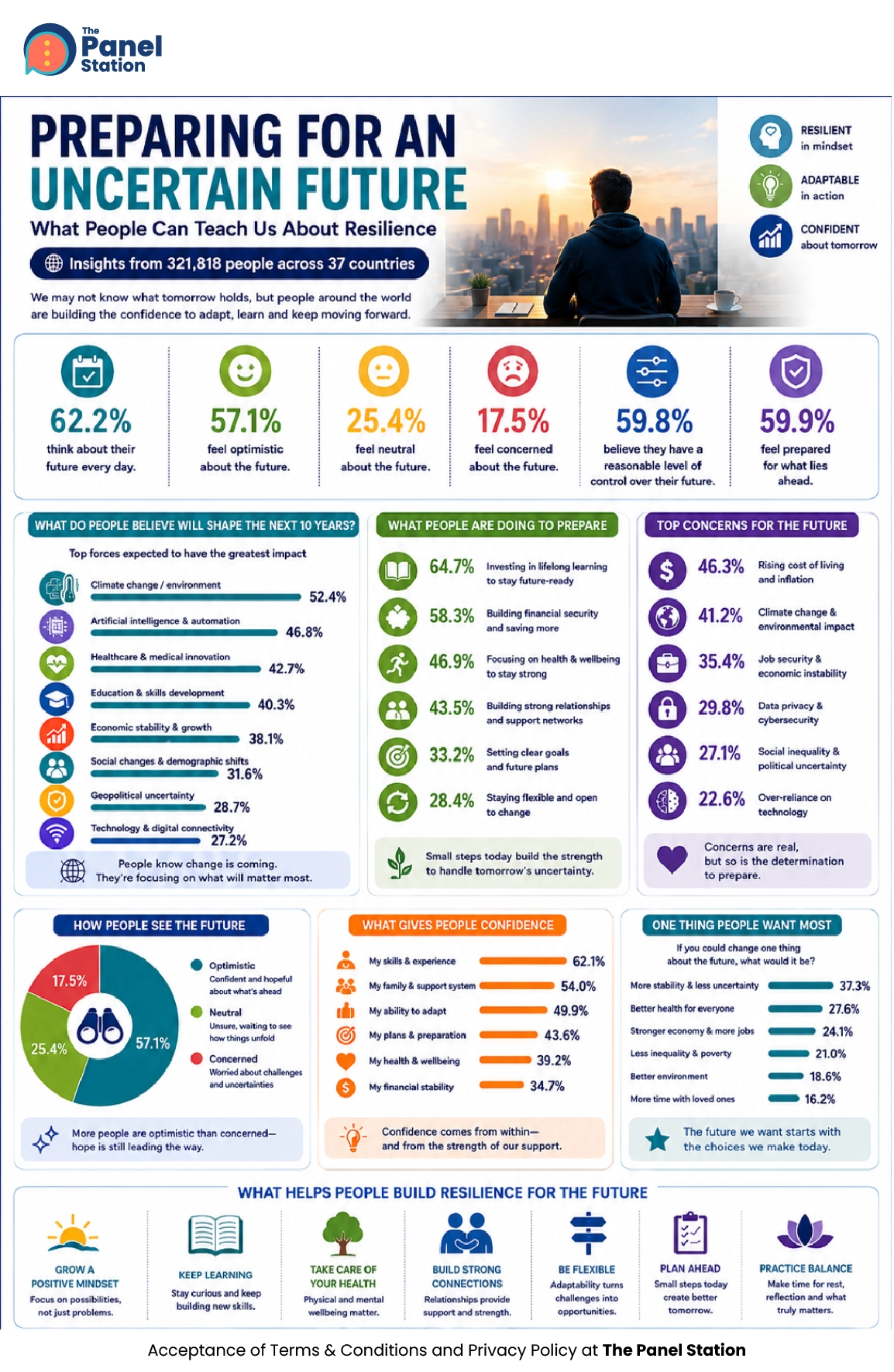
The future has always been uncertain, but uncertainty feels much closer to everyday life now. Technology is changing the way people work, economic pressures influence financial decisions, climate concerns shape long-term thinking, and new skills can become valuable almost overnight. What happens next may be impossible to predict precisely, but people are still making decisions every day based on what they believe the future might require.
Nearly two in three are building greater security for an uncertain future, showing how uncertainty is shaping the way people think ahead.
Someone might save more money, learn a new skill, invest in better health, reconsider a career path, or strengthen relationships that provide support during difficult periods. None of these choices can guarantee a particular outcome, but together they can make uncertainty feel more manageable.
Panel Station’s global research on Uncertain Future explored how often people think about the future, how optimistic they feel, how much control they believe they have, and how prepared they feel for what may come next. The bigger lesson behind those findings is about resilience: people may not know exactly what is coming, but many are choosing to prepare rather than wait for certainty.
Why Are People Still Optimistic About an Uncertain Future?
One of the most encouraging themes emerging from the research is that uncertainty has not erased people’s sense of possibility.
With only 18% feeling pessimistic about the future, optimism clearly outweighs concern, pointing to a broadly positive outlook despite uncertainty.
Even as technology, economic pressures, climate concerns, and changing workplaces reshape everyday life, many people still appear to approach the future with hope rather than fear.
What makes this optimism interesting is that it does not depend on believing everything will become easier. Instead, it seems rooted in confidence that people can learn, adjust, and find new ways forward when circumstances change.
That makes optimism less about predicting a positive future and more about trusting one’s ability to navigate an unpredictable one.
How Prepared Do You Feel?
Share your view and compare how people approach the future.
Why Has Future Planning Become Part of Everyday Life? t
Thinking about the future is no longer reserved for major milestones such as buying a home, choosing a career, or preparing for retirement. For around 65% of the people, future planning has become a way of life.
Smaller decisions from managing money and developing new skills to prioritising health and considering new opportunities are regular parts of everyday routine.Rather than creating a fixed plan and expecting life to follow it, people are learning to prepare while leaving room for circumstances to change.
The goal is not to have every stage mapped out in advance, but to make choices today that create more options tomorrow. In an uncertain world, that flexibility may be more useful than having a perfect long-term plan. The strongest preparation gives people direction without making them dependent on everything unfolding exactly as expected.
Can People Feel in Control Without Knowing What Comes Next
Feeling in control of the future does not mean believing every outcome can be predicted or managed. More often, it comes from knowing that there are still meaningful choices to make, even when larger forces remain uncertain.
60% of respondents believe they have certain control over the future.
Even though people cannot control economic cycles, technological disruption, climate events, or geopolitical change, they can, however, decide how they respond. Learning new skills, strengthening finances, protecting health, building supportive relationships, and staying open to new opportunities can all create a stronger sense of agency.
This is where personal confidence and emotional resilience become especially important.
Why Is Adaptability Becoming More Valuable Than Certainty?
For much of modern life, stability was considered the ideal. People sought predictable careers, clear professional paths, stable institutions, and long-term plans that could be followed with confidence.
Around 50% are willing to adapt to changes indicating that older habits of thinking will become harder to maintain as the future evolves.
Technology can reshape jobs quickly. New industries emerge while others decline. Economic conditions can change priorities, and social expectations continue to evolve. In this environment, adaptability can provide a different kind of security.
Being adaptable does not mean constantly changing direction. It means being willing to reassess assumptions when new information appears. It means learning without feeling that previous knowledge has become worthless, and it means recognising when a plan needs to evolve rather than treating change as failure.
The numbers from the research indicate three-fourths of respondents believe in life-long learning. The findings emphasise education, technology, healthcare innovation, and artificial intelligence as important forces shaping the years ahead.
The traditional model of learning first and working later is becoming less realistic. Skills that were valuable at the beginning of a career may need to be updated, expanded, or replaced several times over a working life. That makes curiosity and willingness to learn increasingly important personal assets.
Lifelong learning also supports confidence. People who believe they can acquire new knowledge may feel less threatened by change because they do not see their current abilities as fixed.
The value of learning, therefore, goes beyond employability. It strengthens adaptability. It gives people more options, and having options can make uncertainty feel less limiting.
Why Does Financial Preparedness Matter So Much When the Future Feels Unclear?
Uncertainty often becomes most tangible when it reaches household finances. A job change, unexpected expense, rising living costs, or economic slowdown can quickly turn an abstract concern about the future into a practical problem.
More than 60% of people say they are making themselves financially secure for future uncertainties.
This is why financial preparedness plays such an important role in resilience. Savings, manageable debt, careful spending, and financial literacy can create a buffer between unexpected change and immediate crisis.
Financial resilience is not about eliminating uncertainty. Few people can prepare for every possibility. It is about creating enough flexibility to make better choices when circumstances shift.
That flexibility matters because financial pressure can reduce options at exactly the moment people need them most. Greater preparedness can make it easier to retrain, relocate, change roles, or absorb a temporary setback without making decisions entirely from fear.
Do you think tomorrow will be safer?
See how your outlook compares with global opinion.
Why Are Relationships Part of Future Readiness?
Preparation is often discussed as an individual responsibility, but resilience is rarely built alone. Strong relationships can provide emotional support, practical help, advice, and perspective when circumstances change.
Around 55% feel a strong support system is a must to build confidence for an uncertain future.
This matters because uncertainty affects more than plans. It can affect confidence. During periods of disruption, people often need reassurance that they are not navigating change in isolation.
Family, friends, colleagues, mentors, and communities can become part of a person’s resilience network. They provide knowledge that an individual may not have, connections that open new opportunities, and emotional support that makes difficult decisions easier to manage.
Preparing for the future, therefore, is not simply about becoming more self-reliant. It can also mean becoming better connected.
Why Does Emotional Resilience Matter as Much as Practical Planning
Not every challenge can be solved immediately. Some uncertainty has to be lived with for a period of time, and that is where emotional resilience becomes particularly important.
Half of the respondents say they are able to adapt to uncertainty and be emotionally resilient for the future.
A person may have a strong financial plan, valuable skills, and supportive relationships but still struggle if uncertainty creates constant anxiety or prevents clear decision-making. Emotional resilience helps people tolerate ambiguity without becoming overwhelmed by it.
In practical terms, emotional resilience may involve rest, strong relationships, realistic planning, healthy routines, and the ability to step away from constant streams of alarming information. Preparing for the future is easier when the present remains manageable.
Do you think tomorrow will be safer?
See how your outlook compares with global opinion.
What Can Businesses and Employers Learn About Resilience
The responsibility for resilience does not sit only with individuals. Organisations also shape how prepared people feel for change.
Around 40% of respondents are aware of job uncertainty and economic instability. This makes employers rethink about learning, clear communication during periods of uncertainty, and help employees understand how technology will affect their roles. Businesses that create adaptable systems are also better positioned to respond when market conditions shift.
Resilience therefore becomes a shared capability. Individuals build it through skills and planning, while organisations strengthen it by creating environments where people can adapt without feeling abandoned by change.
What Does Preparing for the Future Really Mean?
Perhaps the biggest lesson from the research is that the future does not need to become predictable for people to feel more prepared. The data suggests that many respondents already understand this. They think about what lies ahead, remain broadly optimistic, and believe they have some ability to influence their future despite recognising that larger forces remain outside their control.
That is a more realistic definition of preparedness. It does not rely on having the correct forecast. It relies on having enough flexibility to respond when the forecast is wrong.
What Helps You Face Change?
Share your perspective and see what gives others confidence.
If you would like to explore the complete research behind these insights, read The Future Lens Trends 2026: Global Outlook and Readiness Report for the full survey findings and the broader picture of how people are thinking about tomorrow.
Frequently Asked Questions
1. What Does Preparing for an Uncertain Future Mean?
Preparing for an uncertain future means developing the skills, habits, resources, and mindset needed to respond effectively when circumstances change. It combines planning with flexibility rather than relying on perfect predictions.
2. Why Is Resilience Important When the Future Is Uncertain?
Resilience helps people recover from setbacks, manage uncertainty, and adjust their plans without losing confidence. It allows people to respond to change rather than becoming overwhelmed by it.
3. How Can People Prepare for Future Uncertainty?
People can prepare by improving financial stability, learning continuously, looking after their health, strengthening relationships, setting goals, and remaining flexible when plans need to change.
4. Why Is Adaptability Important for the Future?
Adaptability helps people respond to changing technology, workplaces, economic conditions, and personal circumstances. It creates options when familiar plans no longer work.
5. How Does Lifelong Learning Build Resilience?
Lifelong learning keeps skills relevant and helps people develop confidence in their ability to handle unfamiliar situations. It can also create new professional and personal opportunities.
6. Why Does Financial Preparedness Reduce Uncertainty?
Financial preparedness creates a buffer when unexpected costs, job changes, or economic pressures arise. Greater financial flexibility can give people more choices during periods of disruption.
7. How Do Relationships Support Personal Resilience?
Strong relationships provide emotional support, practical assistance, advice, and access to different perspectives. They can make difficult transitions easier to manage.
8. What Is Emotional Resilience?
Emotional resilience is the ability to manage stress, uncertainty, and setbacks without becoming overwhelmed. It supports clearer thinking and more balanced decision-making during periods of change.
9. Can People Feel Optimistic Without Knowing What the Future Holds?
Yes. Optimism does not require certainty. People can remain hopeful because they trust their ability to learn, adapt, seek support, and respond to changing circumstances.
10. What Is the Biggest Lesson from Panel Station's Future Research?
The broader lesson is that preparedness comes from adaptability rather than prediction. People may not be able to control every future event, but they can strengthen the skills and resources that help them respond with greater confidence.