

We can reach almost anyone in seconds.
A message travels instantly. Family groups stay active throughout the day. Friends separated by countries can see what is happening in each other’s lives. Birthdays are remembered by apps. Photographs are shared immediately. A conversation can continue across different cities, time zones and even continents.
By almost every practical measure, maintaining contact has become easier.
And yet, something does not quite add up.
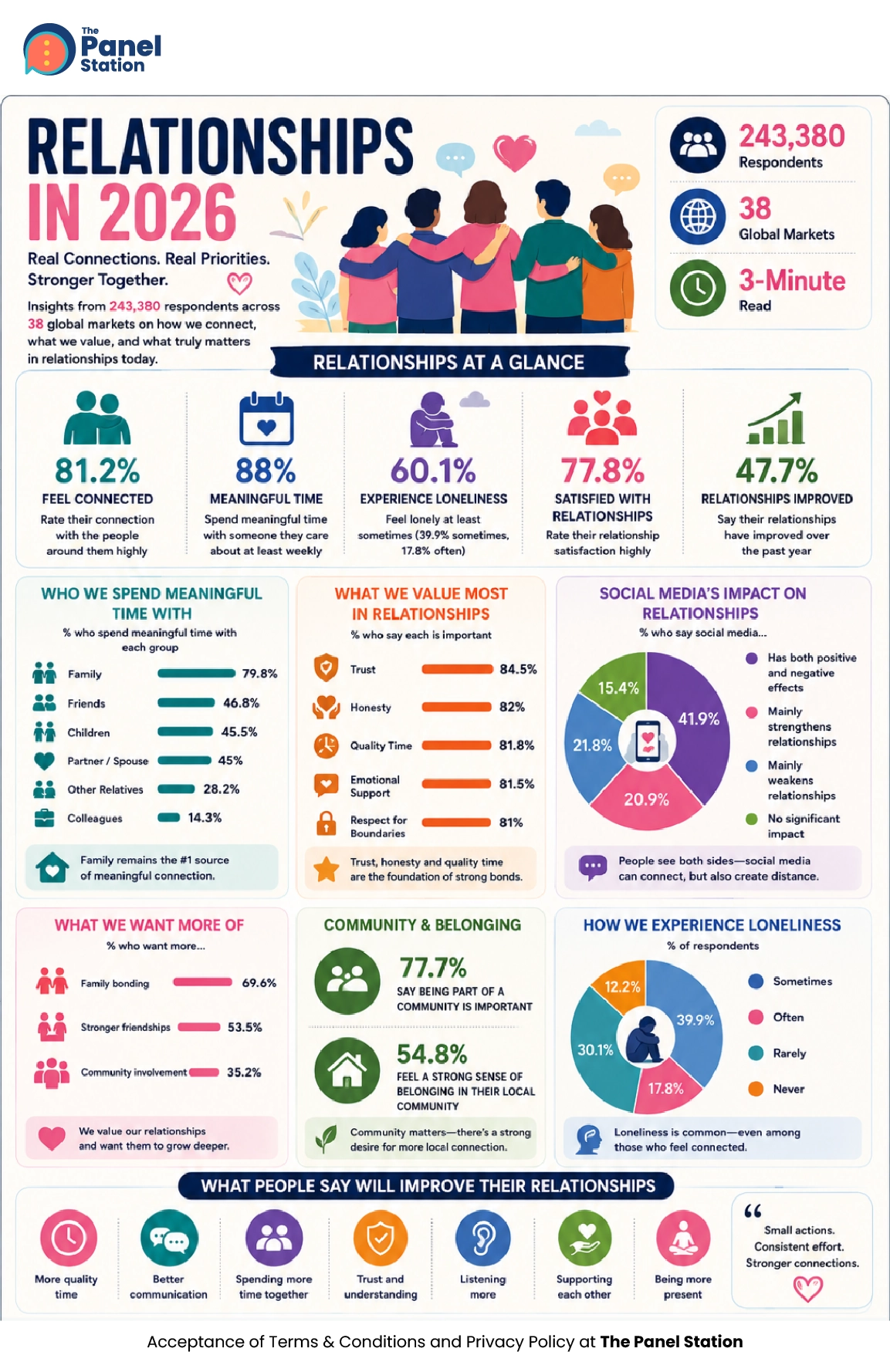
81.2% rate their connection with the people around them highly, and 88% spend meaningful time with someone they care about at least weekly. Those numbers suggest relationships remain a strong part of everyday life.
But another finding complicates the picture: 60.1% experience loneliness at least sometimes.
How can people feel connected and lonely at the same time? Perhaps because modern relationships are revealing an important distinction. Being in contact is not the same as feeling understood.
People can have hundreds of contacts and still want someone to talk to. A family can exchange messages throughout the day without sitting together for a meaningful conversation. Friends can know what each other did over the weekend without really knowing how the other person is feeling.
This is one of the contradictions shaping relationships in 2026: contact is abundant, but closeness still requires work.
The wider Relationships & Realities Trends 2026 research captures this tension particularly well across 243,380 respondents in 38 global markets.
Why Can We Feel Connected and Lonely at the Same Time?
Loneliness is easy to imagine as physical isolation. Someone lives alone, they rarely see friends, and have nobody to call.
But modern loneliness can look very different. It can happen in a crowded home, an active workplace, a busy group chat or a relationship that functions perfectly well on the surface.
The data illustrates this emotional middle ground.
While overall connection is high, the underlying research shows that 39.9% say they sometimes feel lonely and 17.8% experience loneliness often.
This suggests that loneliness cannot be understood simply by counting how many people surround someone. What may matter more is the quality of those interactions.
The question for modern relationships, therefore, is becoming less about “How often do we communicate?” and more about “What happens when we do?”
Is Quality Time Becoming More Valuable Because Attention Is Harder to Give?
Time together has always mattered. What has changed is the competition for our attention.
A conversation today can happen alongside notifications, work emails, television, social feeds and several other things competing for the same mental space. That makes undivided attention surprisingly valuable.
The survey provides a strong signal here: 88% spend meaningful time with someone they care about at least weekly.
And when people describe what they value in relationships, quality time reaches 81.8%, placing it alongside trust, honesty and emotional support.
Meaningful time does not necessarily require elaborate plans. The value lies less in the activity than in the attention. This may explain why small relationship rituals matter so much. Regular meals, weekly calls, morning conversations or weekend routines create predictable spaces where connection can happen without needing to be scheduled as a major event.
Why Does Family Still Sit at the Centre of Connection?
The structure of family life has changed considerably.
People move further from home, households are smaller in many places, careers can separate relatives geographically. Families communicate through screens as often as they meet physically. Yet family remains remarkably important.
When respondents were asked who they spend meaningful time with, family leads at 79.8%, considerably ahead of friends at 46.8%, children at 45.5%, partners or spouses at 45%, other relatives at 28.2% and colleagues at 14.3%.
This does not mean family relationships are always easy. Family can involve responsibility, disagreement, expectation and emotional complexity. But it also provides something that many other relationships cannot easily reproduce: continuity.
Do you think tomorrow will be
See how your outlook compares with global opinion.
Friendships often provide something different from family or romantic relationships. They can create spaces where people share interests, identities and experiences outside their immediate responsibilities.
But friendships need maintenance. As adults move cities, change jobs, raise families or simply become busier, spontaneous time together becomes harder. Relationships that once developed naturally through school, university or early workplaces may increasingly require deliberate effort.
Yet 53.5% of respondents say they want stronger friendships.
A strong friendship may not involve speaking every day. Two people may see each other only occasionally and still feel deeply connected. Frequency matters less when the relationship retains emotional safety—the feeling that a conversation can restart honestly even after time apart.
Perhaps the modern challenge is not maintaining every friendship equally. It is recognising which ones matter enough to protect.
Has Social Media Strengthened Relationships or Made Them Shallower
There is no simple answer, and respondents seem to recognise that.
Around 41.9% say social media has both positive and negative effects on relationships, while 20.9% believe it mainly strengthens them, 21.8% say it weakens them and 15.4% see little impact.
That mixed response reflects how digital connection works in practice. Social media can help families stay close across distances, reconnect old friends and create communities around shared interests. But it can also create a sense of closeness without necessarily creating emotional depth.
Seeing someone’s photographs, reacting to a story or knowing what they are doing is not the same as understanding how they feel.
The real question may therefore be less about whether social media is good or bad for relationships and more about what we expect it to replace. Digital communication is highly effective at maintaining contact, but meaningful connection still depends on conversation, trust and genuine attention.
Do you think tomorrow will be safer?
See how your outlook compares with global opinion.
What Do People Actually Want From Their Relationships?
Despite major changes in how relationships are formed and maintained, the qualities people value most remain remarkably traditional.
Trust leads at 84.5%, followed by honesty at 82%, quality time at 81.8%, emotional support at 81.5% and respect for boundaries at 81%.
What stands out is what does not make the list: popularity, constant communication or grand gestures. Instead, people value what makes relationships feel secure—trust, honesty, quality time, emotional support and healthy boundaries.
Closeness no longer means constant access. Strong relationships increasingly balance connection with individuality. A meaningful relationship, then, may not be one where people share everything or remain endlessly available. It may simply be one where trust, support, honesty and independence can coexist.
Why Is Community Important When Personal Relationships Already Exist?
Relationships extend beyond family, partners and friends; people also need to feel part of something larger.
While 77.7% say community is important, only 54.8% feel a strong sense of local belonging, revealing a clear gap between what people value and what they experience.
Modern life can make that harder. Remote work, online shopping, frequent moves and screen-based entertainment reduce the everyday encounters that once built familiarity with neighbours and local communities.
Yet community offers something close relationships cannot always replace: a wider sense of belonging, recognition and social security. As more of life moves online, feeling rooted in a physical community may become even more valuable.
Do you think tomorrow will be safer?
See how your outlook compares with global opinion.
Are Better Relationships Built Through Big Changes or Small Habits?
Improving relationships does not always require dramatic gestures.
The research repeatedly points to quality time, better communication, trust, understanding, listening and being more present.
These are small behaviours, but their impact is cumulative. Putting the phone away, checking in after a difficult week, remembering what matters or simply listening can gradually build trust and emotional safety.
Relationships often grow stronger through consistency rather than intensity. In the same way, distance rarely appears overnight; it develops through repeated moments of postponement, distraction and disconnection.
Can a Relationship Be Stable Without Being Fulfilling?
One of the more interesting findings is the gap between satisfaction and change.
While 77.8% rate their relationships highly, only 47.7% say they have improved over the past year, and 35.7% report little change.
That is not necessarily negative. Strong relationships often feel successful because they are steady. But stability can sometimes hide emotional drift, where people remain in contact while sharing less of what really matters.
This makes satisfaction only part of the picture. A more revealing question may be: Do the people closest to you know what is happening inside your life, or mainly what is happening around it?
Are Relationships Becoming More Important as the Rest of Life Becomes Less Certain?
As work, technology, cities and economic conditions change, relationships can provide something increasingly valuable: continuity. They offer comfort, stability, emotional support and belonging when other parts of life feel less predictable.
But that also creates pressure. No single partner, friend or family member can meet every emotional need, which makes different layers of connection increasingly important—from close relationships and friendships to colleagues, neighbours and communities.
A strong social life, then, may not be about having the biggest network. It may be about having enough different kinds of connection that no single relationship has to carry everything.
Will Presence Become More Valuable in a More Digital World?
The future of relationships will almost certainly be more digital. Technology will make it easier to stay connected across distances and maintain relationships that might once have faded.
But as contact becomes easier, presence may become more valuable. The strongest relationships may be those where people know when to move beyond the message—to call instead of react, meet instead of scroll and listen without multitasking.
The Relationships & Realities Trends 2026 findings capture this tension. Most people feel connected and spend meaningful time with those they care about, yet loneliness remains common. The lesson is clear: more contact does not automatically create deeper connection.
We may not need more people in our lives. We may simply need to be more present with the people already there.
Where in your life do you have plenty of contact but not enough closeness?
Share your experience with The Panel Station and see how others are redefining connection.
Frequently Asked Questions
1. What are the biggest relationship trends in 2026?
Relationships are becoming more intentional. People increasingly value trust, quality time, emotional support, honesty and meaningful presence rather than simply frequent communication. Digital contact remains important, but people also want deeper face-to-face connection.
2. Are people generally feeling connected?
Yes. 81.2% rate their connection with people around them highly, while 88% spend meaningful time with someone they care about at least weekly.
3. Why are people lonely if they are connected?
Connection and emotional fulfilment are different. People can communicate regularly without feeling deeply understood or supported. The findings show loneliness remains common despite high overall levels of social connection.
4. Who provides the strongest source of meaningful connection?
Family leads at 79.8%, followed by friends at 46.8%, children at 45.5% and partners or spouses at 45%.
5. What do people value most in relationships?
Trust ranks first at 84.5%, followed by honesty at 82%, quality time at 81.8%, emotional support at 81.5% and respect for boundaries at 81%.
6. Does social media strengthen or weaken relationships?
People see both sides. 41.9% say social media has both positive and negative effects, while 20.9% mainly see it strengthening relationships and 21.8% mainly see it weakening them.
7. Are people satisfied with their relationships?
Overall satisfaction is strong, with 77.8% rating their relationships highly. However, high satisfaction can coexist with loneliness or a desire for deeper connection.
8. What relationship improvements do people want most?
Family bonding leads at 69.6%, while 53.5% want stronger friendships and 35.2% want greater community involvement.
9. Why does community belonging matter?
Community provides a wider sense of identity, familiarity and social support beyond immediate relationships. 77.7% say community is important, although only 54.8% report a strong sense of local belonging.
10. What is the simplest way to strengthen a relationship?
Consistency matters more than occasional grand gestures. Making regular time for someone, listening without distraction, communicating honestly and showing emotional support can gradually build deeper trust and closeness.