

Modern life has made almost everything more flexible. Work can continue from anywhere, entertainment is available at any hour, conversations rarely need to end, and unfinished tasks can follow people well beyond the traditional working day.
Sleep is often expected to be just as flexible.
When work runs late, household responsibilities take longer or people finally find some time for themselves, bedtime can become the easiest thing to move. One late night may feel insignificant, but when this happens repeatedly, sleep gradually becomes the part of life that absorbs everything else.
Our recent research reflects that reality. 60.5% of respondents say they frequently or almost every night go to bed later than they intended. The finding matters because it suggests that the challenge is not simply knowing that sleep is important. It is protecting it when so many other demands are competing for the same hours.
The broader findings are explored in Sleep & Wellbeing Trends 2026: Why Rest Is Becoming Harder to Protect. They also raise a bigger question: has sleep quietly become the compromise that allows modern life to keep expanding?
Why Is Sleep So Easy to Negotiate?
Some parts of the day are treated as fixed. Meetings have starting times, deadlines have to be met, children need care and household responsibilities cannot always be postponed.
Sleep feels different because delaying it rarely creates an immediate consequence. An extra half-hour of work may help finish a task. Staying awake longer may provide the only opportunity to relax, watch something or speak to friends. In that moment, sacrificing sleep can feel completely reasonable.
The difficulty appears when the exception becomes the routine. Work illustrates this clearly. Almost half of respondents, 47.2%, say job responsibilities prevent them from getting enough sleep. This suggests that bedtime is not being shaped only by personal habits; it is also being influenced by how work and everyday responsibilities are organised.
That distinction matters because telling people to become more disciplined about sleep can only go so far if the rest of their day continually pushes against it.
Are We Using Sleep to Create More Personal Time?
For many people, staying awake later may feel less like sacrificing sleep and more like reclaiming personal time. When work, study, commuting, caregiving and household responsibilities dominate the day, the evening may be the only period that feels entirely their own.
Digital life fits naturally into this space because social media, messaging and entertainment offer an easy way to unwind. Yet this can also extend the day, with 69.3% of respondents saying screen use often or very often causes them to sleep later than intended.
The challenge is not simply the presence of screens, but the role they play. They can provide a much-needed transition away from responsibility, while at the same time making it harder to decide when the day should end.
This makes the tension more complex than a simple choice between sleep and technology. For many people, it is also a choice between sleep and having enough time left in the day for themselves.
What Happens When Work Has No Clear Ending?
Flexible work can give people more control over their time, but it can also make the working day harder to switch off from.
A quick email after dinner or a final check of messages may not feel significant, yet these small extensions can gradually eat into recovery time. That pattern is visible in the survey, where 58.4% say work or study often or very often continues into the time they would prefer to be sleeping.
The concern is not that people occasionally work late. The problem begins when late work stops feeling exceptional and becomes part of the normal routine.
For organisations, that raises a simple question: is flexibility helping people control their time, or simply making work easier to carry into the hours meant for rest?
WHEN DOES YOUR DAY REALLY END?
Share how work, personal time and everyday responsibilities influence your sleep with The Panel Station.
Are Longer Days Really Making Us More Productive?
Extending the day can feel useful because every extra hour awake appears to create more time for work, study or personal responsibilities. The cost is less obvious because it usually shows up the next day.
After insufficient sleep, respondents commonly report tiredness, difficulty concentrating and lower productivity, with 57.8% saying tiredness is one of the effects they experience. This creates a clear tension: people may stay awake to get more done, only to begin the following day with less energy and focus.
Productivity, therefore, is not simply about how long someone stays active. It also depends on how effectively those hours can be used. A sustainable routine leaves enough room for recovery so that performance can continue the next day.
Have We Normalised Recovering From the Week?
When sleep is difficult to protect during the week, people often try to make up for it later. 65.3% say they often or almost always sleep longer on weekends or days off to recover from insufficient sleep during the week, suggesting that rest is increasingly being deferred rather than maintained consistently.
Naps and caffeine can become part of the same coping pattern. These strategies can be useful in the short term, but when they become routine, they may point to a deeper imbalance between daily demands and the amount of recovery people are getting.
The desire for more rest is also clear in how respondents think about free time. Many say they would use an additional hour for sleep, which suggests that people are not necessarily choosing activity because they value rest less. More often, they may be working within routines that leave sleep competing for whatever time remains.
Why Can't Better Sleep Be Only a Personal Responsibility?
There is good evidence that individual changes help.
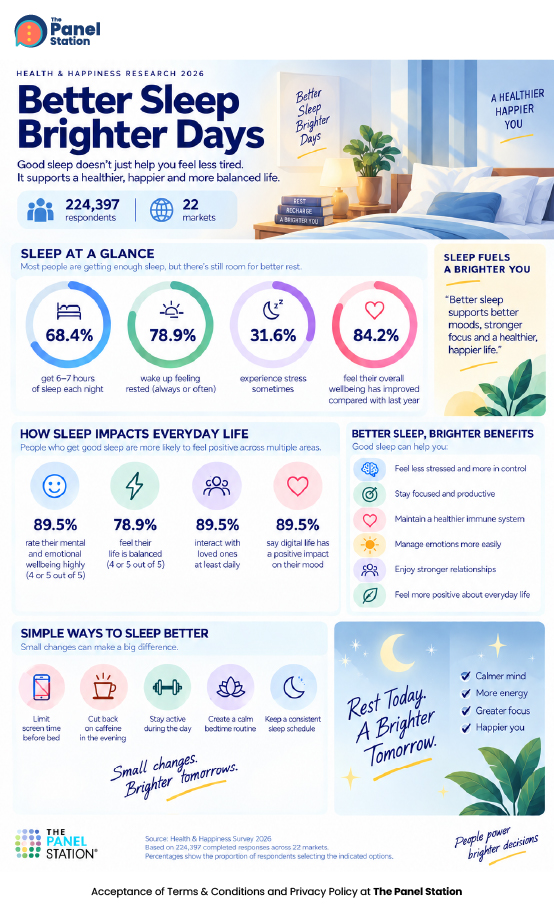
People in the survey are maintaining regular bedtimes, reducing screen use and trying to wake at consistent times. Among those actively taking steps to improve their sleep, 73.8% say those efforts are very or somewhat effective.
That is encouraging, but it also reveals an important limitation of the personal-responsibility narrative. Healthy habits are easier to sustain when the surrounding environment supports them.
This is why sleep should matter to employers, technology companies and wellbeing leaders as much as it matters to individuals. The question should not only be, “What can people do differently?” It should also be, “What are we asking people to fit into their day, and what is being sacrificed to make it fit?”
Readers interested in the underlying patterns can explore the complete survey findings in Sleep & Wellbeing Trends 2026: Why Rest Is Becoming Harder to Protect.
What If Sleep Stopped Being the First Thing We Compromise?
Modern life will never follow perfectly controlled schedules. Late nights, deadlines, travel and responsibilities will sometimes take priority over rest; the concern begins when that compromise becomes routine.
Sleep is often valued most clearly after it is lost, through tiredness, poor concentration and the need to recover. That is why the conversation may need to shift from asking how people can fit better sleep into crowded lives to asking why those lives leave so little room for rest.
For individuals, this may mean protecting bedtime more deliberately. For organisations and technology companies, it may mean creating expectations and experiences that make switching off easier.
Sleep does not need to come first every day, but it should not always be the first thing sacrificed.
WHAT WOULD HELP YOU PROTECT YOUR REST?
Tell The Panel Station what makes sleep easier to prioritise and what most often forces you to compromise it.
Frequently Asked Questions
1. Why is sleep becoming harder to protect?
Work, study, digital activity, household responsibilities and the desire for personal time are increasingly competing for the hours traditionally reserved for rest.
2. Why do people go to bed later even when they know sleep is important?
Bedtime can become the easiest part of the schedule to delay because the consequences are not immediate. People may also use late evenings to reclaim personal time after a demanding day.
3. Are screens responsible for delayed sleep?
Screens are one important factor, but they are part of a wider picture involving work, stress and daily responsibilities. The survey shows that many respondents feel screen use pushes their bedtime later.
4. Why does work need to be part of the sleep conversation?
Work is one of the most commonly reported barriers to sufficient sleep, suggesting that workloads and expectations around availability can influence how much recovery time people have.
5. Are people catching up on lost sleep?
Yes. Many respondents report sleeping longer on weekends or days off, suggesting that recovery is often being postponed until schedules allow more time.
6. Can better habits improve sleep?
Yes. Most respondents who are actively trying to improve their sleep say their efforts are effective, although sustainable improvement also depends on the pressures and routines surrounding them.