
Modern life contains a strange contradiction. We have spent years creating technologies that save time, reduce effort and make everyday tasks easier, yet many people still feel that their days are becoming fuller rather than lighter. Messages arrive instantly, meetings happen without travel, shopping can be completed from a phone, and artificial intelligence can now handle tasks that once required far more manual effort.
The promise behind all of this is efficiency. Yet nearly 7 in 10 respondents still want better work-life balance, suggesting that saving time does not automatically create more space in life.
The real challenge may be less about doing things faster and more about protecting time from being filled just as quickly.
Yet the time saved by one convenience is often absorbed by another task, message or expectation. Instead of creating more space, efficiency can simply increase the amount that fits into the same day.
The Time and Priorities Trends 2026 report is therefore becoming less about how much people can fit into a day and more about whether enough of that day still feels meaningful, manageable and genuinely their own.
What Would a Better Relationship With Time Look Like?
Perfect balance is probably unrealistic.
Some weeks will naturally belong more heavily to work. Others may revolve around family, health, study, travel or recovery. Life does not divide itself neatly into equal categories.
A better goal may be dynamic balance: the ability to notice when one part of life has taken too much space and deliberately adjust.
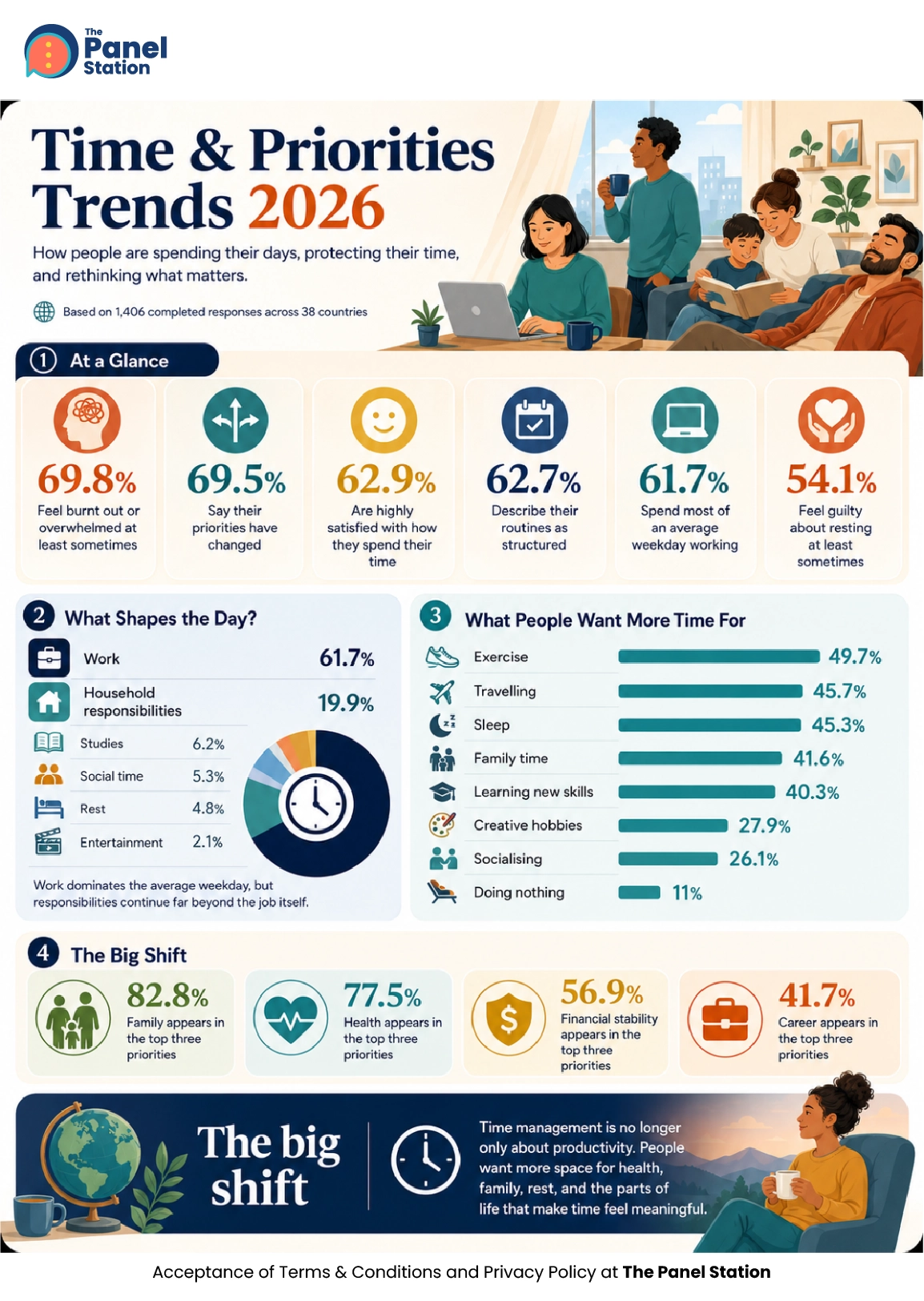
The survey reflects both progress and pressure. Around 63% are highly satisfied with how they spend their time, and 61% rate their work-life balance positively.
Yet nearly 70% have felt burnt out or overwhelmed at least sometimes in recent months.
Those findings can coexist.
Someone can be broadly satisfied with their life and still have exhausting weeks. They can value their career and still want more sleep. They can enjoy family life and still need time alone. Balance is not the absence of pressure; it is having enough room to recover from it.
Do We Need More Time, or More Control Over It?
Two people can have equally full days and experience them very differently. One may spend a busy Saturday cooking, exercising, seeing friends and visiting family and still feel satisfied at the end of it. Another may spend the same number of hours moving between meetings, errands, household responsibilities and work requests and feel completely drained.
Around 1 in 4 respondents say time management is a challenge, which helps explain why control over time can seem difficult to achieve.
The problem is that there is almost always something left to do. This is where time ownership becomes important. That is why better time management cannot solve every problem with modern busyness. The deeper question is: “How much influence do I have over where my time goes?”
What Are We Really Asking for When We Say We Need More Time?
When people say they need more time, they rarely mean they want several empty hours simply for the sake of having them.
They usually want time for something.
The survey makes this especially clear. Nearly half want more time for exercise, 45.7% want more time for travel, 45.3% for sleep, 41.6% for family and 40.3% for learning new skills.
These are revealing choices because they span several dimensions of life: health, recovery, relationships, experiences and personal growth. The desire for more time is therefore often a desire for a broader life.
People may not necessarily want to abandon work or responsibility. They may simply want enough capacity left afterwards to exercise without rushing, sleep without compromise, speak to family without multitasking or learn something that is not immediately required by the next deadline. Time scarcity becomes particularly frustrating when the things repeatedly postponed are the very things that make life feel worthwhile.
If you could reclaim one part of your day, what would you choose to protect?
Share what deserves more space in your everyday life.
Most productivity advice focuses on optimisation. Meetings can be shortened, emails answered faster and digital tools used to reduce repetitive work. These improvements are useful, but they often assume that the activity itself still deserves a place in the day.
Around 85% value quality time, suggesting that people are increasingly protective of how their time is spent.
Sometimes the better solution is subtraction: removing an unnecessary meeting, dropping a report that no longer serves a purpose or reducing avoidable email can create more space than simply completing the same work faster.
The quality of free time matters as much as the quantity. An uninterrupted hour can feel more restorative than several hours divided between screens and unfinished thoughts.
Are We Actually Busier, or Just More Interrupted?
Busyness is often measured through hours worked or tasks completed, but those measures overlook how fragmented attention has become.
A day can look manageable on paper and still feel exhausting when concentration is repeatedly broken. A work message arrives while someone is focusing on another task. A notification appears during lunch. Family responsibilities interrupt work, while unfinished work follows people into family time.
The survey reflects this overlap. Work calls and emails disrupt personal time for 44.3% of respondents, family commitments for 43.7%, and household chores for 41.9%.
None of these pressures is unusual. That may be precisely why they are so powerful. Modern busyness often comes not from one overwhelming event but from many reasonable demands competing for the same attention.
When Did Rest Become Something We Have to Earn?
Many people still treat rest as something that comes after everything else is finished. Complete the work, answer the messages, deal with the chores and organise tomorrow; then it will be acceptable to relax.
Around 54% of respondents say they feel guilty about taking breaks at least sometimes. That is significant because guilt turns rest from a basic need into something that must be justified.
Even leisure can start to feel productive. Exercise is tracked, sleep is measured, holidays are carefully planned and hobbies can quickly turn into side projects. These activities can still be valuable, but they also show how deeply optimisation has entered personal life.
Where in your day do you feel that your time genuinely belongs to you?
Share how your routines and priorities are changing.
Are Our Priorities Changing Faster Than Our Routines?
Most people can easily identify what matters to them. Health, relationships, family, financial security, personal development and rest often sit near the top of the list. Work arrives with deadlines and meetings, while personal priorities are usually more flexible and therefore easier to postpone.
The faster pace of modern life suggests that daily routines do not always prioritise wellbeing.
Around 20% feel modern lifestyles are affecting their health, showing that convenience and speed can sometimes come at a personal cost.
Exercise can happen tomorrow, a friend can be called later and sleep can be reduced for one night. The problem is that temporary postponement can become permanent. Important things often wait quietly while urgent things demand attention.
Without deliberate protection, the things people value most can become the things that wait longest.
What Happens When Work Can Follow Us Everywhere?
Flexible working has created genuine benefits. It can reduce commuting, give people greater control over routines and make employment more accessible to those with different responsibilities.
Only around 36% prefer hybrid work, pointing to a clear demand for flexibility. But flexibility can also blur boundaries.
When work can happen anywhere, it can potentially happen at almost any time. The laptop that enables working from home can also make it easier to return to work after dinner, while the phone that supports flexibility during the day can keep the workplace within reach long after working hours are over.
Flexibility without boundaries can therefore become expanded availability. The question is not simply where people work, but whether work still has a clear point at which it stops.
What Will Define Time and Priorities in the Future?
Modern life will probably become more efficient, not less. Artificial intelligence, automation and digital services will continue reducing the effort required for many everyday tasks.
But efficiency alone will not decide whether life feels calmer.
The more important question will be what happens to the time that technology saves. If every spare minute immediately becomes available for another task, meeting, notification or obligation, people may become more productive without feeling any less busy.
The challenge ahead is therefore one of choice. Perhaps the most meaningful measure of time in 2026 is not how much we manage to fit into a day. It is whether the things that matter most still have enough room to fit at all.
Frequently Asked Questions
1. Why does modern life feel so busy?
Modern life feels busy not only because people have more to do, but because their attention is constantly divided. Work, messages, household responsibilities, digital platforms and personal commitments often compete for the same hours, making even an organised day feel crowded.
2. Has technology actually made life easier?
Technology has made many tasks faster and more convenient, but that does not always create more free time. Faster communication, easier scheduling and automation can increase expectations and allow more activity to fit into the same day.
3. Why does saving time not always give us more free time?
Time saved through technology or efficiency is often quickly filled with another task, meeting or responsibility. Instead of reducing demands, greater efficiency can create additional capacity, which means people may accomplish more without feeling less busy.
4. What is time ownership?
Time ownership is the sense that you have meaningful control over how your time is used. A full day can still feel satisfying when activities are chosen, while an equally busy day can feel exhausting when most of it is shaped by obligations.
5. Why does free time sometimes not feel relaxing?
Free time can remain mentally crowded when work, notifications, social media and unfinished responsibilities continue competing for attention. Having time available does not always mean being psychologically free from everything demanding it.
6. Is attention becoming more important than time?
Attention is becoming increasingly important because digital life allows several demands to enter the same moment. An uninterrupted hour can often feel more restorative than several hours spent repeatedly switching between messages, screens and other responsibilities.
7. Why is it difficult to rest without feeling guilty?
Modern culture often connects productivity with achievement and personal value. When rest is treated as something that must be earned after everything is finished, people can struggle to relax because there is almost always another task waiting.
8. Can doing less improve wellbeing?
Yes. Doing less can create more space for concentration, relationships, recovery and priorities that matter. The goal is not simply to reduce activity, but to become more selective about which commitments genuinely deserve time and attention.
9. What can employers do to reduce modern time pressure?
Employers can examine how work is designed rather than placing all responsibility on employees. Fewer unnecessary meetings, clearer boundaries, realistic workloads and better expectations around availability can help reduce fragmentation and overload.
10. What could a healthier relationship with modern life look like?
A healthier relationship with modern life may involve greater control over time, clearer boundaries around work and technology, more protected attention and a willingness to leave some things unfinished. The goal is not perfect balance, but making enough room for work, relationships, rest and personal priorities to coexist.