Ask someone what creates a good quality of life, and the answer is unlikely to begin with economic growth or national statistics.
More often, people talk about feeling safe when they walk home, being able to afford everyday essentials, knowing their neighbours, finding opportunities to grow, and believing that tomorrow can be a little better than today.
That shift is important. Quality of life is becoming more personal.
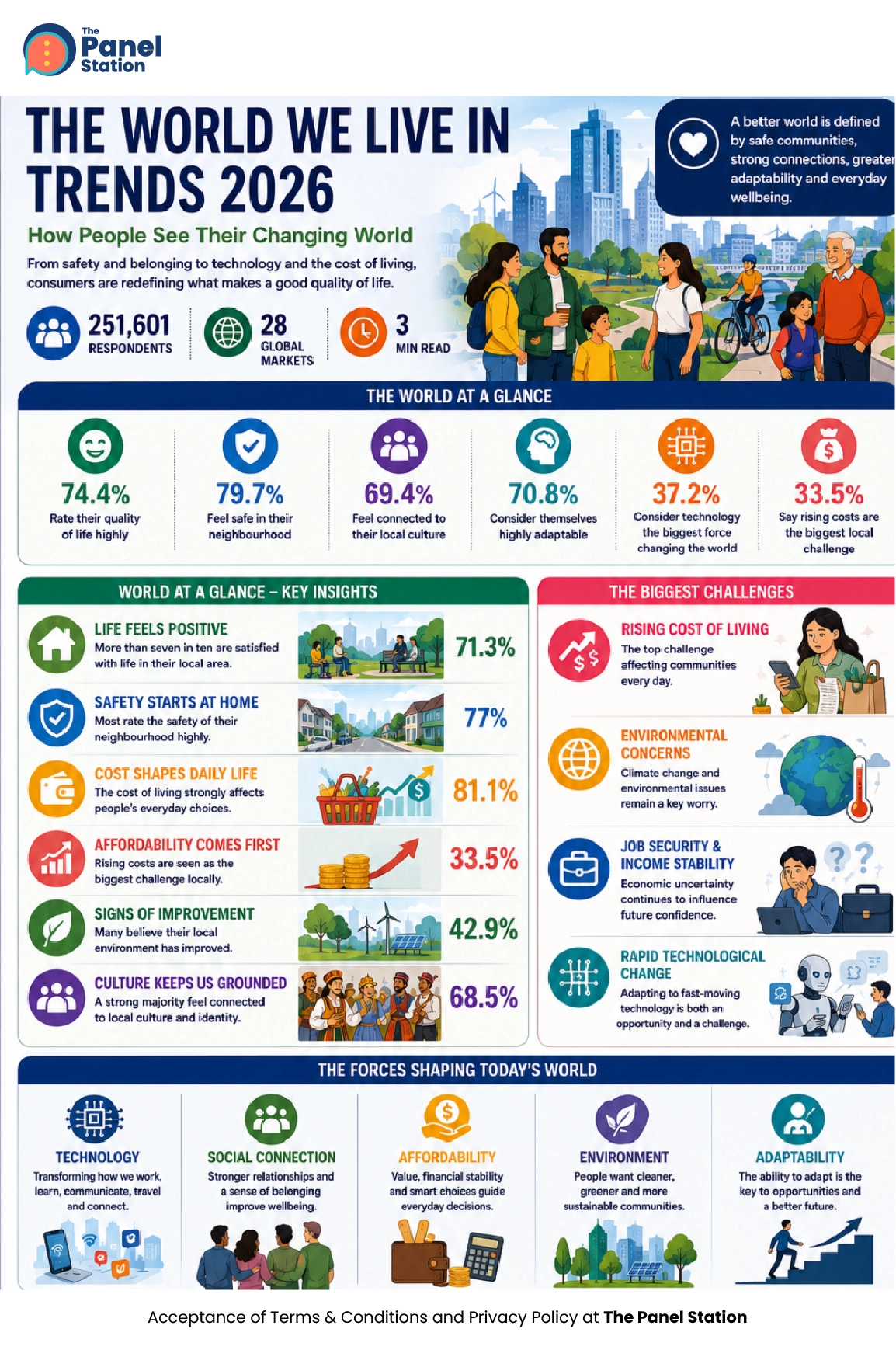
75% of people rate their quality of life high as it is measured through everyday factors like how they live, work, connect, and plan for the future.
It is no longer judged only by income levels or infrastructure. Increasingly,
The Panel Station’s The World We Live In Trends 2026 explores how consumers view the places they live, the pressures shaping their lives, and the changes influencing their future. While the trends report presents the survey findings, it also raises a broader question:
What does progress actually mean if people’s everyday lives do not improve alongside it?
Why Is Quality of Life About More Than Economic Growth?
For decades, progress was often measured through numbers such as income, employment, production, or economic expansion. These indicators remain important, but they do not always capture how people experience everyday life.
A better measure of progress may therefore be how development translates into daily experience. Safer neighbourhoods, stronger social ties, lower stress and greater trust can reveal whether progress is improving not just economies, but the lives people lead within them.
Why Does Feeling Safe Shape How People Experience the World?
Safety creates confidence. 80% of the study participants feel safe in the neighborhood.
When people feel secure, they are more likely to spend time outdoors, participate in community activities, support local businesses, and build stronger relationships with neighbours. Safety influences daily routines in ways that often go unnoticed until it disappears.
A neighbourhood that feels safe encourages movement, conversation, recreation, and belonging. It allows families to imagine a future in the same community rather than constantly looking for alternatives.
This is why safety represents much more than protection from crime. It creates the conditions that allow communities to grow. The places people value most are often those where security allows everyday life to happen naturally.
Can Progress Still Matter If People Do Not Feel It in Everyday Life?
Progress is often measured through economic growth, technology, infrastructure or innovation. But these improvements can feel distant if everyday life continues to be shaped by financial pressure, insecurity, poor access to services or limited opportunities.
Around 35% say rising costs are among the biggest barriers to a better life, showing how strongly financial pressure shapes everyday wellbeing.
A better world may therefore depend not only on progress being made, but on whether people can actually feel its benefits in the way they live, spend, work and plan for the future.
What Makes a Society Feel Fair, Not Just Successful?
A society can be economically successful while still leaving many people feeling that opportunities, resources or security are unevenly distributed. This is why perceptions of fairness can matter as much as prosperity itself.
Job and income stability was rated highlyFairness is not necessarily about everyone having the same outcome. It can be about believing that people have a reasonable chance to succeed, that rules apply consistently and that basic needs and opportunities are accessible. When people believe the system works for more than a fortunate few, success can feel more shared. A better world may therefore be one where progress feels possible for more people, not simply visible at the top.
Can a Better World Be Built Without a Stronger Sense of Belonging?
Better cities, stronger economies and new technologies can improve living standards, but people also need to feel connected to the places and communities around them. Without that sense of belonging, progress can still feel strangely impersonal.
70% believe social connection is the one of the most important factors shaping quality of life.
Belonging can come from family, friendships, neighbourhoods, culture or simply knowing that there are people who will notice when something is wrong. These connections create forms of security that infrastructure alone cannot provide.
Building a better world may therefore require strengthening not only the places people live, but also the relationships that make those places feel like home.
Economic growth remains important, but it cannot capture everything that determines whether life feels better. Income can rise while housing becomes less affordable. Technology can advance while stress increases. Cities can expand while people feel less connected to one another.
72% feel safer neighbourhoods can influence how people experience progress more directly than headline achievements.
This suggests that a better world may need broader measures of progress. Safety, affordability, health, time, relationships, environmental quality and confidence about the future can all shape how people judge their lives. The most meaningful measure of progress may ultimately be whether everyday life becomes safer, healthier, fairer and more manageable for more people.
Why Is Belonging Becoming Just as Important as Location?
People rarely describe their favourite place using geography alone. Instead, they describe how the place makes them feel.
Belonging develops through familiar faces, shared traditions, supportive neighbours, cultural identity, and everyday interactions that create trust over time. A location becomes meaningful because of the relationships people build within it.
This explains why two places with similar facilities can create completely different experiences. One may feel welcoming and connected. The other may feel anonymous.Communities that encourage participation often create stronger emotional attachment because people feel they are contributing rather than simply living there.
Belonging is becoming one of the most valuable forms of social infrastructure.
What Does Affordability Really Mean in Everyday Life?
Conversations about the cost of living often focus on inflation, wages, or housing prices.
82% have indicated that when cost of living continues to rise, people naturally become more selective about how they spend both money and time.
That shift affects businesses as well.
But affordability influences much more than monthly budgets. It shapes whether families can travel, pursue hobbies, save for emergencies, invest in education, improve their homes, or simply enjoy leisure without constant financial pressure.
Consumers increasingly prioritise value, durability, practicality, and experiences that genuinely improve daily life rather than purchases driven purely by impulse. Affordability is therefore becoming a quality-of-life issue rather than only an economic one.
What Would Improve Your Everyday Life Most?
Share your perspective and discover how others define a better quality of life.
Why Is Adaptability Becoming an Essential Life Skill?
Change has become a permanent feature of modern life. Technology evolves rapidly. Workplaces continue to transform. Consumer expectations shift. Skills become outdated more quickly than before, while entirely new opportunities emerge.
Around 80% rate adaptability as theThe most valuable skill.
Rather than resisting this pace of change, many people are learning to adapt alongside it. Adaptability no longer belongs only in professional environments. It influences personal finances, education, family life, health, and the ability to respond when unexpected challenges arise.
How Is Technology Changing the Way We Experience Daily Life?
Technology is no longer something people occasionally use. It shapes how they communicate, travel, learn, shop, manage finances, receive healthcare, and entertain themselves. Digital tools increasingly influence almost every routine throughout the day.
This creates enormous opportunities. Technology can save time, simplify tasks, improve access to services, and connect people across distances. At the same time, it introduces new questions about privacy, balance, digital wellbeing, employment, and the pace of change itself.
The future will depend not only on technological innovation but also on how thoughtfully societies choose to integrate those innovations into everyday life. Technology should ultimately support better living rather than simply faster living.
Why Are Strong Communities Becoming More Valuable?
Modern life often encourages independence, but resilient communities remind people that progress is rarely achieved alone.
70% of people in the study revealed that communities provide emotional support, practical help, local knowledge, and opportunities to participate in something larger than individual routines.
Small interactions matter. Knowing neighbours. Supporting local businesses. Participating in community events. Protecting shared public spaces. Volunteering. Looking after vulnerable people.
These actions rarely appear in economic reports, yet they strongly influence how people experience everyday life. Communities become stronger when people believe they belong to them rather than simply occupy the same location.
What Can Governments and Businesses Learn About Quality of Life?
Improving quality of life requires more than building infrastructure. It requires understanding how people actually experience the places where they live.
Governments can improve safety, healthcare, education, transport, housing, and public services. Businesses can contribute by creating fair employment, developing accessible products, supporting local communities, and designing services that reduce everyday friction.
Both have an opportunity to improve quality of life when they place people—not systems—at the centre of decision-making.The strongest societies combine economic progress with human wellbeing.
What Will Define a Better World in the Future?
The idea of progress is becoming broader.nEconomic growth, innovation and opportunity will continue to matter, but people may increasingly judge progress by how those gains improve everyday life. Safer communities, affordable living, healthier environments, stronger relationships and greater confidence about the future are becoming just as important.
The most successful societies may therefore not be those that grow the fastest, but those that turn progress into a better quality of life. A better world, in practical terms, may be one that feels safer, fairer, healthier and more manageable for the people who live in it.
What Does a Better World Look Like to You?
Share your ideas and compare your perspective with consumers around the world.
Frequently Asked Questions
1. What defines quality of life today?
Quality of life increasingly includes safety, affordability, health, belonging, opportunity, and overall wellbeing rather than income alone.
2. Why is community important to wellbeing?
Strong communities provide trust, support, shared identity, and opportunities for meaningful social connection.
3. How does affordability affect quality of life?
Affordable living allows people to meet essential needs, reduce financial stress, and invest in education, health, and future opportunities.
4. Why is adaptability important in modern life?
Adaptability helps people respond to changing technology, careers, economies, and lifestyles with greater confidence.
5. How does technology influence quality of life?
Technology improves convenience and access to services, but it also requires thoughtful use to support wellbeing and balance.
6. Why does neighbourhood safety matter?
Feeling safe encourages participation in community life, strengthens trust, and improves overall wellbeing.
7. What creates a sense of belonging?
Belonging develops through relationships, shared experiences, cultural identity, and active participation in community life.
8. What role do governments and businesses play?
Both influence quality of life through infrastructure, services, employment, accessibility, innovation, and community investment.
9. What will shape future communities?
Future communities will be shaped by affordability, sustainability, inclusion, technology, resilience, and stronger local connections.
10. What is the biggest lesson from the research?
Progress matters most when it improves everyday life. People increasingly define a better world through safety, belonging, opportunity, adaptability, and wellbeing.