

For the average working professional, career progression was once seen as relatively straightforward: earn more, move up, gain status, and build greater security. Those ambitions still matter, but they no longer capture everything people expect from their working lives.
As awareness around work, wellbeing, and personal priorities has grown, people have become more deliberate about the choices they make. A higher-paying role may look attractive, but an individual may also consider how much additional time and energy it will demand. Someone else may be comfortable with slower career progression if the role gives them greater control over their day.
This does not mean that these choices necessarily contradict one another. They reveal something more interesting about modern work: people are not simply deciding what they value. They are deciding what they are willing to exchange for it.
Our broader Work & Worth Trends 2026 research shows how complex these career decisions have become. Salary, job security, flexibility, work-life balance, growth, purpose, and management all influence how people assess a role. The more revealing insight, however, emerges when these priorities begin to compete and employees have to decide which ones matter most.
Is There Really Such a Thing as the Perfect Job?
The idea of the perfect job often comes with a long wish list. People want good pay and security, but they also value flexibility, meaningful work, opportunities to grow, supportive managers, recognition, and enough time for life beyond work.
The challenge is that few roles offer all of these in equal measure. In reality, employment choices are rarely that simple. Most people eventually have to weigh one benefit against another.
While a promotion can bring a bigger salary, it may also require longer hours and less personal time. A flexible role can offer greater control over daily life, even if career progression is slower.
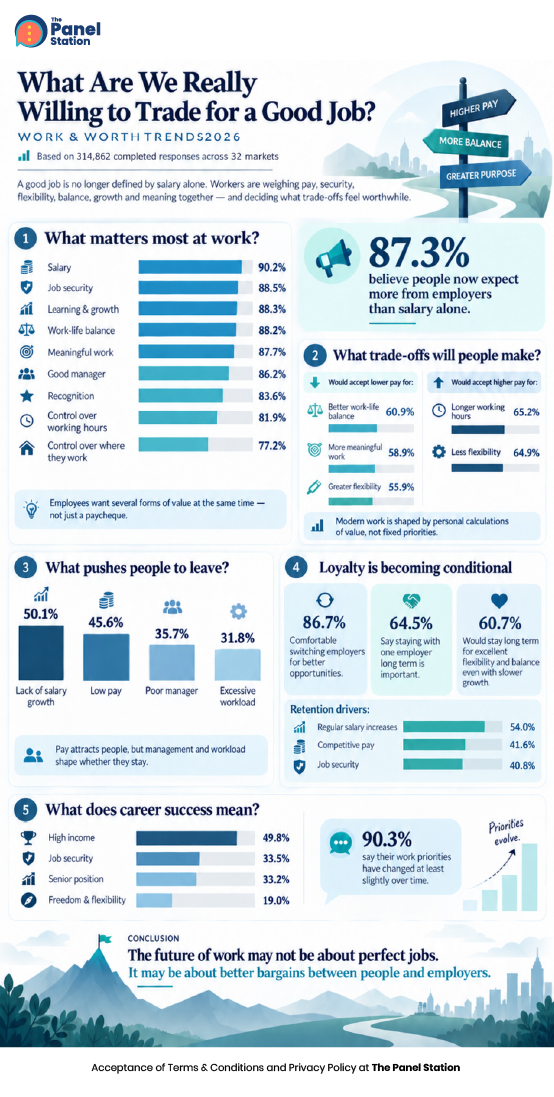
Our research found that salary is extremely important to 90.2%, while work-life balance matters to 88.2% and meaningful work to 87.7%.
So, what makes a role attractive often depends on the trade-offs an individual is willing to accept.This is why asking employees to rank individual benefits can only provide a partial view of what they truly value in a job.
Are We Choosing Jobs — or Choosing the Sacrifices We Can Live With?
Choosing a job often depends on what matters most at a particular stage of life. Someone raising young children may place greater value on flexible working hours than rapid promotion, while someone saving for a home may be more willing to accept longer hours in return for higher pay.
60.9% say they would probably or definitely accept lower pay for significantly better work-life balance.
It would be easy to interpret this as evidence that money is becoming less important. But the same respondents tell another story.
65.2% would accept higher pay if it meant consistently longer working hours, while 64.9% would consider higher pay even if it required giving up most workplace flexibility.
The real shift is therefore not from salary to lifestyle. It is increasingly shaped by how each person weighs what they gain from a job against what they have to give up. That makes the idea of a universally “good job” increasingly difficult to comprehend.
WHAT WOULD YOU TRADE FOR A BETTER WORKING LIFE?
Share how pay, time, flexibility and career growth shape your work decisions with The Panel Station.
When Does More Money Stop Feeling Like More Value?
Salary is an important part of employee satisfaction, but it cannot be the only measure.
A pay rise may look lucrative on paper, while the costs that come with it are often less obvious. They may appear as longer working hours, fewer uninterrupted weekends, a more demanding commute, or less control over when and how work gets done.
This is why salary comparisons alone cannot give a complete picture when people evaluate job opportunities. At the same time, flexibility cannot solve everything.
What matters is how people weigh pay against time, flexibility, and personal wellbeing. A higher salary may justify certain compromises, but only up to the point where the demands of the role begin to outweigh the benefits.
Has Flexibility Become a Form of Compensation?
Traditionally, compensation has been understood in terms of salary, bonuses, and benefits. Flexibility is beginning to broaden that definition.
When two jobs offer similar salaries, 41.6% of respondents say better work-life balance would most influence their choice, while 23.9% would prefer a more flexible schedule. This suggests that time and control are becoming valuable parts of the overall employment offer.
An employee who avoids a long commute may save both time and money. Someone with greater control over working hours may find it easier to manage childcare, caregiving, or other personal responsibilities.
Flexibility is becoming another important part of what employees consider when assessing a role. For employers competing for talent, the question may no longer be only how much a job pays, but also how much control it allows people to retain over their time and their lives.
What Happens When a Job Looks Good but Feels Bad?
A role can be attractive on paper and still become difficult to live with. That is where management and workload enter the picture.
In the survey, 35.7% say a poor manager could make them seriously consider leaving, while 31.8% identify excessive workload. A good manager is also considered very or extremely important by 86.2%.
These findings matter because employees understand their organisation through their everyday work, not simply through what the company policies state.
What shapes the employee experience is often far more practical: clear priorities, realistic expectations, fair treatment when mistakes happen, recognition for good work, and the freedom to switch off without feeling left behind.
A company may offer competitive salaries and impressive benefits, yet a poor daily working environment can slowly reduce their value. This is why employee experience should be seen as a core part of the employment offer, rather than as a separate HR initiative.
Is Career Ambition Changing — or Becoming More Personal?
Panel Station research does not strongly support the idea that younger or more modern working professionals care less about career progression.
33.8% say they currently want to maximise earnings, while 29% want to build their careers quickly. High income remains the most commonly selected measure of career success at 49.8%.
Ambition has not disappeared. What appears to be changing is the idea that ambition must look the same for everyone.
One individual may define progress through seniority, another through higher income, while someone else may see it in deeper expertise, greater autonomy, or the freedom to organise work around the rest of life.
Why Might Retention Have Less to Do With Loyalty Than We Think?
Employers often treat retention as a sign of loyalty, but the reasons people stay or leave are usually far more complex. The data suggests a more complicated relationship.
86.7% are comfortable switching employers for better pay, flexibility or career opportunities. Yet 64.5% still say staying with one employer for a long time is important.
These findings can coexist. People may be perfectly willing to build a long relationship with an employer, but they no longer necessarily believe longevity should require accepting a weaker deal.
Regular salary increases are the leading factor respondents say would encourage them to stay, selected by 54%. That makes retention less about persuading people to remain and more about continually giving them a reason to do so.
What Should We Really Ask Before Saying Yes to a Job?
Perhaps the most useful question is not, “Is this a good job?” It is, “Is this a good job for the life I am trying to build?”
That changes the evaluation.
Salary matters, but so does what the salary requires. Flexibility matters, but so does whether the work remains secure and financially sustainable. Career growth matters, but so does whether the direction of that growth is personally meaningful.
That is reflected in the research: 90.3% say their work priorities have changed at least slightly compared with earlier in their working lives.
The answer may change with age, family circumstances, financial pressure, ambition or health. The job that feels right at 25 may not fit at 35 or 45.
WHAT MAKES WORK WORTH IT FOR YOU?
Tell The Panel Station what a job needs to give back for the time, energy and effort you put into it.
Frequently Asked Questions
1.What makes a good job today?
Pay, security, flexibility, balance, growth and good management all matter.
2. Would employees accept lower pay for better balance?
Yes. 60.9% would accept lower pay for better work-life balance.
3. Does salary still matter?
Yes. 90.2% say salary is very or extremely important.
4. Why do employees leave good-paying jobs?
Poor management, heavy workloads and limited salary growth can outweigh pay.
5. Is employee loyalty disappearing?
Not entirely. Many still value long-term employment but will move for better opportunities.
6.Has career success changed?
Yes. Income and security still matter, but flexibility and personal control matter more too.