

A house provides a place to live, but what makes it feel like home is more personal.
It can be the chair someone uses every evening, the kitchen where family members gather, the photographs collected over time, or a quiet corner used to relax. These everyday details often shape how people connect with their living spaces.
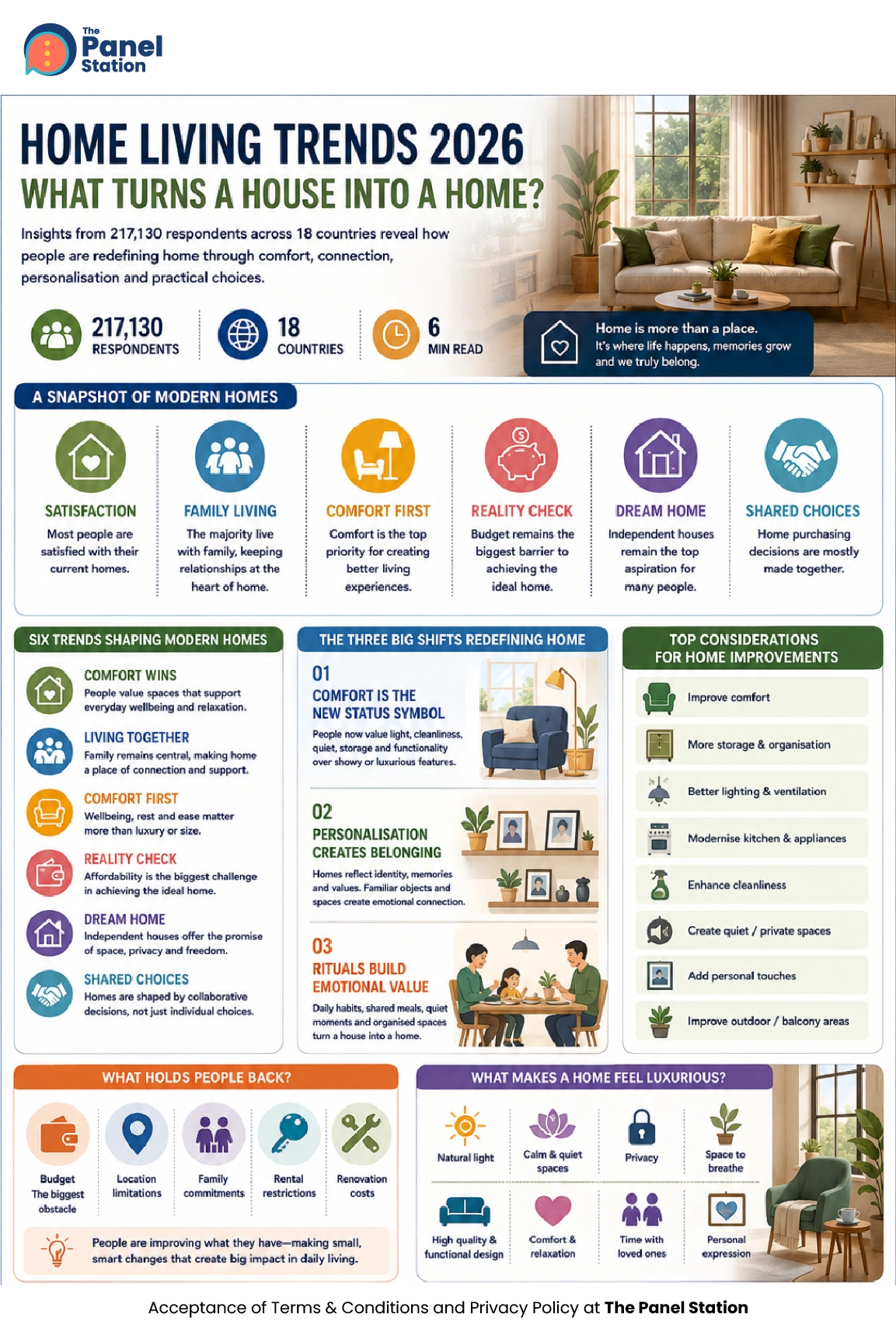
The survey suggests more than half the respondents believe that comfort, cleanliness and security are the top three indicators of a home.
That distinction matters even more as the role of home expands. It is no longer simply where people return at the end of the day. Home can also be a workplace, a classroom, a place to exercise, somewhere to entertain, a space to care for family, and, perhaps most importantly, somewhere to step away from everything happening outside.
The Panel Station’s Home Living Trends 2026: What Makes a House Feel Like Home? brings together the perspectives of 217,130 respondents across 18 countries to explore what people value in their living spaces and what creates a genuine sense of belonging.
The trends story gives us the research picture. But behind the findings is a bigger question: as homes take on more roles in everyday life, what do people actually need from the spaces they live in?
Why Is Comfort Becoming the New Measure of a Good Home?
For a long time, the idea of an aspirational home was closely associated with visible signs of success. More rooms, larger spaces, expensive interiors, and statement features often represented the ultimate upgrade.
Around 85% believe comfort is essential indicating the definition of home is changing with time.
The study points towards a more personal understanding of quality. Comfort, cleanliness, natural light, quiet spaces, practical layouts, and adequate storage are becoming important because they affect everyday experience rather than simply appearance.
This suggests that people are evaluating their homes through a different lens. Instead of asking only, “How impressive is this space?”, they are also asking, “How well does this space work for my life?”
Why Does a Home Need to Feel Personal?
A perfectly designed room can still feel strangely unfamiliar when there is nothing in it that reflects the person who lives there. Personalisation changes that.
Around 70% have a personal relaxation space where they feel the most at home. It could be a well lit space, a tiny garden or a shelf of books to read.
Homes develop a sense of identity slowly, often without anyone noticing. Photographs find their place on shelves, furniture shifts around daily routines, and objects gathered from travels or passed down through family become part of the space.
The report describes homes as increasingly becoming physical expressions of identity, shaped by memories, routines, values, and personality rather than simply being decorated to impress visitors. This explains why personalisation matters even when people are not undertaking major renovations.
Why Are Everyday Rituals More Important Than Perfect Interiors
Much of what turns a house into a home happens without anyone deliberately planning it.
Panel Station research study points that around 60% respondents believe simple rituals such as cooking together, keeping spaces organised, creating quiet corners, and displaying meaningful belongings as important contributors to a sense of home.
Someone makes tea at the same time every evening. Family members naturally gather in the kitchen. A favourite chair becomes the place for reading or unwinding. Children leave small traces of themselves across shared spaces. Weekends develop their own familiar rhythm.
These everyday behaviours matter because belonging is built through repetition. A room gains meaning when memories, routines, and relationships begin to accumulate within it.
What Makes Home Feel Like Home?
Share your perspective and compare what home means to others.
Home is often where relationships become part of the space itself, with around seven in ten respondents agreeing that the people they live with shape how home feels.
Comfort, then, is not only physical. A sofa can be inviting, but it becomes more meaningful when it is where conversations happen. A kitchen can be practical, but it gains emotional value when it becomes the centre of shared meals, familiar routines, and everyday connection.
At the same time, living together means balancing very different needs. One person may want conversation while another needs quiet. Children need room to play, adults may need places to work, and everyone benefits from having some space that feels their own.
The modern home therefore has to balance between connection and privacy. The best spaces are not simply shared. They are flexible enough to support togetherness without making people feel crowded by it.
Why Is the Dream Home Becoming More Realistic?
Dream homes are often imagined as something to work towards: a larger house, a better location, a countryside retreat, or a well-designed apartment.
Those aspirations still matter, but more than 60% of people are also focusing on improving the homes they already have.
Better organisation, storage, lighting, furniture, and functional upgrades can make everyday living more comfortable. This makes the idea of a dream home more practical. A better kitchen layout, a quieter workspace, or a more comfortable place to relax may not change the address, but they can improve how the home works day to day.
Why Is Affordability Changing the Meaning of Home Improvement?
Home aspirations inevitably meet financial reality. Around 60% of respondents belive budget is the biggest barrier to achieve their ideal home.
But financial constraints are not eliminating the desire for improvement. They are changing how improvement happens. Instead of relying only on large renovations or relocation, consumers are making smaller, more deliberate changes. This creates a more incremental version of aspiration.
That may ultimately make home improvement more accessible because the goal shifts from creating a perfect finished space to continuously creating a better one.
Why Is Luxury Becoming More About How a Home Feels?
The meaning of luxury is also evolving.The question is gradually shifting from “What does my home say about me?” to “What does my home allow me to feel?”
For nine in ten respondents, comfort has become the new luxury—suggesting that feeling at ease in your living space now matters as much as owning more.
A large home may offer space, but size alone does not create calm. Expensive furniture or a stylish interior can impress without necessarily making a space feel comfortable or personal. Increasingly, desirable living is defined by experiences: privacy, natural light, useful storage, and room to unwind.
More than status or display, the strongest sense of luxury may now come from feeling relaxed, secure and completely at ease in your own space.
Why Are Household Decisions Becoming More Collaborative?
A home usually serves more than one person, so many household decisions naturally become shared ones.
46% of households make home-related purchasing decisions together,
This number shows that decisions about furniture, appliances, décor and other home purchases are often a collective family or household choice.
The modern home purchase is therefore less about choosing an object in isolation and more about how well it fits everyday life. Consumers are looking for products that suit shared routines, solve practical needs, and continue to offer value long after the purchase is made.
How Will Homes Need to Adapt to the Way We Live Next?
The future home will be expected to do more. Changing work patterns, family needs, digital lifestyles, affordability, and wellbeing will continue to shape how people use their spaces. Flexibility will matter, but the basics are unlikely to change.
Comfort, privacy, cleanliness, personal identity, and a sense of belonging will remain central to how people experience home.
The best homes of the future may not be the biggest or the most advanced. They may simply be the ones that adapt well to the people living in them.
What Does a Better Home Really Look Like?
Perhaps the most useful lesson from the research is that Comfort, Cleanliness, Sustainability, Connection, Well Being and Safety are core pillars of a happy home.
It means that a happy home is not defined by one thing alone.
One person dreams of an independent house with more space. Another prefers the convenience of an apartment. Someone else wants a countryside home, while another simply wants better storage in the place they already live.
What connects these aspirations is not a particular architectural style. It is the desire for greater comfort, flexibility, privacy, identity, and control over everyday surroundings. Because ultimately, a house becomes a home when the people living there can recognise themselves in it.
What Would Make Your Home Better?
Share the change that would make the biggest difference to you.
Frequently Asked Questions
1. What Makes a House Feel Like Home?
A house begins to feel like home when it provides comfort, familiarity, privacy, and a sense of belonging. Personal belongings, relationships, memories, and everyday routines can make a physical space feel emotionally meaningful.
2. Why Is Comfort Important in Modern Homes?
Comfort influences how easily people can rest, work, connect, and manage everyday routines. Modern consumers increasingly value spaces that support daily wellbeing rather than simply looking impressive.
3. How Does Personalisation Make a House Feel Like Home?
Personalisation allows people to express their identity through colours, furniture, photographs, artwork, keepsakes, and room layouts. These details help transform a generic space into one that feels individual and familiar.
4. Why Do Everyday Rituals Matter at Home?
Repeated activities such as cooking together, relaxing in a favourite place, organising spaces, or sharing meals create familiarity and memories. Over time, these routines strengthen emotional attachment to a home.
5. Why Is Family Important to the Meaning of Home?
Family relationships can create connection, stability, shared memories, and belonging. This means the emotional experience of home is often shaped as much by the people within it as by the physical environment.
6. How Are People Creating Their Dream Homes Without Moving?
People can improve existing spaces through better organisation, décor changes, storage solutions, furniture rearrangement, and functional upgrades. Small improvements allow households to move closer to their ideal home without relocating.
7. Why Is Affordability Influencing Home Improvement?
Budget constraints can make major renovations or relocation difficult. As a result, households may focus on smaller improvements that provide practical benefits and improve comfort without requiring significant investment.
8. What Does Luxury Mean in a Modern Home?
Luxury is increasingly associated with experiences such as comfort, privacy, natural light, quiet, and space to relax. A home can feel luxurious because it supports wellbeing, even without traditional status features.
9. What Should Home and Lifestyle Brands Learn from Changing Consumer Preferences?
Brands can focus on products that combine quality, affordability, durability, functionality, and personalisation. Helping consumers solve real household problems can be more valuable than promoting an unrealistic image of the perfect home.
10. What Will Shape the Future of Home Living?
The report suggests that comfort, flexibility, emotional connection, personal identity, and changing family and work needs will continue influencing home living. Future homes will increasingly need to adapt to the lives taking place within them.