Entertainment used to occupy a fairly defined part of the day. People watched television, listened to music, went to the cinema, played a game, or picked up a book when they wanted a break.
That boundary is becoming less clear.
Entertainment now moves with people throughout the day and serves different purposes depending on the moment. Music can help someone reset after work. A comedy clip can provide a quick mood lift. A creator may introduce a new idea or trend. A playlist can communicate identity, while sharing a meme can help maintain a friendship.
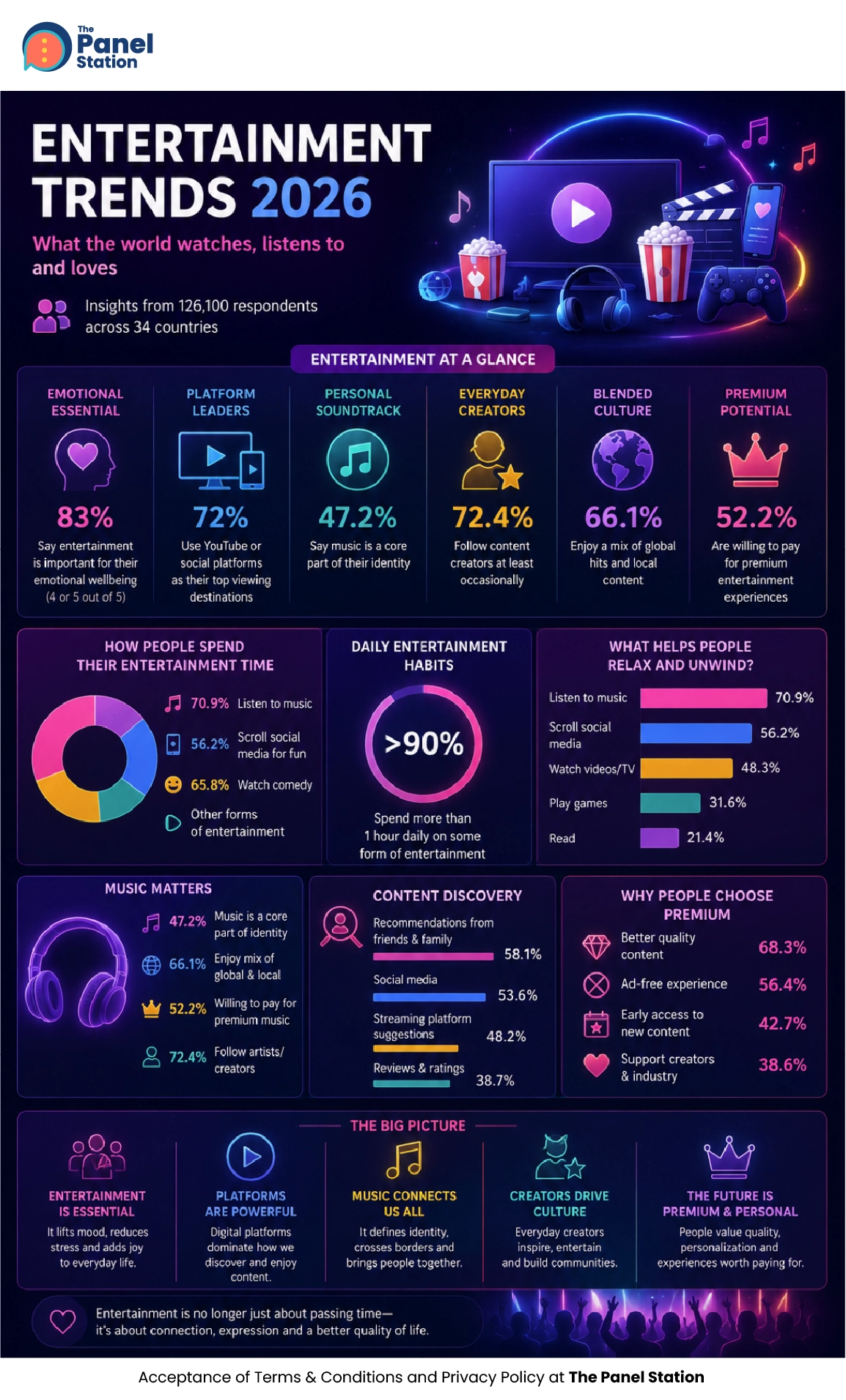
As per the report more than 90% spend at least one some form of entertainment.
Entertainment is no longer separate from everyday life. It increasingly overlaps with mood, relationships, culture, creativity, discovery, and self-expression.
The related Entertainment & Expression Trends 2026: How Content Is Becoming Personal explores the survey findings behind these changes. This blog looks beyond the numbers to ask what happens when entertainment becomes something people do not simply consume, but use in different ways throughout their lives.
Why Has Entertainment Become Part of Everyday Emotional Life?
People do not always choose entertainment because they are bored. Often, they are looking for a particular feeling. 83% feel entertainment is very essential for their emotional well being.
Someone may play music on the way home to shift out of work mode. Another person may choose comedy after a stressful afternoon. Someone else may return to a familiar television series because knowing what happens next feels comforting.
In these moments, entertainment performs an emotional function. It can create energy, provide distraction, offer familiarity, or simply create a pause between responsibilities. Understanding entertainment today therefore means looking beyond what people watch or listen to. It also means understanding what they want that content to do for them.
Why Does Mood Influence What People Choose?
Traditional audience categories assume fairly stable tastes: one person prefers comedy, another action, while someone else watches documentaries. Real behaviour is more flexible.
Around 70% of respondents watch comedy to unwind their day.
This data reveals what people choose can depend on mood, available time, energy, location, and how much attention they are willing to give. Someone may watch a serious documentary in the afternoon but prefer something lighter in the evening. A person who follows the news during the week may avoid it entirely on a stressful weekend.
This is why entertainment ecosystems need variety. Audiences do not necessarily want one genre, platform, or past preference to define them.
Personalisation becomes more useful when it recognises that the same person can want very different things at different moments.
How Is Entertainment Becoming a Form of Self-Expression?
Taste has always communicated something about identity. The music people listen to, the films they recommend, the games they play, and the creators they follow can reflect personality, culture, interests, and values.
For 50% of the respondents music is part of their identity.
Digital platforms have made those preferences more visible. A playlist can be shared instantly. Fans can remix content, join trends, create reaction videos, or participate in conversations around music, gaming, films, and culture.
Entertainment feels more personal when audiences can take what they enjoy and make it part of how they express themselves.
What does entertainment say about you?
Take The Panel Station survey and share how music, films, creators, games, and culture fit into your life.
Entertainment is no longer dominated by a single screen or format.
YouTube leads at 71.9%, closely followed by social media platforms at 70.6%, showing how strongly video, creator content and short-form entertainment now shape everyday viewing habits.
Part of their appeal is flexibility. People can move between music, comedy, tutorials, commentary, live content and short videos without committing to a traditional programme or schedule. Entertainment increasingly fits around spare moments rather than requiring people to organise their day around it.
The closeness of the two figures also suggests that audiences are not necessarily choosing one platform over another. Attention is being shared across an entertainment ecosystem, with people moving between platforms depending on their mood, available time and the type of content they want.
Why Are Global and Local Entertainment Blending Together?
Digital entertainment has made the boundary between “global” and “local” harder to define.
Around seven in ten enjoy a mix of entertainment, pointing to a strong opportunity for culture to travel while still preserving the language, humour, references and identity that make it distinctive.
A creator can speak in a regional language, use humour rooted in a particular culture, and still reach viewers around the world. At the same time, global formats are constantly adapted to local tastes.
Audiences do not necessarily see a contradiction between global and local entertainment. One person can enjoy regional music, international television, local comedy, and creators from several countries as part of the same routine.
Why Are Creators Changing Entertainment Discovery?
Discovery once depended heavily on broadcasters, publishers, cinema schedules, advertising, and editorial recommendations. Today, creators, online communities, and algorithms play a much larger role.
The study suggests that content creators are becoming powerful cultural influencers, shaping what people watch, discuss, try and increasingly consider relevant.
Creators are particularly influential because they do more than point towards content. They interpret it. A recommendation can feel more relevant when it comes from someone whose taste or personality an audience already understands.
This means discovery itself has become part of entertainment. Reviews, reactions, recommendations, clips, and conversations can influence whether something feels worth watching, listening to, or playing.
How Can Personalisation Help Without Becoming Predictable?
Free entertainment is everywhere. People can watch videos, listen to music, follow creators, play games, and browse social content without paying directly for every experience. That changes what premium entertainment needs to offer.
55% are willing to pay a premium cost for personalized entertainment.
Access alone may not be enough. Personalisation can make entertainment easier to navigate by helping audiences find content that feels relevant to their interests and mood. People are more likely to see value when a paid service improves convenience, delivers better quality, offers something distinctive, or provides an experience that is difficult to replace.
Premium entertainment therefore has to keep proving its relevance.The question is no longer simply, “How much content is available?” It is, “Does this service make entertainment better for me?”
Why Are Audiences Moving From Watching to Creating?
The distinction between audience and creator is becoming less clear. Creating content once required specialist equipment and access to distribution. Today, someone can record, edit, publish, and share content using the same device they use to watch it.
That has made participation part of ordinary entertainment behaviour. Not everyone who creates wants to become an influencer or earn money from it. Many people create because it is enjoyable, because they want to express an opinion, join a trend, share an experience, or connect with others.
The creator economy is therefore much wider than professional creators. It includes everyday acts of participation that allow audiences to contribute to entertainment culture.
What Should Entertainment Brands Learn From Active Audiences?
Audiences increasingly expect more than a steady supply of content. They want choice, participation, recognition, and opportunities to respond.
That means viewing behaviour tells only part of the story.
An active audience may share content, discuss it, recommend it, join a community, create something inspired by it, or return to it because it has emotional meaning.
Entertainment brands therefore need to understand not only what people watched, but what happened afterwards. Did it start a conversation? Was it recommended to someone else? Did it inspire participation? Did it become part of a routine or community?
These behaviours reveal forms of engagement that viewing numbers alone may miss.
The related Entertainment & Expression Trends 2026: How Content Is Becoming Personal provides the research behind these changing behaviours.
The wider lesson is that entertainment becomes more meaningful when audiences feel involved in the experience rather than simply treated as viewers.
What do your entertainment choices say about you?
Take The Panel Station survey and compare your viewing, listening, and creating habits with others.
What Will Make Entertainment Feel Personal in the Future?
Entertainment will continue to become easier to access. Platforms will improve recommendations. AI may help create, translate, adapt, and personalise content. Creators will reach audiences across borders more easily, while the distinction between consuming and creating may become even smaller.
But technology alone will not determine what people value. People will still look for comedy after a difficult day, music that captures a particular feeling, stories that introduce them to another experience, and communities built around shared interests.
The future is therefore unlikely to belong to one platform, format, or genre.
Frequently Asked Questions
1. Why is entertainment becoming more personal?
Entertainment is becoming more personal because people increasingly choose content according to mood, interests, available time, identity, and context. Digital platforms also make it easier to personalise, share, and participate in entertainment.
2. How does entertainment influence emotional wellbeing?
Entertainment can help people relax, shift their mood, take a mental break, or find comfort after a difficult day. Different formats can support different emotional needs.
3. Why does mood influence entertainment choices?
Stress, energy levels, available time, and emotional state can influence whether someone chooses comedy, music, gaming, reading, social content, or long-form storytelling.
4. How is entertainment connected to self-expression?
Music, films, games, creators, and fashion can communicate personal taste, interests, values, and cultural identity. Sharing and creating content makes those preferences more visible.
5. Why are more audiences becoming creators?
Digital tools have made creation easier and more accessible. People can respond through videos, reviews, memes, gaming clips, writing, and other formats without becoming professional creators.
6. Why does local content still matter?
Local content provides language, humour, cultural familiarity, and shared context. Global platforms allow it to reach wider audiences while also exposing local audiences to international entertainment.
7. How do creators influence entertainment discovery?
Creators introduce audiences to music, films, games, products, and cultural trends through recommendations, commentary, reviews, and everyday content.
8. What makes premium entertainment worth paying for?
Premium entertainment needs to offer additional value through quality, convenience, distinctive content, useful features, easier discovery, or an experience that free alternatives cannot easily provide.
9. Can entertainment personalisation become too repetitive?
Yes. Recommendation systems that depend too heavily on previous behaviour can limit discovery. Effective personalisation should combine familiar choices with opportunities to explore something unexpected.
10. What will shape the future of entertainment?
The future will be influenced by personalisation, creator participation, AI, blended global and local culture, changing discovery habits, and expectations for content that feels relevant to different moments in people’s lives.