

Have you ever reached the end of a busy day and wondered what you actually did with all your time?
The day may have started with checking your phone before you were fully awake. Then came breakfast, work, messages, household responsibilities, errands, family commitments, entertainment, and perhaps a little time to yourself before going to bed. Nothing about the day seems particularly unusual, yet somehow it feels full from beginning to end.
That experience says something important about modern living. Feeling busy is no longer determined only by how many hours people spend at work. It is shaped by the number of different demands competing for their attention throughout the day.
Around three-fourths of respondents say their day starts within one hour of waking up.
The Life in Motion research from The Panel Station explores this changing relationship with time across 25+ countries, looking at how people start their mornings, navigate their daily routines, manage screen time and stress, and think about the changes that could make their days better.
While the original insight story explores those behaviours, the findings raise a broader question: if technology and convenience are supposed to save time, why does modern life still feel so busy?
Why Does Modern Life Feel Busier Even When Everyday Tasks Are Easier?
Technology has removed friction from countless parts of daily life. People can order groceries without visiting a shop, pay bills in seconds, communicate instantly, work remotely, and access entertainment whenever they want.
In theory, all that convenience should create more free time. Around 66% say they juggle a lot throughout the day suggesting fast pace of life.
In practice, saved time rarely remains empty. It is quickly filled with another task, another message, another piece of content, or another responsibility. The result is a strange contradiction of modern living: people can accomplish more in less time while still feeling that there is never quite enough time.
Part of the explanation lies in the way responsibilities now overlap. Work can follow people home through smartphones. Personal conversations happen alongside professional messages. Entertainment competes with notifications. Even moments that once provided natural breaks, such as travelling or waiting, can now be filled with digital activity.
Being busy, therefore, is no longer simply about having too much to do. It is also about rarely experiencing moments when nothing demands attention.
What Does Your Daily Routine Say About Modern Life?
How Does Your Day Compare?
How Are Morning Habits Setting the Pace for the Rest of the Day?
The way people begin their mornings can reveal a great deal about the pressures shaping modern routines. 43% say they feel most productive in the early morning. Phones, messages, work updates, household responsibilities, and preparation for the day can begin almost immediately.
That matters because mornings establish the rhythm that often continues for the next several hours. When the day begins in reaction mode, with people responding to whatever demands attention first, it becomes harder to feel in control of time later.
This does not mean everyone needs an elaborate morning routine. The larger lesson is that even small pockets of intentional time can change how a day feels. Breakfast without distraction, a short walk, exercise, planning the day, or simply delaying the first screen interaction can create a clearer boundary between waking up and becoming busy.
The desire for better routines is therefore not necessarily about becoming more productive. Increasingly, it is about starting the day with greater control.
Why Is Screen Time Changing Our Experience of Time?
Screens have become woven into almost every part of daily life. More than 5 out of 10 say their average screen time has increased significantly. Screen time has become an integral part of their daily life. They help people work, communicate, shop, learn, manage money, find directions, and relax.
Due to this, the distinction between necessary and optional screen time has consequently become increasingly difficult to make. This is one reason digital activity can make a day feel more crowded than it appears on a schedule.
A few minutes checking messages can become half an hour moving between apps. A short work notification can interrupt personal time. Entertainment can continue much longer than intended because another video, post, or recommendation is always waiting.
The result can be a day filled with activity but surprisingly few moments that feel complete.
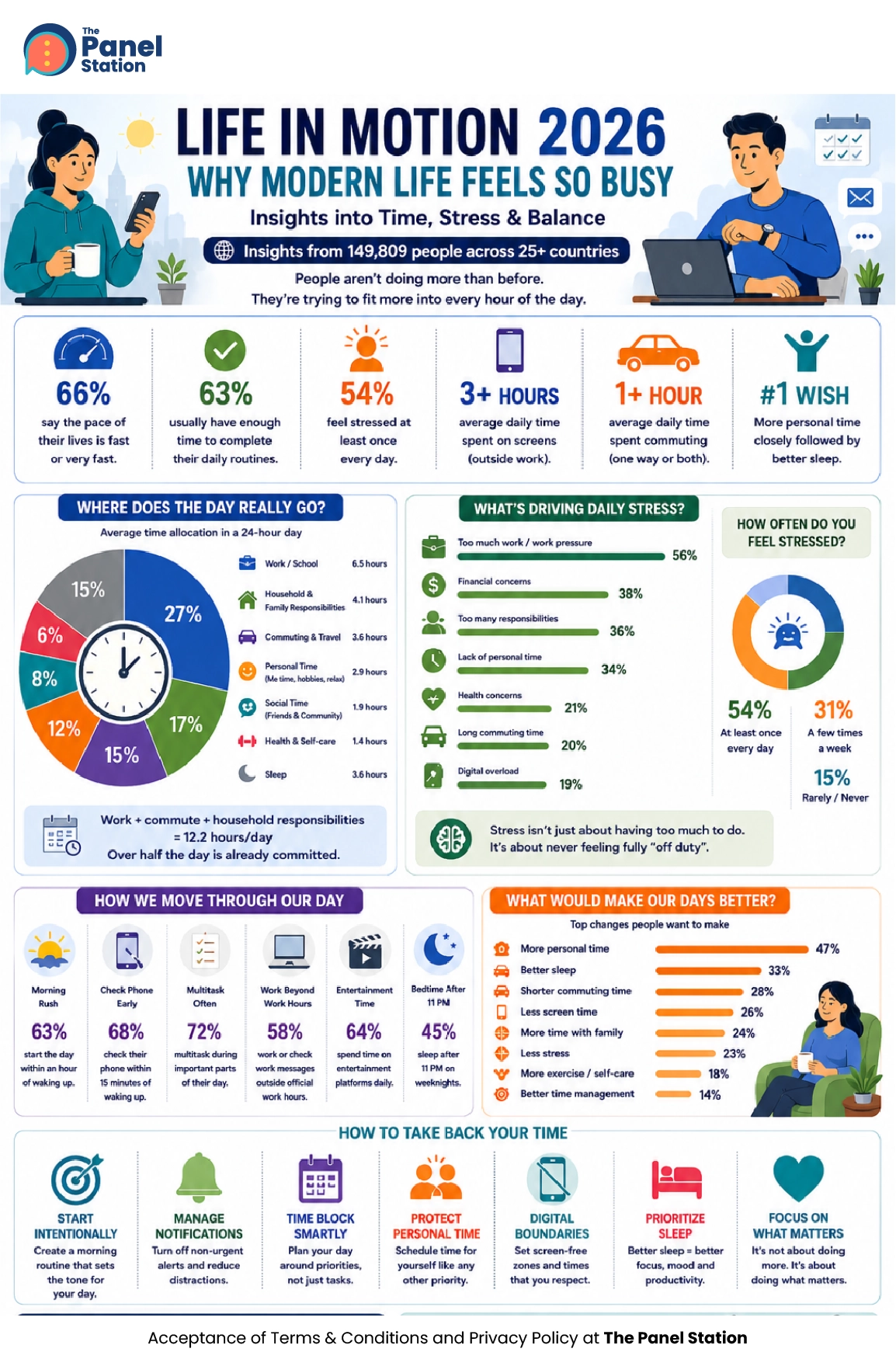
Multitasking often feels like a practical response to an overfilled day with more than 50% saying they multi-task all the time. People answer messages while travelling, watch entertainment while eating, check work notifications during personal time, and move between household and professional responsibilities.
Doing several things at once can create the impression that time is being used efficiently. Yet the experience can also make everyday life feel fragmented.
When attention is repeatedly redirected, even straightforward tasks can feel mentally demanding. More importantly, multitasking can remove the boundaries that once separated different parts of the day.
The challenge is therefore not necessarily to eliminate multitasking. Modern responsibilities often make that unrealistic. Instead, the findings invite a different question: which moments deserve someone’s full attention?
Why Is Stress About More Than Having Too Much to Do?
Stress is often associated with workload, but a demanding schedule is only one part of the story. The feeling of being constantly available can create pressure even when people are not actively working. The study reveals for 79% stress is not a rare experience, rather they encounter it at least occasionally.
A message can require a response. A notification can introduce another task. An unfinished responsibility can remain mentally present while someone is doing something completely unrelated.
This creates what might be called the invisible workload of modern life: the collection of things people are remembering, anticipating, postponing, and mentally managing throughout the day.
Reducing stress therefore requires more than completing a longer to-do list. It may also require clearer boundaries around when people work, when they respond, and when they allow themselves to disengage.
The goal is not an empty schedule. It is a schedule that contains genuine opportunities to recover.
What Would You Change Today?
Share the one change that could make your daily routine better.
Why Is Personal Time Becoming a Measure of a Good Life?
For years, productivity was treated as one of the clearest signs of a successful day. A packed calendar suggested ambition, while being constantly occupied could even become a status symbol.
That definition is beginning to look incomplete. Around 50% of the respondents want more personal time. People are becoming more aware that a productive life without enough time for rest, relationships, hobbies, movement, or simply doing nothing can eventually become difficult to sustain.
Personal time is therefore moving from something enjoyed after everything else is finished to something that needs to be protected deliberately. What matters is whether people have enough control over their routines to make room for the parts of life they value.
In that sense, personal time is not wasted time. It is part of what makes busy lives sustainable.
Can Better Time Management Really Solve a Busy Life?
Time-management advice often begins with optimisation: prioritise better, create lists, eliminate distractions, and schedule every important task. These strategies can certainly help. But they also have limits.
Around 62.7% describe their routines as structured, yet 69.8% still feel burnt out or overwhelmed at least sometimes.
A perfectly organised schedule can still be overloaded. Someone can manage every hour efficiently and still have too little time for themselves. In those situations, the problem is not organisation. It is capacity.
This distinction matters because it changes the question from “How can I fit everything in?” to “What deserves space in my day?” A healthier relationship with time may begin when people stop treating every available minute as something that must be filled.
What Can One Small Change Reveal About What People Really Need?
Asking people what they would change about their daily lives reveals something important: improvement does not always begin with a dramatic reset. Often, it starts with making everyday life feel a little easier, healthier or more manageable.
The value of that question goes beyond the individual answers.
84.2% say their wellbeing has improved since the previous year, with small changes in everyday habits such as walking or drinking enough water. Small changes can feel almost invisible from one day to the next, but over time they can change how life feels.
The bigger insight is that people do not always want radically different lives. Often, they want better energy, less pressure and routines that work more naturally within the lives they already have.
What Will a More Balanced Future Look Like?
The future of daily life is unlikely to become less connected. Digital services, flexible working, AI tools, and increasingly personalised technology will continue reshaping how people organise their time.
The bigger question is what people will choose to do with the time those technologies save.
If every efficiency simply creates room for another task, modern life may continue feeling increasingly compressed. But if convenience allows people to protect more time for sleep, relationships, movement, interests, and genuine rest, technology could contribute to a very different experience of everyday life.
The Life in Motion in 2026 findings suggest that the next evolution of modern living may not be about doing more. It may be about becoming more intentional about what deserves attention.
Frequently Asked Questions
1. Why Does Modern Life Feel So Busy?
Modern life combines work, family responsibilities, digital communication, entertainment, and personal commitments within the same limited amount of time. Constant connectivity can also make it difficult to experience genuine downtime.
2. How Do Daily Routines Affect Wellbeing?
Daily routines influence how people divide their time between responsibilities, rest, relationships, and personal activities. Sustainable routines can provide greater structure and make busy days feel more manageable.
3. Why Is Personal Time Important?
Personal time gives people opportunities to rest, pursue interests, connect with others, and mentally disengage from responsibilities. Protecting it can help create a healthier sense of balance.
4. How Does Screen Time Affect Daily Routines?
Screens support work, communication, entertainment, shopping, and many other activities. However, frequent notifications and switching between digital activities can fragment attention and blur boundaries between different parts of the day.
5. Why Can Multitasking Make People Feel Busier?
Multitasking requires attention to move repeatedly between activities. Although it may feel efficient, constant switching can make tasks feel more fragmented and mentally demanding.
6. What Causes Daily Stress?
Daily stress can come from professional responsibilities, household demands, financial concerns, digital connectivity, lack of rest, and the pressure of managing several priorities simultaneously.
7. Can Better Time Management Improve Work-Life Balance?
Time management can help people organise responsibilities, but it cannot solve every source of imbalance. Workload, personal responsibilities, boundaries, and the amount of genuine free time available also matter.
8. Why Are People Looking for More Control Over Their Time?
Greater control allows people to decide how much time they give to work, relationships, rest, and personal priorities. Having that flexibility can make a demanding routine feel more sustainable.
9. How Can Technology Improve Daily Life Without Adding More Pressure?
Technology can reduce friction by simplifying routine tasks, improving communication, and saving time. Its benefits are greater when it supports people’s priorities without creating unnecessary interruptions or demands for attention.
10. What Does Life in Motion Research Tell Us About the Future of Daily Life?
The broader lesson is that people are reconsidering what makes a day feel successful. Productivity remains important, but rest, personal time, meaningful relationships, and greater control over daily routines are becoming equally important measures of a well-lived day.