
“What makes a celebration truly memorable?”
Most people won’t remember the decorations, the menu, or even the gifts they received. What stays with them are the people who gathered around the table, the stories that resurfaced after years, the familiar taste of a family recipe, and the feeling of belonging that only certain occasions can create. Long after the photographs are forgotten in phone galleries, those moments continue to shape how people remember their lives.
This is what makes celebrations so fascinating in 2026. On the surface, they appear to be changing rapidly. Families are more geographically dispersed, cultures are blending more than ever before, and technology has transformed the way people invite, organise, and even experience important occasions. Yet beneath these visible changes lies a striking constant. The latest The Panel Station Celebrations & Traditions Trends shows that while celebrations may look different today, their emotional purpose remains remarkably unchanged.
56.4% prefer social gatherings as part of their celebrations, showing that being together still matters even as digital participation grows. They continue to bring people together, strengthen relationships, and reinforce a sense of identity in an increasingly fast-moving world.
How Do You Celebrate Today?
Take the survey and compare your traditions worldwide.
How Can Traditions Offer Stability in an Unpredictable World?
Modern life rarely follows a predictable rhythm. Careers evolve faster than ever, families often live in different cities or countries, and technology ensures that work and personal life are never completely separate. Amid constant notifications, changing priorities, and increasingly busy schedules, celebrations have become something far more valuable than social occasions. They offer moments of pause.
Every festival, birthday, anniversary, or family gathering interrupts the pace of everyday life. It creates an opportunity to reconnect with people who often become secondary to deadlines and routines. The survey reflects 74.8% say family remains at the heart of meaningful celebrations, reinforcing the role of shared occasions in maintaining close relationships. This suggests that, despite changing lifestyles, people continue to seek occasions that strengthen their closest relationships rather than simply filling their calendars.
Are Traditions Changing Without Losing Their Meaning
There is a common belief that traditions are fading, especially among younger generations. More than nine in ten still value traditions, suggesting that celebrations may be changing in form, but not losing the meaning behind them..Traditions are not disappearing—they are adapting.
A family celebration today may include customs from multiple cultures. A festival meal might combine recipes passed down through generations with dishes discovered through travel or social media. Weddings increasingly blend traditions from different backgrounds, while birthdays often bring together friends and relatives joining from different parts of the world through digital platforms.
These changes are not signs of cultural loss. Instead, they reflect the way traditions have always evolved. Every generation reshapes customs to fit its own reality while preserving the values that matter most. What remains constant is not the exact way people celebrate, but the reasons they continue to celebrate at all.
What is the Most Valuable Part of Any Celebration That Money Cannot Be Buy
People may appreciate thoughtful gifts or beautiful venues, but what they remember most are the conversations, laughter, shared meals, and unexpected moments that unfold naturally throughout the day. These experiences cannot be purchased or replicated. They emerge from time spent together.
For 65.9%, meaningful people matter most, while 74.8% place family at the heart of how they celebrate. In many ways, time has become the rarest luxury. Modern consumers have access to more products, services, and experiences than ever before, yet uninterrupted time with loved ones often feels increasingly scarce. Celebrations create protected spaces where people temporarily step away from work, responsibilities, and digital distractions to focus entirely on one another.
Does Food Continue to Connect Generations
Few traditions illustrate the emotional power of celebration better than food. Every culture has dishes reserved for special occasions, recipes that appear only during festivals, or meals that instantly remind people of childhood.
Food does far more than satisfy hunger during celebrations. It carries stories. It reflects migration, family history, regional identity, and shared experiences that stretch across generations. A single recipe can preserve decades of family tradition without anyone consciously trying to protect it.
Every celebration seems to have a dish everyone waits for. It may be a family recipe, a festive sweet, a special meal, or something that only appears once a year. As 91.6% continue to value traditions, these familiar flavours help turn celebrations into rituals people recognise, remember, and want to pass on.
Food remains one of the most powerful ways people celebrate where they come from while embracing where they are going.
Is Technology Expanding Human Connection Rather Than Replacing It
Technology has fundamentally changed the way celebrations are organised and shared. Invitations arrive instantly, families separated by continents celebrate through video calls, and important milestones can be experienced simultaneously across different time zones.
These changes have undoubtedly made celebrations more accessible. Yet they have also highlighted something technology cannot replace.
Presence.
People increasingly recognise the difference between recording a moment and experiencing it. While photographs, videos, and social media help preserve memories, the emotional value of a celebration still comes from genuine interaction. The conversations that happen away from screens often become the ones people remember most.
Technology works best when it supports human connection rather than competing with it.
Are Traditional Celebrations Evolving With Younger Generations?
The Panel Sation Report onTraditions and Celebrations reveals that younger generations are not necessarily moving away from tradition, but they are changing how traditions fit into modern life. Celebrations may become smaller, more informal, more personalised, or influenced by digital platforms and changing lifestyles.
With 91.6% still valuing traditions and 78.6% wanting to pass them on, the stronger story is one of adaptation rather than decline.
At the same time, many young people still value the meaning behind familiar customs, particularly when they create opportunities to spend time with family and friends. The difference is often in how those traditions are expressed.
This suggests that traditions can remain relevant without staying exactly the same.
Are The Moments We Celebrate Together The Ones We Treasure Most
For 65.9%, the people they celebrate with matter most. That shifts the meaning of a great celebration away from how elaborate it looks and towards who is around the table, in the room, or on the other end of the call.
Consumer priorities have shifted noticeably over the past decade. Across travel, entertainment, and lifestyle, experiences are increasingly valued above possessions. Celebrations reflect this same transition.
People may appreciate thoughtful gifts or beautifully planned events, but what they remember years later is often far simpler. A conversation that lasted long after dinner. A family recipe prepared together. Children participating in traditions for the first time. The laughter that no photograph can fully capture.
These experiences become meaningful because they cannot be replicated or purchased. They emerge naturally when people spend uninterrupted time together.
How Are Celebrations Keeping Generations Connected?
With 91.6% continuing to value traditions and 78.6% wanting to pass them forward, rituals, recipes, music, stories, and family customs become bridges between past and present.
Celebrations create natural opportunities for different generations to spend time together, share stories, and take part in familiar traditions. Older family members often bring customs, memories, and rituals, while younger people introduce new ideas and more modern ways of celebrating.
This exchange helps traditions stay relevant. A family recipe may be passed down but prepared differently, a festival ritual may be shared online, or a familiar gathering may take on a more informal format.
What matters is the connection created around the tradition. Celebrations give generations a reason to come together, understand one another better, and carry meaningful customs forward in ways that still fit modern life.
Do Celebrations Reveal What Society Values
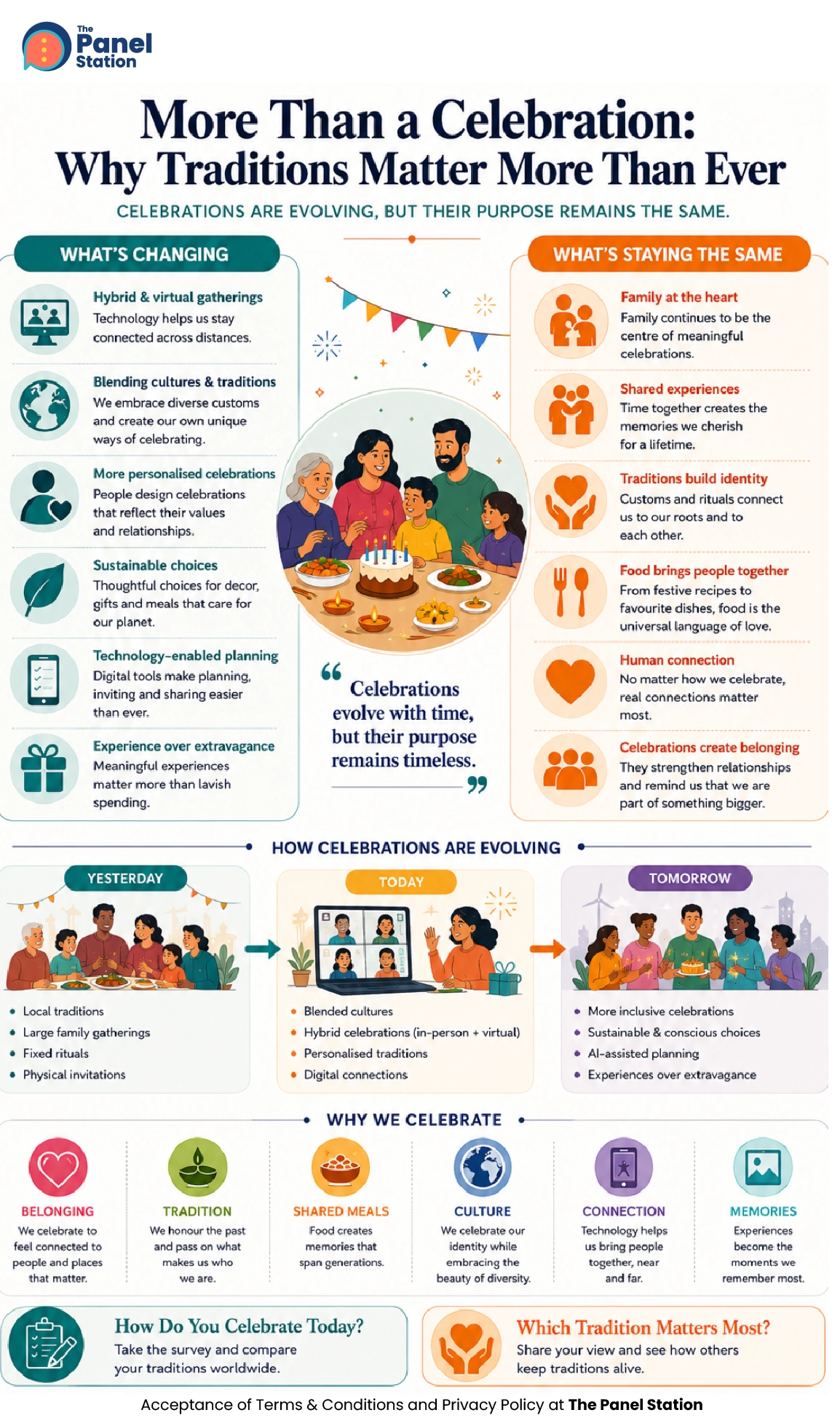
Perhaps the most fascinating aspect of celebrations is that they quietly reflect broader social change. They reveal what people prioritise, how communities evolve, and which values continue to matter across generations.
With 91.6% still holding traditions close and 74.8% placing family at the heart of celebrations, these occasions become more than dates on a calendar.
As families become more diverse, celebrations become more inclusive. As sustainability becomes more important, people rethink how they decorate, travel, and exchange gifts. As cultures become more interconnected, consumers increasingly adopt traditions beyond those they inherited while continuing to preserve the customs that define their own identities.
Celebrations therefore become more than personal milestones. They become expressions of the kind of society people hope to build.
Why Will The Future of Celebration Be More Human Than Ever
Technology will continue to reshape how people communicate. Artificial intelligence may simplify planning, sustainability will influence celebrations, and global cultures will continue inspiring new traditions. These changes are inevitable.
What is unlikely to change is the reason people continue to celebrate.
They celebrate to strengthen relationships. To honour milestones. To create memories. To remind themselves that amid constant change, some experiences remain timeless.
Perhaps that is the biggest lesson from The Panel Station Celebrations & Traditions Trends 2026. The future of celebrations will not be defined by bigger events, grander experiences, or more sophisticated technology. It will be defined by something much simpler and far more enduring: the human desire to belong.
Because long after the lights come down and the tables are cleared, what people remember most is never the event itself. It is how they felt while sharing it with the people who mattered most.
Frequently Asked Questions
1. Why are celebrations still important in today's fast-changing world?
Celebrations create moments to reconnect with family, friends, and communities. They offer continuity, strengthen relationships, and provide a sense of belonging in an increasingly busy and digital world.
2. Are traditional celebrations disappearing?
Not necessarily. Many traditions are evolving rather than disappearing. Families are adapting customs to suit modern lifestyles while preserving the values and memories that make celebrations meaningful.
3. How is technology changing the way people celebrate?
Technology is making it easier for people to stay connected through virtual gatherings, digital invitations, and shared online experiences. However, most people still value face-to-face interactions and meaningful time together.
4. Why do family traditions matter across generations?
Family traditions create shared memories, reinforce cultural identity, and help pass values from one generation to the next. They provide a sense of continuity even as lifestyles change.
5. What role does food play in celebrations?
Food brings people together and often carries cultural and emotional significance. Family recipes and festive meals help preserve traditions while creating lasting memories around the table.
6. Are younger generations celebrating differently?
Younger generations are embracing new experiences and blending traditions from different cultures. While the format of celebrations may be changing, the desire to connect with loved ones remains just as strong.
7. What can brands learn from changing celebration trends?
Brands that respect cultural traditions, create authentic experiences, and support meaningful moments are more likely to build lasting relationships than those focused only on seasonal promotions.
8. Why are shared experiences becoming more valuable than expensive celebrations?
Many people now place greater value on quality time, meaningful conversations, and memorable experiences than on lavish events or expensive gifts. Emotional connection often leaves a stronger impression than material displays.
9. What do celebration trends reveal about society?
Celebration trends reflect changing lifestyles, cultural diversity, and evolving consumer values. They show how people balance tradition with modern influences while continuing to prioritise relationships and belonging.
10. What is the future of celebrations likely to look like?
Celebrations are expected to become more personal, inclusive, and experience-led. While technology will continue to support how people gather, meaningful human connection will remain at the heart of every celebration.