
"Do you feel safe?"
It seems like a simple question. Yet, in 2026, the answer is anything but straightforward.
For some, safety means walking home after dark without looking over their shoulder. For others, it means checking whether a text message is genuine before clicking a link. Many feel perfectly comfortable in their neighbourhoods but hesitate before making an online payment. Safety today is no longer confined to streets, homes, or cities—it follows us wherever we go, both offline and online.
The latest The Panel Station Trends study on Global Safety paints a fascinating picture of how people experience safety today. The findings reveal an interesting paradox: while most people feel secure in their immediate surroundings, they are increasingly aware of the growing risks that surround modern life.
The question is no longer “Are we safe?” Instead, it has become “What does feeling safe really mean?”
Has Safety Become a State of Mind
For decades, conversations around safety focused primarily on crime rates, policing, and physical security. While these remain important, today’s world has introduced a new category of everyday risks.
Every notification, online transaction, ride-share booking, or social media interaction requires a small act of trust. We rely on technology more than ever, but that reliance has also expanded the ways we can feel vulnerable.
This shift explains why safety has become deeply psychological. People no longer judge their security solely by where they live. They evaluate it by how confidently they navigate both their physical and digital worlds.
In many ways, safety has evolved from being a place to being a feeling.
Do you think tomorrow will be
See how your outlook compares with global opinion.
Why Confidence and Caution Coexist
One of the most striking insights from the study is that confidence and caution often exist together.
Many respondents reported feeling safe in their neighbourhoods while simultaneously expressing concern about personal safety or future risks. At first glance, these findings may seem contradictory. In reality, they reflect how people naturally adapt to an increasingly complex world.
Feeling safe does not mean believing that danger has disappeared. Instead, it means learning to manage uncertainty. People continue to enjoy their daily routines, travel to work, shop online, and engage with their communities while remaining alert to scams, misinformation, identity theft, and unexpected emergencies. This balance between confidence and vigilance has become the new normal.
How the Digital World Has Changed the Meaning of Safety
A decade ago, conversations about safety largely centred on streets, homes, and workplaces. Today, a significant portion of our lives unfolds online.
Banking, healthcare, education, entertainment, shopping, and even social relationships are increasingly digital. As convenience has grown, so too have concerns about cybersecurity, privacy, and fraud.
Modern safety therefore extends far beyond locks and alarms. It includes protecting passwords, recognising phishing attempts, safeguarding personal data, and understanding how digital platforms use our information.
For many people, an online scam can feel just as personal and disruptive as a physical theft. This changing landscape means digital literacy is no longer simply a technology skill, it is becoming an essential life skill.
How Much Does the Neighbourhood Shape Our Sense of Safety?
The neighbourhood people live in can strongly influence how safe they feel day to day. Well-lit streets, familiar faces, visible security, clean public spaces, and easy access to help can all contribute to a greater sense of comfort.
Community also matters. Knowing neighbours, seeing people regularly, and feeling that others look out for one another can make an area feel more secure.
At the same time, poor lighting, neglected spaces, limited public services, or frequent reports of local crime can increase concern. This shows that neighbourhood safety is shaped not only by actual risk, but also by how people experience and interpret the environment around them.
Why Can People Feel Unsafe Even When No Immediate Threat Exists?
Feeling safe is not always determined by whether something dangerous is happening at that moment. People can still feel uneasy because of uncertainty, past experiences, financial pressure, concerns about crime, online risks, or constant exposure to negative news.
World safety in 2026 is also closely connected to predictability and control. When people are unsure about their surroundings, finances, personal information, or what might happen next, that uncertainty can influence how secure they feel.
This is why perceptions of safety can differ even among people living in similar circumstances. Feeling safe is not only about avoiding danger; it is also about having confidence in the environment, people, and systems around us.
Is Trust Still the Strongest Safety Net
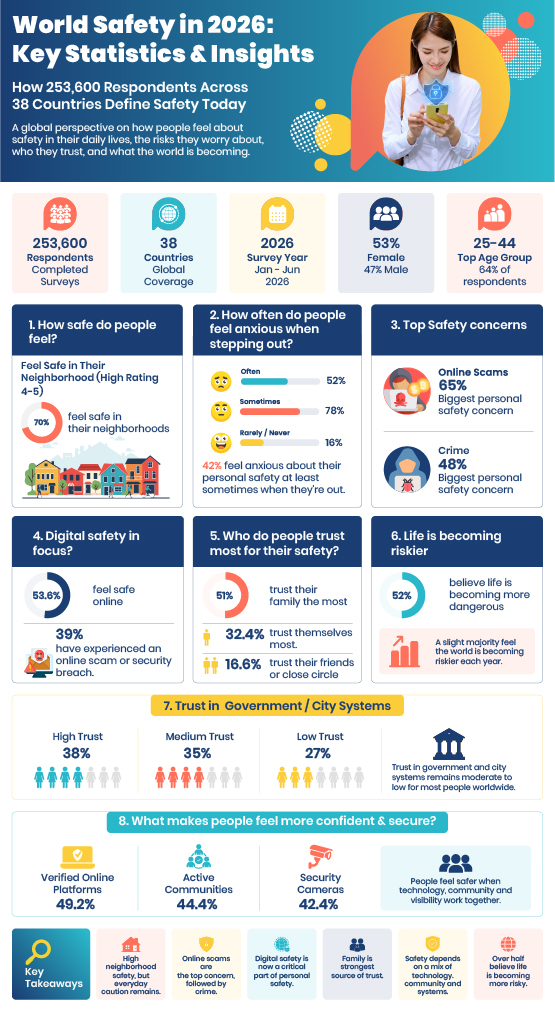
Although technology continues to reshape how we experience safety, one finding remains reassuringly timeless: people continue to place their greatest trust in those closest to them.
Family remains the strongest source of reassurance during uncertain times. This reflects an important truth about human behaviour.
When people face uncertainty, they instinctively turn to relationships before institutions. Emotional support, shared experiences, and trusted advice often provide a greater sense of security than any technological solution alone.
Self-reliance also plays an increasingly important role. Whether it involves staying alert while travelling, verifying online information, or making informed decisions, individuals recognise that personal responsibility remains one of the strongest contributors to everyday safety.
Technology may provide useful tools, but people continue to trust people most.
How Building Safer Communities Starts with Everyday Actions
42% of people feel unsafe when they step-out of their houses. When people think about improving public safety, the conversation often centres on major policy reforms or large-scale investments. However, The Panel Station Trends Study suggests that what people value most are often simple, everyday measures.
Well-lit streets, visible security, prompt emergency services, supportive neighbourhoods, and trusted digital platforms all contribute to a stronger sense of safety. While each may seem like a small improvement on its own, together they shape how secure people feel in their daily lives.
The findings also reinforce an important trend: safety is influenced as much by community trust as by physical infrastructure. When people know their neighbours, have confidence in local services, and believe help is available when they need it, their overall sense of security grows.
Ultimately, creating safer communities isn’t just about preventing crime, it’s about fostering trust, connection, and confidence in the places where people live, work, and interact every day.
Do you think tomorrow will be safer?
See how your outlook compares with global opinion.
Why Safety Is Becoming More Personal
Perhaps the most significant shift revealed by the findings is that safety is becoming increasingly individual.
Two people living on the same street can experience safety very differently. Age, previous experiences, digital habits, family responsibilities, and local infrastructure all influence how secure someone feels.
Safety means different things to different people. For parents, it often centres on their children’s wellbeing. Young adults are more likely to prioritise protection against cyber fraud and online privacy risks, while older generations may place greater importance on access to healthcare and strong community support.
For professionals who travel frequently, safeguarding their digital identity can be as important as feeling secure in their physical surroundings. There is no universal definition of safety anymore. Instead, people build their own personal “safety equation” based on the risks that matter most to them.
How Do News and Social Media Influence Safety Perceptions?
News and social media can shape how people understand risk, even when events are happening far from their own surroundings. Frequent exposure to stories about crime, conflict, scams, accidents, or economic uncertainty can make certain risks feel more immediate.
Social media can amplify this effect because information spreads quickly and often appears repeatedly across feeds. Personal experiences, videos, warnings, and opinions can all influence how safe people believe their communities or digital spaces are.
This does not mean people simply accept everything they see. But when negative information is constant, it can affect perceptions of safety and make trust in reliable information even more important.
What Governments, Businesses and Communities Can Learn
Understanding public perceptions of safety is valuable because perception influences behaviour.
People who feel unsafe may avoid public transport, spend less time in public spaces, hesitate to adopt digital services, or limit community participation. Businesses face similar challenges. Consumers are more likely to engage with brands they trust to protect their personal information and provide secure digital experiences.
Governments benefit from understanding where confidence exists and where it does not. Investments in public infrastructure, emergency services, cybersecurity awareness, and community engagement all contribute to improving both actual and perceived safety.
Ultimately, feeling safe encourages people to participate more fully in society.
Do you think tomorrow will be safer?
See how your outlook compares with global opinion.
The Future of Safety Is Shared
As artificial intelligence, connected devices, digital payments, and smart cities continue to expand, safety will become even more interconnected.
Protecting people will require collaboration between governments, businesses, technology providers, communities, and individuals.
No single solution can eliminate every risk. However, stronger digital education, better-designed public spaces, transparent technology, responsive institutions, and supportive communities can collectively make everyday life safer.
The future of safety is unlikely to depend on one breakthrough innovation. Instead, it will depend on thousands of small decisions made by organisations and individuals every day.
The Bigger Picture
The most significant insight from Panel Station Trends Study is that safety today extends far beyond crime rates or security measures. Increasingly, it is defined by how confident people feel in their everyday lives.
It’s the confidence to walk through your neighbourhood without hesitation, trust the websites you use, support your community, let your children explore, and navigate an increasingly connected world with peace of mind.
Ultimately, feeling safe isn’t just about avoiding risk, it’s about having the freedom to live, work, connect, and grow without constant uncertainty.
As the world continues to change, understanding people’s perceptions of safety is becoming just as important as addressing the risks they face. These insights highlight that the future of safety isn’t defined solely by stronger systems
Continue Exploring
Curious to see how people around the world perceive safety today?
Explore Panel Station Trends: World Safety Rating – What’s Your Score? to discover interactive insights, global findings, expert analysis, and key takeaways from respondents across 38 countries.
Do you think tomorrow will be safer?
See how your outlook compares with global opinion.
Frequently Asked Questions
1. What influences people's sense of safety the most?
A combination of trusted relationships, secure environments, reliable public services, and safe digital experiences shapes how people perceive safety.
2. Why is digital safety becoming as important as physical safety?
As everyday activities move online, cyber threats such as scams, identity theft, and data breaches increasingly affect people’s confidence and wellbeing.
3. How can individuals improve their everyday safety?
Staying aware of your surroundings, practising good cyber hygiene, verifying online information, and supporting your local community are simple but effective ways to reduce risks.
4. Why do perceptions of safety matter?
How safe people feel influences where they travel, how they shop, whether they trust digital services, and how actively they participate in their communities.
5. How can communities become safer?
Strong neighbourhood connections, better infrastructure, visible security measures, responsive emergency services, and inclusive public spaces all contribute to greater confidence and resilience.
6. How does the media affect people’s sense of safety?
Frequent coverage of crime, accidents, or cyber incidents can heighten anxiety even when overall risk levels are stable, while balanced reporting that includes context and prevention tips helps people form more realistic views.
7. What role does technology play in both improving and threatening safety?
Tools such as surveillance cameras, emergency apps, and AI-based fraud detection enhance protection, yet the same technologies can create new risks through privacy breaches, deepfakes, and automated scams if not properly managed.
8. How can parents and caregivers help children feel and stay safer?
Understanding global safety perceptionsTeaching age-appropriate digital literacy, maintaining open communication, setting clear online boundaries, and modelling calm risk-awareness habits build both physical and online resilience in young people.