

Building trust has never been easy, but keeping it has become even harder.
Consumers today have more information, more choices, and higher expectations than ever before. A single poor experience, an unexplained price increase, or declining product quality can cause people to rethink a brand they have trusted for years. Loyalty is no longer based on familiarity alone; it is earned through consistent experiences that prove a brand deserves its place in people’s lives.
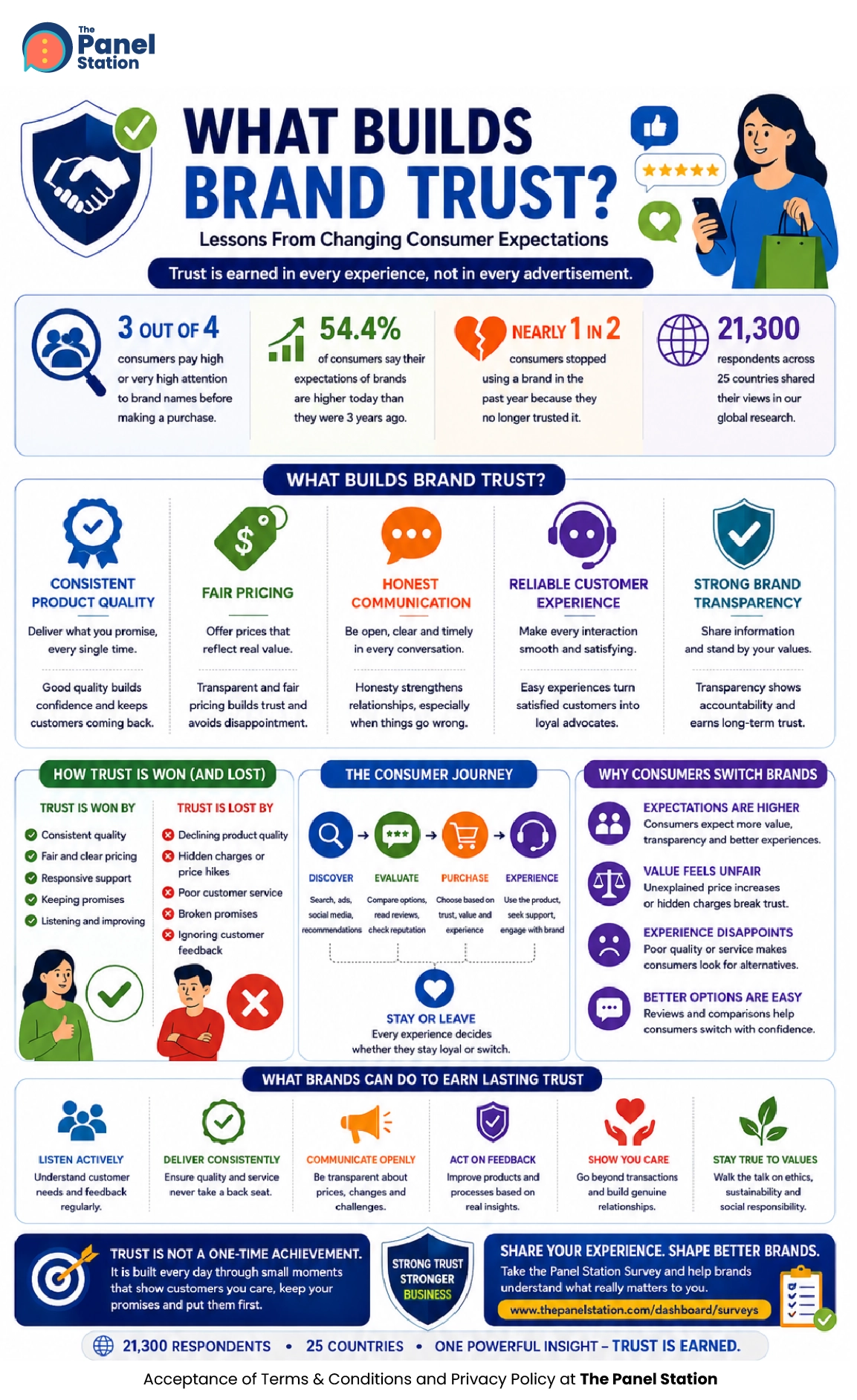
Around 72% say personal experience shapes their trust most strongly, far ahead of social media at 11% and advertising at 8%. That is why building brand trust has become one of the most important priorities for businesses.
According to Panel Station’s Global Research Brand Trust Report, consumers are increasingly clear about what influences their buying decisions, what earns their trust, and what ultimately makes them walk away from a brand.
While the original insight story highlights the survey findings, the research also reveals a broader lesson for businesses: lasting consumer relationships are built through consistent quality, transparency, positive experiences, and the ability to meet rising expectations.
Does Brand Recognition Get Attention While Trust Wins Loyalty?
One of the strongest findings from the research is that consumers pay very high attention to brand names before making consumer buying decisions. However, recognition can help a brand enter the consideration set, but it cannot guarantee that a consumer will stay.
With 95% saying quality is extremely important and 71% having abandoned a brand because of poor quality, consistency becomes one of the strongest forms of reassurance.
When respondents were asked what influences trust in brands, they consistently ranked product quality, fair pricing, and clear communication among the most important factors. Ethical practices and sustainability also matter, but consumers first expect brands to deliver reliably on the fundamental promise behind the product or service.
This suggests that building brand trust begins long before a company talks about its values.
Why Are Rising Consumer Expectations Changing Brand Loyalty?
Another important finding from the Consumer Trust On Brands 2026 Trends Study is that consumers’ expectations of brands are higher today than they were just three years ago. Around 68% say they now expect more from brands than they did before, which means a company cannot rely on habit or reputation alone. That shift matters because it changes what loyalty means.
Consumers increasingly expect businesses to be responsive, transparent, and accountable. They want clear communication, understandable pricing decisions, and products that continue to deliver value after the first purchase. In an increasingly competitive marketplace, brand transparency is becoming part of the experience consumers use to decide whether a company deserves their continued trust.
As expectations rise, customer loyalty becomes more conditional. Consumers may have a favourite brand, but familiarity alone does not guarantee their next purchase. They are continually assessing whether the experience they receive still justifies their loyalty.
Why Does Word of Mouth Still Beat the Sales Pitch?
Behind every statistic is a real customer experience. Survey responses help organisations understand what consumers value, where expectations are changing, and which parts of the experience need greater attention.
Around 58% say they follow recommendations from people they trust. In a crowded marketplace, a friend, family member, colleague, or fellow consumer can sometimes carry more influence than the brand itself. Trust transfers when the recommendation comes from someone whose judgement already feels credible.
Consumer opinions can also help brands identify what is already working. If customers consistently associate a company with reliability, quality, transparency, or good service, those strengths can become an important part of future strategy and communication.
Share Your Brand Experience
Take the survey and help brands understand what consumers value.
Perhaps one of the most important findings from the research is that consumers stopped using at least one brand during the past year because they no longer trusted it.
Trust does not always collapse because of one major failure. More often, it weakens through small moments: a delayed reply, unclear pricing, an inconsistent product, a difficult return, or a promise that is not quite kept.
With 72% saying personal experience shapes trust most strongly, these everyday interactions matter. Consumers notice whether a brand makes things easy, communicates clearly, and delivers what it promised. Trust is often lost quietly—one disappointing moment at a time.
Brands can use surveys and ongoing feedback to understand exactly where trust is being strengthened or weakened. Rather than relying only on broad satisfaction scores, they can ask customers about specific moments such as product quality, service interactions, pricing, communication, delivery and problem resolution.
What Can Businesses Learn from Changing Consumer Expectations?
The study reveals that businesses need to adapt quickly to changing consumer expectations. Around 82% value recommendations, while 79% pay attention to reviews. Before trying something unfamiliar, consumers increasingly look for evidence from people who have already taken the risk.
Reviews, comparison platforms, social media conversations, and digital marketplaces allow consumers to evaluate alternatives before committing to a purchase. A company’s advertising therefore represents only one part of the information people use to make decisions.
This means businesses increasingly compete through the entire customer experience. Reliable products, responsive support, transparent communication, and fair pricing collectively shape brand reputation and influence whether customers return.
What Brands Can Learn From Consumers Who Leave
The study reveals that businesses need to adapt quickly to changing consumer expectations. Around 82% value recommendations, while 79% pay attention to reviews. Before trying something unfamiliar, consumers increasingly look for evidence from people who have already taken the risk.
Reviews, comparison platforms, social media conversations, and digital marketplaces allow consumers to evaluate alternatives before committing to a purchase. A company’s advertising therefore represents only one part of the information people use to make decisions.
This means businesses increasingly compete through the entire customer experience. Reliable products, responsive support, transparent communication, and fair pricing collectively shape brand reputation and influence whether customers return.
How Can Brands Turn Customer Experience into Long-Term Loyalty?
A brand can make strong promises, but customers ultimately judge it by what they actually experience. Around 72% say personal experience shapes their trust most strongly, far ahead of social media at 11% and advertising at 8%. Hence, building brand trust requires consistency across the entire customer journey.
The closer the actual experience comes to the promise a brand communicates, the easier it becomes for consumers to believe that promise the next time they make a decision.
For consumers, trust is often built slowly and tested quickly. Every purchase therefore becomes a moment when a brand either strengthens the relationship or gives people a reason to reconsider it.
A compelling advertisement followed by poor service creates a contradiction. A high-quality product accompanied by confusing pricing can create doubt. Friendly customer support cannot completely compensate for a product that repeatedly disappoints.
Why Does Transparency Matter More When Something Goes Wrong?
Transparency is easy when everything is working well. Its real value becomes visible when expectations are not met. Around 85% say transparency matters when deciding whether to trust a brand.
Consumers understand that businesses are imperfect, but how a company communicates during those moments can influence whether disappointment becomes distrust. For brands, transparency should therefore be understood as more than sharing information. It is about reducing the gap between what consumers expect and what they actually experience.
Clear explanations, timely communication, and visible attempts to resolve problems can demonstrate accountability. Silence, confusing messages, or promises that do not match the eventual outcome can do the opposite.
What Will Building Brand Trust Look Like in the Future?
The Study points to an important shift in the relationship between consumers and brands.
People continue to value trusted brands, but their loyalty is increasingly earned rather than assumed. Every purchase, service interaction, product experience, and communication contributes to the decision to stay or look elsewhere.
As consumers gain even greater access to information and alternatives, the strongest brands are likely to be those that make trust visible through their actions. They will listen carefully, communicate clearly, deliver consistent quality, and respond when expectations change.
Technology may transform how consumers discover and interact with brands, but the fundamental ingredients of trust remain surprisingly human: reliability, fairness, honesty, and consistency.
What Makes You Trust a Brand?
Share your experience and help shape better consumer insights.
If you want to explore the complete survey findings behind these insights, the original What Makes Consumers Trust a Brand in 2026 story provides the broader research picture.
Ultimately, building brand trust is not about convincing consumers to believe what a company says about itself. It is about giving them enough consistently positive experiences to reach that conclusion on their own.
Frequently Asked Questions
1. What Does Building Brand Trust Mean?
Building brand trust means creating confidence that a business will consistently deliver what it promises. Product quality, fair pricing, honest communication, and reliable customer experiences all contribute to that confidence.
2. Why Is Brand Trust Important for Customer Loyalty?
Trust gives consumers a reason to return. When customers repeatedly receive reliable products, fair value, and positive experiences, they are more likely to maintain a relationship with the brand.
3. Why Are Consumer Expectations Increasing?
Consumers have greater access to information, reviews, comparisons, and alternatives. This makes it easier to evaluate brands and raises expectations around quality, service, transparency, and value.
4. How Does Product Quality Influence Brand Trust?
Consistent product quality demonstrates that a brand can deliver on its core promise. When quality becomes inconsistent, consumers may begin questioning whether the brand still deserves their confidence.
5. Why Is Brand Transparency Important?
Brand transparency helps consumers understand a company’s decisions and actions. Clear, honest communication can reduce uncertainty and strengthen confidence, particularly when problems occur.
6. How Does Fair Pricing Affect Consumer Trust?
Consumers want prices to feel reasonable in relation to the value they receive. Clear pricing helps build confidence, while unexplained increases or unexpected charges can weaken trust.
7. How Does Customer Experience Affect Brand Reputation?
Every customer interaction contributes to brand reputation. Consistent experiences across purchasing, delivery, service, and support can strengthen the overall perception of a brand.
8. What Influences Consumer Buying Decisions Today?
Consumer buying decisions can be influenced by product quality, price, brand reputation, reviews, customer service, previous experiences, and the level of trust consumers have in a company.
9. Why Do Consumers Switch Brands?
Consumers may switch when product quality falls, prices no longer feel justified, service disappoints, or another brand provides a better experience. Repeated small disappointments can be as damaging as a major failure.
10. How Can Businesses Build Long-Term Brand Trust?
Businesses can strengthen trust by consistently delivering quality, communicating honestly, listening to feedback, resolving problems effectively, and ensuring that the customer experience matches the promises they make.