
Sustainability is often discussed through large ideas: climate targets, clean energy, corporate commitments and environmental policy. Yet most people experience it in much smaller moments.
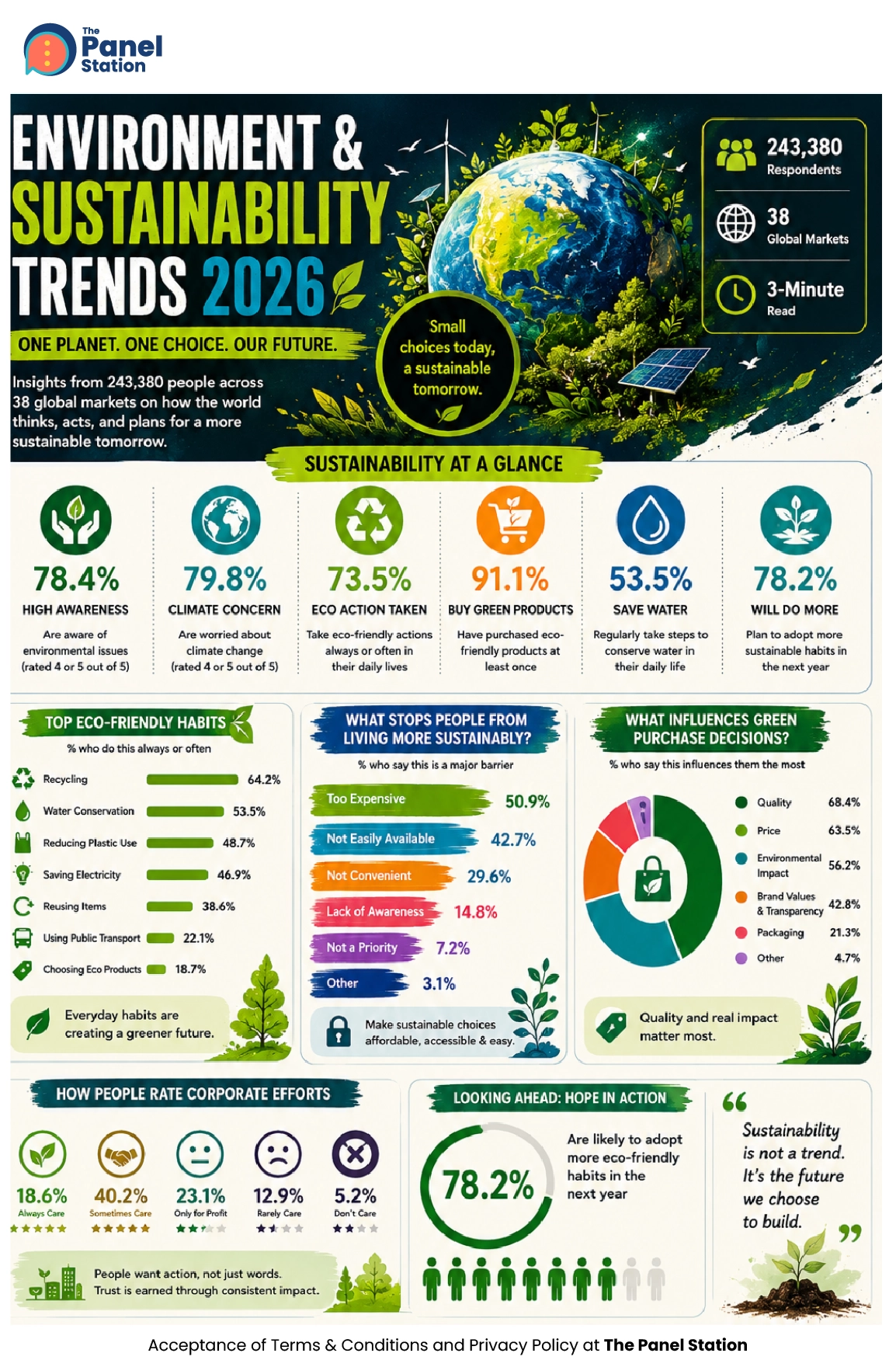
Data suggests 91.1% have purchased an eco-friendly product at least once which reflects the intent of consumers to have a greener planet.
It appears when someone decides whether to reuse a bag, repair something instead of replacing it, switch off a light, choose a different product or spend slightly more for an option that claims to be better for the environment.
That is what makes everyday sustainability interesting. People can care deeply about environmental issues while still making decisions shaped by price, time, access and convenience. A greener choice may look straightforward in principle but become much harder when it costs more, takes longer or is difficult to find.
The Panel Station’s Environment & Everyday Life Trends 2026 research points towards this practical reality. The next stage of sustainable living may not depend on persuading people that the environment matters. It may depend on making environmentally responsible choices easier to repeat when ordinary life is already demanding.
Has Sustainability Become Too Focused on Individual Responsibility?
Many environmental conversations begin with personal behaviour. Use less plastic, recycle more, save water, buy responsibly and waste less. Each action can make sense, but taken together they can create the impression that progress depends mainly on whether individuals make perfect choices.
The study reveals that more than 50% of the respondents say cost is one of the biggest barriers to sustainable living.
A household may understand the value of energy-efficient products but be unable to afford the upfront cost. Someone may want to buy sustainably but live where greener products are difficult to find. Another may want to reduce car use but have no reliable public transport. Individual behaviour matters, but it operates within systems that either make sustainable choices easier or more inconvenient.
The more useful question may therefore be not “Why aren’t people doing more?” but “Are they being given sustainable choices that are affordable enough to make the better option realistic?”
Why Do Small Green Habits Matter So Much?
Environmental action can feel overwhelming because the scale of the problem is so large. Climate change, resource depletion and pollution are difficult to connect with one household decision, which can make small habits seem insignificant.
73.5% practise eco-friendly habits always or often which clearly suggests the importance of small green habits in daily life.
Switching off lights when not in use once in a while changes little. Doing it conciously every day turns it into part of how a household operates. The same is true of carrying reusable bags, avoiding unnecessary packaging or conserving water.
Habits also reduce the effort sustainability requires. A behaviour that needs constant motivation is easier to abandon during a busy week. A behaviour that has become routine requires far less thought. Everyday sustainability becomes more durable when people do not have to make a fresh environmental decision every time.
Is Convenience the Hidden Competitor to Sustainability?
Most people do not make environmental decisions in isolation. They are also managing work, families, spending, errands and limited time.
A sustainable option that requires extra attention and efforts may be attractive in theory but difficult to maintain. That is why the data reveals that only around 30% make everyday sustainability choices a part of regular routine.
A refill station is less useful if reaching it requires a long journey. Public transport may be greener, but not if it makes a short commute unreliable. A reusable product works best when it fits naturally into existing routines.
This does not suggest that people are unwilling to change. It suggests that habits compete with friction. The strongest sustainable solutions may be those that remove effort rather than repeatedly asking consumers to overcome it.
Price remains one of the most difficult parts of sustainable consumption.
But with 50.9% still held back by cost, the next step is not simply convincing people to care—it is making greener choices easier to afford and maintain.
Consumers are encouraged to choose products made with better materials, responsible sourcing or lower environmental impact, yet these options can carry a premium.
That creates an uncomfortable contradiction. Sustainability is presented as something everyone should practise, while some choices associated with it can feel designed for people with greater financial flexibility. Environmental responsibility becomes harder to normalise when consumers are repeatedly asked to pay more for it.
Some better materials or production methods will cost more. But the long-term opportunity is to narrow the gap between the sustainable option and the affordable one. Green living becomes easier to scale when it stops feeling like a premium lifestyle and starts functioning as an ordinary consumer choice.
Which part of sustainable living feels hardest to maintain in everyday life?
Share your experience and explore how other consumers are navigating the same choices.
Are We Buying Sustainability or Better Products?
A green claim may attract attention, but few consumers buy products solely because they sound environmentally responsible. People still expect them to work well, last long enough and feel worth the price.
68.4% say sustainability and product quality should not be treated as separate promises.
A product that uses responsible materials but performs poorly may create more frustration and waste. A durable item that needs replacing less often can support sustainability without making environmental language its main selling point.
The strongest sustainable products may be those in which the environmental benefit is built into the overall value. Consumers should not have to choose between something that works and something that feels responsible.
Why Are Consumers Becoming More Skeptical of Green Claims?
Sustainability has become a useful marketing language. Terms such as natural, responsible, conscious, recyclable and eco-friendly appear across packaging, advertising and corporate reports. The difficulty is that consumers cannot always tell how much those words really mean.
The data reflects that skepticism, with only 18.6% believing companies always genuinely care about the environment.
When every brand sounds environmentally committed, claims begin to lose their power. Vague or exaggerated messages can also make genuine progress harder to recognise because consumers become more doubtful of everyone.
Trust therefore depends on clearer evidence. Specific actions, understandable claims and visible progress are more credible than broad promises. Sustainability may become more believable when companies communicate what has changed, what has not and what still needs work.
Does Sustainable Living Need to Feel Less Like Sacrifice?
Environmental behaviour is often communicated through reduction: use less, buy less, travel less and consume less. Sometimes reduction is necessary, but a message built entirely around sacrifice can make sustainability feel like a permanent loss of convenience or enjoyment.
A different approach would focus on what better systems can add. Efficient homes can reduce bills. Walkable communities can make daily life easier. Durable products can save replacement costs. Better public transport can create mobility without requiring everyone to own a car.
Not every sustainable choice produces an immediate personal benefit. But environmental progress becomes easier to support when people can see how it improves ordinary life as well as protecting something more distant.
What Makes a Green Habit Last?
Good intentions are strongest when people are thinking deliberately about them. Habits have to survive the moments when they are not.
63.5% say price influences sustainable purchases.
Sustainable behaviour needs to work on rushed mornings, difficult weeks and periods when money is tight. If a green habit depends on perfect planning, constant motivation or significant extra expense, it is likely to disappear when life becomes complicated.
The most resilient habits are simple enough to continue without much negotiation. Reusing what is already available, reducing unnecessary consumption or conserving energy can become normal behaviour. Sustainability lasts when it fits real life rather than an ideal version of it.
Can Sustainable Choices Become the Default?
Defaults are powerful because people often follow the option that requires the least additional decision-making. If standard packaging uses less material, consumers do not need to request it. If an appliance is efficient by design, households benefit without repeatedly thinking about energy use.
73.5% practise eco-friendly habits always or often.
The goal is not to remove consumer choice. It is to stop treating the environmentally better option as an exception that must always be actively selected. Sustainability becomes more normal when the default itself improves.
Instead of asking millions of people to make a more responsible decision every day, systems can make many of those decisions automatically. That may be one of the strongest routes towards everyday sustainability.
What Role Should Governments and Communities Play?
Some environmental choices cannot be solved at the checkout. Recycling depends on local collection systems. Public transport depends on infrastructure. Energy choices depend on what homes and communities can access. Waste reduction can be influenced by regulation and product standards.
Sustainable living therefore cannot sit entirely with consumers or businesses. Public systems determine whether many environmental behaviours are realistic in the first place.
The strongest progress may happen when the different parts reinforce one another. Consumers bring willingness, businesses create better options, and public systems make those options easier to use at scale. When one part is missing, individual effort has to work much harder.
What would make the greener choice easier for you to make every day?
Share what needs to change and explore how sustainability could fit more naturally into everyday life.
What Will Make Everyday Sustainability Work?
The future of sustainable living will probably not depend on dramatic lifestyle transformation. It will depend on whether small, repeatable choices become easier to make across different incomes, locations and ways of living.
With 64.2% recycling, it stands out as the most common green habit—showing that sustainable action gains momentum when it is familiar and easy to practise.
Awareness alone is not enough. People may understand environmental problems but still face limits around cost, access, time and infrastructure. Sustainable behaviour is more likely to become routine when those barriers are reduced and greener choices fit naturally into everyday life.
The goal should be a world in which environmental responsibility does not require exceptional commitment. When greener products perform well, responsible habits fit naturally into routines and better systems make the sustainable choice convenient, sustainability can move from something people try to do into simply how everyday life works.
Frequently Asked Questions
1. What is redefining1. What does sustainable living mean in everyday life? career success in 2026?
Sustainable living means making practical choices that reduce waste, conserve resources and lower environmental impact while fitting realistically into daily routines.
2. Why are small eco-friendly habits important?
Small habits matter through repetition. Once actions such as reducing waste or saving energy become automatic, they are easier to maintain.
3. Why is sustainable living sometimes difficult?
Cost, limited access, inconvenience and inadequate infrastructure can make responsible choices harder even when people want to make them.
4. Why can eco-friendly products cost more?
Some sustainable materials and production processes are more expensive. Better scale and systems can help make greener options more affordable.
5. What makes a sustainable product attractive?
Consumers still expect quality, durability, usefulness and fair value. Sustainability works best when it strengthens the product rather than replacing these basics.
6. What is greenwashing?
Greenwashing occurs when environmental claims create a stronger impression of sustainability than the company’s actions or product can support.
7. How can brands build trust around sustainability?
Brands can use specific claims, avoid exaggeration and show how commitments translate into real changes in products, packaging or operations.
8. How can businesses make sustainable choices easier?
Businesses can improve durability, reduce unnecessary packaging, offer affordable greener options and remove extra effort from sustainable purchasing.
9. Is sustainable living only an individual responsibility?
No. Businesses, governments, infrastructure and local systems strongly influence which sustainable choices are practical and accessible.
10. What is the future of everyday sustainability?
The future is likely to involve greener products, systems and habits becoming increasingly built into ordinary life rather than treated as exceptions.