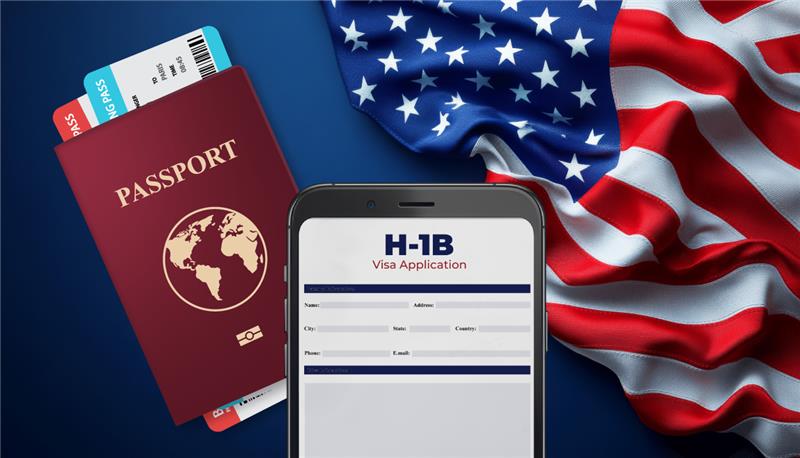

The U.S. H1B visa has served as a gateway for skilled professionals worldwide to live and work in America. But that pathway is undergoing dramatic changes. As of September 2025, the U.S. government has introduced tight new entry rules and a staggering $100,000 fee requirement for new H-1B visa applications. These updates could reshape who gets in, how many get in, and how the entire system functions.
In this blog, we’ll walk from the basics — what is H1B, how it has worked, the latest rules, who is affected, how employers and visa holders should adapt, and answers to frequently asked questions.
What Is H1B Visa and What Does It Mean
Let’s get the foundation right of what H1B Visa means before diving into changes.
What is H1B Visa
The H-1B visa is a nonimmigrant U.S. work visa for specialty occupations. These are roles that typically require a university degree or equivalent. It allows U.S. employers to hire foreign professionals in fields like IT, engineering, science, and more.
In plain terms, when someone asks, “what is H1B?” you can say, it’s a visa program letting qualified foreign workers join the U.S. workforce under employer sponsorship.
H1B Visa Requirements
To get an H1B visa, you usually need:
- A job offer in a specialty occupation from a U.S. employer.
- A relevant bachelor’s degree or equivalent in the field or specialized experience.
- The employer must file a Labor Condition Application (LCA) and show they will pay you at least the prevailing wage.
- The employer submits an H-1B petition (Form I-129) to U.S. Citizenship and Immigration Services (USCIS).
- In many cases, due to high demand, you go through a lottery system if applications exceed the annual cap.
Extensions, change of employer, or adjustments of status may be possible under certain conditions.


H1B Visa Cost
Before these new changes, the cost for an H-1B petition typically included multiple fees: filing fees, fraud prevention & detection fees, premium processing (optional), etc. The total ranged from hundreds to a few thousand dollars depending on the situation.
As of September 2025, a new $100,000 one-time fee has been introduced for certain new H-1B petitions (more on that below).
What Changed in 2025: U.S. Restrictions and New Rules on H1B
In 2025, the U.S. government issued a presidential proclamation restricting the entry of certain H-1B visa holders unless an employer pays a $100,000 fee, among other reforms.
Key Provisions of the New H1B Entry Restrictions
- The restrictions take effect 12:01 a.m. EDT on September 21, 2025, and are set to expire after 12 months unless extended.
- The new rule applies to new H-1B petitions filed on behalf of individuals outside the U.S. It does not apply to currently held H-1B visas, approved or pending petitions filed before the effective date, or those already in the U.S. (with clarifications).
- Employers must pay a $100,000 fee (in addition to existing fees) if they want to bring in H-1B workers who are outside the U.S. under the new regime.
- The proclamation also instructs agencies to revise prevailing wage levels and prioritize H-1B beneficiaries who are higher paid or highly skilled.
- Case-by-case exemptions may be granted if hiring a particular worker or industry is in the national interest.
Clarifications from USCIS, CBP & Department of State
After the proclamation, USCIS, U.S. Customs and Border Protection (CBP), and the Department of State issued guidance to clarify how the changes are applied:
- The restrictions are prospective — they don’t retroactively affect approved visas or petitioners before Sept. 21, 2025.
- Current H-1B visa holders in the U.S. may still exit and reenter, though travel is recommended with caution.
- Applications for extension, change-of-status, or amendments inside the U.S. may or may not be impacted. The guidance is less clear and still evolving.
- Consular officers will verify that the $100,000 payment is made for new filings.
In other words: not every H1B visa path is blocked, but the changes do introduce significant new hurdles, especially for new applicants abroad.
Why Did the U.S. Do This? Intent & Rationale
The administration cites several reasons for these changes:
- Combat abuse of the H-1B program. The proclamation claims that some employers replace American workers with lower-paid H1B workers, depress wages, or abuse the system.
- Prioritize U.S. workers. By raising costs and filtering for higher-paid roles, the intent is to push domestic hiring or deter over-reliance on foreign labor.
- Raise revenue and impose “skin in the game.” The $100,000 fee ensures only serious petitions proceed.
- Reshape the selection system. Proposals suggest replacing or modifying the lottery system to favor more skilled or better compensated roles.
Implications: Who Gets Affected & How
These changes ripple across multiple stakeholders: prospective workers, current H1B visa holders, U.S. employers, and economies (both in the U.S. and abroad).
Prospective H1B applicants abroad
- Many may no longer qualify unless employers pay the hefty $100,000 fee.
- Those from countries like India, which historically account for a large share of H-1B recipients, could face disruption.
- The barrier to entry is much higher; early-career professionals or companies with limited budgets may be priced out.
Current H1B visa holders / petitioners inside U.S.
- Existing H1B visa holders are largely protected under clarifications. The new rules do not apply to petitions filed before the effective date.
- However, traveling outside the U.S. may be risky; reentry under new rules may trigger scrutiny.
- Change-of-employer or extension requests might face uncertainty depending on evolving regulations.
U.S. employers
- Companies that rely heavily on foreign skilled labor (especially in tech, research, and engineering) will see their costs balloon.
- Small and mid-sized firms may struggle to absorb the extra burden, leading them to rethink hiring strategies or move operations abroad.
- Many firms are already advising H1B employees abroad to return before restrictions tighten.
- Some large firms warned that this may cause loss of talent or slow innovation.
Broader economic & global impact
- The tech industry may slow down, with diminished access to global talent.
- Countries competing for skilled immigrants (e.g., Canada, UK, Australia) may attract those who are blocked from U.S. pathways.
- For economies like India, which supply many H1B visa holders, this could reduce remittance and talent outflow.
- Research warns that innovation systems in the U.S. may suffer.
How to Navigate the New H1B
For individuals and organizations affected, adaptability is key. Here are several strategies:
For visa seekers / foreign professionals
- If possible, enter the U.S. before the rule takes effect (if your petition is already approved).
- Choose alternate visa options, such as O-1 (extraordinary ability) or green-card categories like EB-1A, which are not subject to H1B caps or the lottery.
- Consider opportunities in other countries that welcome skilled professionals (Canada, Australia, EU nations).
- If you must apply under H1B, target higher-paying roles and employers who can absorb the costs.
Limitations & Controversies
No policy of this scale is free from debate. Here are the main points of contention:


- Risk of talent exodus: Skilled professionals may choose not to work in the U.S., favoring other countries with more stable visa environments.
- Barrier to innovation: U.S. leadership in high-tech industries may suffer if the pipeline of global talent shrinks.
- Unintended hits to academia and research: Universities, nonprofits, and research institutions often rely on foreign scholars and may face constraints.
- Legal questions: Critics argue that imposing such a fee via proclamation may bypass required legislative processes.
- Worse outcomes for smaller firms: Large tech firms might absorb costs, but startups and mid-size firms may be disproportionately harmed.
- Perverse incentives: Companies might push for fewer but more senior roles, sidelining entry-level foreign professionals.
Frequently Asked Questions on H1B Visa
Q1. Does the new rule cancel existing H1B visas?
No. The new restrictions and $100,000 fee apply only to new H1B petitions filed after September 21, 2025, especially for beneficiaries outside the U.S. Current H1B visa holders or petitions filed before that date are, by guidance, not subject to these restrictions.
Q2. Does this affect H1B extensions or change of employer applications?
It’s unclear. While the proclamation appears focused on new petitions abroad, guidance is still evolving on extension, amendment, or change-of-employer cases inside the U.S. It’s safest to consult legal counsel.
Q3. Who exactly must pay the $100,000 fee?
Employers filing for new H1B petitions for individuals outside the U.S. (after the effective date) must accompany the petition with the $100,000 payment, unless an exemption is granted.
Q4. Are there any exemptions?
Yes — exemptions may be granted if hiring a particular worker or industry is in the national interest. Also, some employers (e.g. universities, nonprofits) may have more favorable treatment. The proclamation directs rulemakings and agency discretion.
Q5. What alternatives exist if I cannot get H1B now?
Alternatives include:
- O-1 visa for individuals with extraordinary ability or achievement
- EB-1A green card (if you qualify)
- Working in other countries with favorable immigration regimes
- Remote or global work for U.S. companies without physically being in the U.S.