

Credit cards have long been associated with convenience. They make payments faster, simplify online purchases and give consumers flexibility when they do not want to use cash immediately.
However, their role is beginning to change.
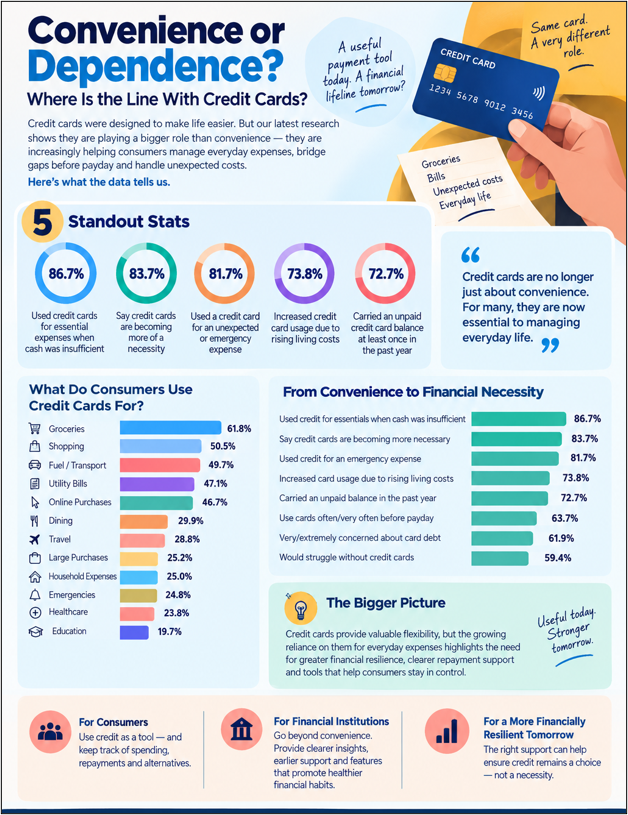
Our recent research found that 83.7% of respondents believe credit cards are becoming more of a necessity than they used to be, while 63.7% of card users say they often or very often use credit before their next income or payday arrives.
These findings do not automatically suggest irresponsible borrowing. Instead, they point to a more complicated reality in which credit cards are increasingly helping consumers manage the timing of everyday expenses.
For the broader data behind this shift, Credit Card Trends 2026: When Convenience Becomes Necessity explores how card use is changing across everyday spending, emergencies, repayments and rising living costs.
The bigger question is whether credit cards are still primarily a convenient payment option or whether they are gradually becoming something consumers feel they cannot do without.
When Does Convenience Become Something More?
Convenience remains one of the strongest reasons people use credit cards. They are easy to carry, quick to use and particularly useful for online transactions.
The relationship changes when credit begins to support the basic timing of household finances.
A consumer may have enough income over the course of a month but still face bills before that income arrives. In that situation, the card becomes more than a payment method because it fills the gap between an expense and the money available to cover it.
The survey shows how common this behaviour has become. 73.8% say rising living costs have caused them to use credit cards more, while 68.1% say they are using cards more frequently than they were a year ago.
For consumers, the important question is not simply whether they use credit more often. It is why that usage is increasing and whether the card is providing choice or compensating for limited financial flexibility.
HOW DOES CREDIT FIT INTO YOUR EVERYDAY LIFE?
Share how you use credit to manage spending, emergencies and financial flexibility with The Panel Station.
What Happens When Groceries Move Onto Credit?
The changing role of credit becomes clearer when we look at what people are buying.
Credit cards are often associated with travel, expensive purchases or occasional discretionary spending. Yet 61.8% of card users say they use them for groceries, while fuel, transport and utility bills also account for a significant share of usage.
Groceries are especially revealing because they are routine and unavoidable.
Putting a holiday on a card may be a decision about convenience or timing. Using a card for food because cash is temporarily unavailable reflects a very different financial need.
That difference becomes even clearer when 86.7% of users say they have used credit for essential expenses because they did not have enough money available at the time.
For consumers, this creates a risk that ordinary spending becomes less visible. Individual purchases may feel manageable, but regular essentials can accumulate quickly once they move onto revolving credit.
For financial institutions, the finding raises a broader responsibility. Products designed to make spending easier may also need to help customers recognise when everyday spending is beginning to create longer-term repayment pressure.
Is Credit Becoming Part of the Household Safety Net?
Emergency spending reveals another important dimension of the relationship.
81.7% of card users say they used a credit card for an unexpected or emergency expense during the past year. For many households, this access can provide valuable financial breathing room when an urgent cost cannot be postponed.
That flexibility can be useful, but it is not the same as having savings available. Savings absorb a shock without creating a future repayment obligation. Credit solves the immediate problem but moves part of the financial pressure into the months ahead.
This distinction matters most when emergencies are frequent or when household budgets are already stretched. The concern is therefore not that consumers are using cards when something goes wrong. The more important question is whether credit is increasingly replacing the savings or financial buffers that households would otherwise rely on.
HOW ARE YOU MANAGING EVERYDAY FINANCIAL PRESSURE?
Share how rising costs, unexpected expenses and credit are shaping your financial decisions with The Panel Station.
One of the most interesting findings in the survey is the apparent contradiction between repayment habits and debt.
72.5% say they usually or always repay their full balance, yet 72.7% also say they have carried an unpaid balance from one month to the next at least once during the past year.
These figures can exist together because financial behaviour is rarely consistent every month. A consumer may normally clear the balance in full but carry debt after an emergency, a large bill or a period when household expenses rise faster than income.
The reasons respondents give support this interpretation. Unexpected expenses are the leading reason for not paying balances in full, followed by keeping cash available and planning to repay later.
Debt concern is also significant, with 61.9% saying they are very or extremely worried about the amount they currently owe.
This suggests that traditional labels such as “responsible borrower” and “struggling borrower” may be too simplistic. Financial wellbeing depends not only on whether someone usually pays in full, but also on how often they need credit, what they are using it for and how much flexibility remains when circumstances change.
Why Can Dependence Be Difficult to Recognise?
Dependence on credit does not always begin with an obvious financial crisis. More often, it can develop gradually through a series of reasonable decisions.
A card may cover groceries before payday one month, absorb a utility bill the next and provide support when an unexpected expense appears later. Each decision can make sense in isolation. The issue emerges when credit becomes built into the household budget rather than remaining an occasional option.
This is why the finding that 59.4% of users would struggle significantly or experience some difficulty managing normal monthly expenses without access to their cards deserves attention.
People may not describe themselves as dependent on credit because the card still feels useful and convenient. However, if removing access suddenly makes ordinary expenses difficult to manage, the relationship has clearly changed.
The dividing line between convenience and dependence may therefore have less to do with how frequently someone uses a card and more to do with whether they could comfortably manage without it.
What Does Responsible Credit Look Like Now?
This shift has important implications for banks, issuers and fintech companies.
Historically, much of the industry has competed through rewards, credit limits, speed and frictionless payments. Those benefits remain relevant, but consumers increasingly need better visibility into the consequences of borrowing as well.
Customers need to understand how balances are building, how long repayment may take and when regular spending is starting to create future pressure. This creates an opportunity for financial providers to rethink what good customer experience means.
Spending alerts, clearer repayment projections, category-level insights and earlier support when balances begin to rise can help consumers make better decisions without removing the flexibility that makes credit useful in the first place.
Responsible credit should not simply make borrowing available. It should also help customers understand when short-term flexibility is beginning to create long-term strain.
Readers looking for the wider survey findings behind these behaviours can explore Credit Card Trends 2026: When Convenience Becomes Necessity, which examines everyday spending, emergency use, repayments and changing perceptions of credit.
The Real Issue Is Whether Consumers Still Have Choice
Credit cards remain valuable because they give consumers flexibility.nThe real concern appears when flexibility starts to disappear.
When someone chooses to use a card because it earns rewards, protects a purchase or makes payment easier, credit is serving a clear purpose. When the same person has no realistic alternative for groceries, utilities or an unexpected expense, the role of credit becomes very different.
This is why the future conversation around credit should move beyond asking whether credit cards are good or bad.
A more useful question is whether consumers still have meaningful financial choices. Financial resilience is strongest when credit is one option among several, rather than the only tool available when everyday life becomes difficult to afford.
WHAT WOULD MAKE CREDIT WORK BETTER FOR YOU?
Tell The Panel Station what would make credit safer, clearer and more useful in everyday financial life.
Frequently Asked Questions
1. Why are consumers becoming more dependent on credit cards?
Rising living costs, gaps between income and expenses, emergency costs and everyday spending can all increase reliance on credit cards.
2.Are people using credit cards mainly for non-essential purchases?
No. The survey shows significant usage for groceries, utilities, transport and other everyday household expenses.
3. Does using a credit card before payday mean someone is in financial trouble?
Not necessarily. Some consumers use credit strategically to manage timing, although frequent reliance can also indicate limited cash-flow flexibility.
4. Why can consumers pay in full and still carry debt?
Repayment behaviour can change from month to month. Someone may normally clear the balance but carry debt after an emergency, a large expense or a financially difficult period.
5. What is the biggest risk of growing credit dependence?
The main risk is that short-term flexibility becomes a recurring part of the household budget, leaving future income increasingly committed to previous spending.
6. What can financial-services companies do to support healthier credit use?
Clear repayment information, useful spending insights, timely alerts and early support can help consumers manage credit before balances become difficult to control.